

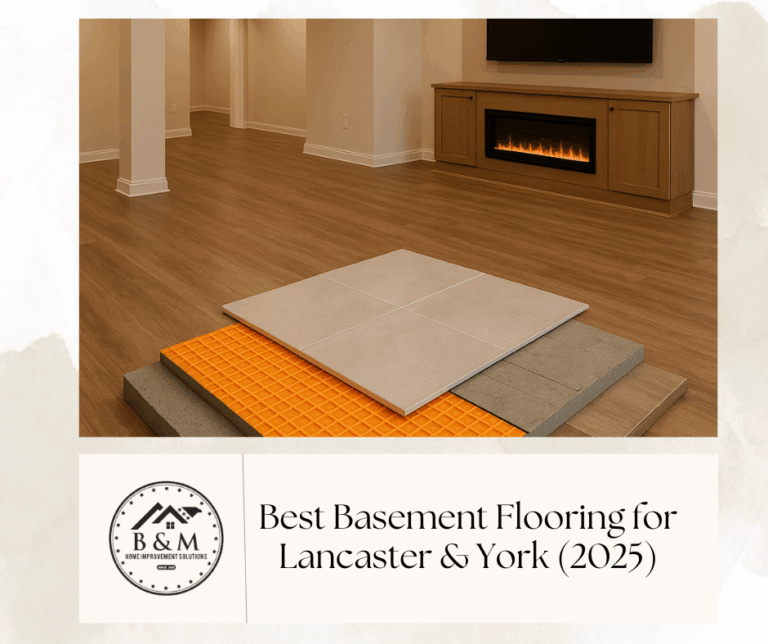
Best Basement Flooring for Lancaster & York (2025): Warmth, Moisture Control, and Materials That Last
Best basement flooring Lancaster PA homeowners choose has to handle one thing first: moisture. Below-grade slabs can transmit vapor, feel cold, and amplify sound. The right system solves for comfort, humidity, and durability—then style. This in-depth guide compares luxury vinyl plank (LVP), engineered wood rated for below grade, porcelain tile, and specialty subfloor systems, with Central PA realities in mind. You’ll see what each material does well, how to make it warmer and quieter, and where budgets usually land when installed professionally. We also outline sequencing (what to do before flooring), basement-specific installation details, and common mistakes we fix. When you’re ready, B&M Home Improvement Solutions sources materials through Lezzer Lumber and Too the Trades, coordinates fixtures via Hajoca, and pairs finishes with tops and thresholds from Natural Stoneworks and Henry H. Ross & Son—serving Lancaster County and York County.
Want more information about Finishing your basement successfully? Read our article about Basement Finishing In Lancaster and York PA here!
Common Basement Challenges in Lancaster & York
Moisture & Vapor (the non-negotiable)
Concrete slabs are porous. Even when a basement doesn’t “leak,” water vapor can rise through the slab and telegraph into flooring. Left unmanaged, that vapor causes cupping, curled edges, odors, or adhesive failure. Therefore, every finish starts with a moisture plan: grade and downspouts outside, slab assessment inside, and humidity control year-round.
Cold Surfaces
Concrete holds the cool of the soil. Without a thermal break or insulated underlayment, floors feel chilly in winter and shoulder seasons. Materials with integrated pads or subfloor panels reduce the temperature swing.
Sound & Echo
Open finished basements can sound hollow. Flooring choices, underlayments, and area rugs help absorb footfall noise and improve conversation clarity.
Access & Headroom
Ceiling ductwork and beam drops may limit ceiling height—so you may not want to “spend” much thickness on subfloors. Low-profile systems and careful transitions at stairs and doors keep things safe and clean.
Thinking of adding a Bathroom in your basement and need more information? check out our Lancaster bathroom remodeling guide.
Flooring Options Overview (What Actually Works Below Grade)
1) Luxury Vinyl Plank (LVP) & Luxury Vinyl Tile (LVT)
Why homeowners choose it: Waterproof, forgiving on imperfect slabs, warm underfoot compared with tile, and quiet with the right pad.
Formats: Click-lock floating planks or glue-down tiles/planks.
Where it shines: Family rooms, play spaces, offices, and media zones.
Upgrade ideas: Thicker wear layers (20 mil and up), integrated underlayment, beveled edges for realism, and acoustic underlayment in media zones.
2) Engineered Wood (Below-Grade Rated)
Why homeowners choose it: Real wood look and feel with engineered stability.
Formats: Floating click-lock or glue-down. Always verify below-grade rating and humidity range in the manufacturer’s spec.
Where it shines: Higher-end family rooms and offices where warmth and acoustics matter.
Upgrade ideas: Wider planks for a modern look; premium underlayment; keep RH ~40–50% year-round.
3) Porcelain/ Ceramic Tile (with the Right Membrane)
Why homeowners choose it: Maximum durability and easy cleaning, especially in wet zones (baths, entries from bulkheads).
Where it shines: Basement bathrooms, laundry areas, and at doors that see slush and mud.
Upgrade ideas: Large-format porcelain for fewer grout joints; anti-fracture/decoupling membrane; subtly textured finishes for slip-resistance; warm area rug in living zones.
4) Specialty Subfloor Systems (Panels & Sleepers)
What they are: Low-profile panels with dimpled moisture channels and an OSB or composite top, or sleeper systems with rigid foam under a plywood layer.
Why homeowners choose them: Improve warmth and comfort, allow a more “real wood” feeling, and create a buffer between slab and finish.
Where they shine: Whole-basement upgrades when budget allows a comfort-first build.
Step-by-Step Considerations (Planning, Budget, Timeline, Sequencing)
1) Assessment & Scope
Moisture check: Look for past efflorescence, hairline cracks, and perimeter dampness. If you run a dehumidifier to keep RH near 45–50%, note the setting and performance.
Flatness: Most floating floors want slabs within a flatness tolerance (e.g., 3/16″ over 10′). Mark low spots for patch/skim.
Transitions: Identify adjacent surfaces (stairs, tile baths, exterior doors) to plan heights and reducers.
2) Budget Ranges for Lancaster & York (Installed, Typical)
These are B&M planning benchmarks for Central PA—final pricing depends on floor area, prep, patterns, and trim.
LVP/LVT: good/better/best packages vary by wear layer, core, and brand.
Engineered wood (below-grade rated): higher material costs and tighter humidity requirements add labor controls.
Porcelain tile: material varies by style; labor increases for membranes, layout, and grout sealing.
Subfloor panels/sleepers: add a comfort premium; worthwhile in media rooms and offices.
(We’ll size your scope on site and recommend where to spend vs. save.)
3) Timeline
Straight LVP install: often 1–3 days for typical basement zones (prep dependent).
Engineered wood: similar timelines, with acclimation and humidity management.
Tile: 3–5+ days with membrane, setting, grout cure, and trim.
Subfloor + finish: add 1–2 days depending on area and levels.
4) Moisture & Warmth First
Fix exterior water paths and consider an interior drain/sump if needed.
Add a thermal break where feasible (underlayments, panels).
Keep RH stable year-round (dehumidifier with continuous drain is ideal).
5) Layout & Electrical Planning
Plan receptacles for dehumidifiers and media; avoid running cords across walkways.
Add floor outlet locations early if you’ll place floating furnishings in large rooms.
6) Selections & Lead Times (Local Sourcing)
Lezzer Lumber: LVP/engineered lines, trims, stair noses, baseboards.
Too the Trades: adhesives, membranes, patch compounds, acoustical pads.
Natural Stoneworks / Henry H. Ross & Son: thresholds, hearths, and stone sills (bath entries).
Hajoca: bath trims, floor drains, and accessories for adjacent baths.
7) Permits & Inspections
Most flooring projects are finish work; however, bathrooms, new circuits, or walls in the same phase can trigger inspections. We coordinate those within the broader project schedule.
8) Typical Build Sequence
Protect finished areas, set up air scrubber if dusty demo.
Correct moisture paths; clean and prep slab.
Patch/skim low areas; sand high spots if needed.
Install subfloor panels (if specified) or underlayment.
Install finish floor (LVP/engineered/tile).
Set base/quarter-round and transitions; final clean.
Want to ensure you know more about inspections and permitting process- Learn more in our Lancaster Basement remodel Planning guide.
Materials & Specs Deep Dive (Make the Right Choice the First Time)
Luxury Vinyl Plank (LVP/LVT)
Construction & Wear Layer
Look for 20-mil wear layer or greater for basements with pets and kids.
SPC/WPC cores: SPC (stone-polymer composite) is very dent-resistant; WPC (wood-polymer composite) feels a touch warmer and softer.
Underlayments & Acoustics
Integrated IXPE or EVA pads reduce sound; some products still benefit from a thin acoustical underlayment if the slab needs help.
For media rooms, we often layer an additional acoustic underlayment to tame footfall.
Moisture & Expansion
Floating systems need expansion gaps and careful edge detailing at posts and stair stringers.
Avoid pinning the floor under heavy cabinets; use transition breaks under doors and cased openings.
Pros
Waterproof, forgiving, quick to install, easy to replace planks if damaged.
ConsCan sound “clicky” if installed over unaddressed hollow spots; direct sun through walk-out doors may require UV-tough lines or shades.
Engineered Wood (Below-Grade Rated)
What to Specify
Confirm below-grade rating and approved installation methods (float vs glue).
Favor multi-ply cores and balanced construction for stability.
Target humidity 40–50% year-round; plan dehumidification to stay within spec.
Underlayments
Premium acoustic/thermal underlayment improves warmth and quiet.
For glue-down assemblies, use manufacturer-approved moisture-tolerant adhesives.
Pros
Authentic wood look/feel, excellent acoustics with the right underlayment, upscale resale signal.
ConsSensitive to chronic humidity swings; pet scratches and water left standing still matter.
Porcelain/Ceramic Tile (with Membranes)
Substrate & Membrane
Use an anti-fracture/decoupling membrane over the slab to reduce telegraphing from minor movement and hairline cracks.
Flatness matters more with large-format tile; expect more prep time.
Grout & Maintenance
Specify high-quality grout (pre-mixed or cementitious with sealer), narrow joints, and low-sheen tiles where you want a “stone” feel.
Add a heated mat or integrated heated membrane in premium zones if you want warmth without a full sleeper system.
Pros
Maximum durability and water resistance; ideal for baths and entrances.
ConsCold without a rug or heat; higher labor; harder to modify later.
Heated Flooring Options for Basements (Tile & LVP)
Heated Tile Floors with Schluter® DITRA-HEAT (Our Standard System)
What it is:
A purpose-built uncoupling/waterproofing membrane that accepts electric heating cables in its stud pattern. Tile is set directly on top—no separate mats needed. The DITRA-HEAT-DUO version adds an integrated thermal break and sound control via its bonded fleece, which is excellent for basements where slabs run cool.
Why it works below grade:
Thermal break & sound control (DUO): Floors feel warmer faster and footfall noise drops—ideal for media rooms and bedrooms.
Uncoupling + waterproofing: Manages in-plane movement over concrete and protects the assembly from incidental moisture migration.
Targeted heat placement: We heat the aisles, vanities, and shower approaches you actually stand on, reducing energy use while improving comfort.
Typical assembly (sequence):
Prep slab (clean, flat; patch dips).
Bond DITRA-HEAT or DITRA-HEAT-DUO membrane to the slab.
Snap the heating cable into the membrane studs per layout; set a floor sensor.
Set tile directly over the membrane; grout.
Wire a dedicated circuit to a DITRA-HEAT thermostat (programmable touchscreen or simple on/off, both with built-in GFCI) and set your schedules.
Controls & zoning:
We typically zone bathrooms separately from larger living areas.
Programmable thermostats let you pre-heat for morning/evening routines, then coast.
Pros: Fast, even warmth; best-in-class under tile; quieter/warmer feel with DUO; matched components from one system provider.
Cons: Higher initial cost than LVP heat; when off, tile still reads cooler than LVP—add a rug in sitting areas.
Heated LVP (Luxury Vinyl Plank) — How We Design It Safely
Can LVP be heated?
Yes—many LVP/LVT lines are approved for electric radiant heat, but each brand specifies maximum surface temperatures (often ≤85°F), installation methods, and compatible underlayments. We select the LVP first, then design the heat to that specification.
Two electric approaches we use under LVP:
Embedded cable or mat in self-leveling underlayment (SLU):
The heat element is buried in SLU for even heat distribution and a flat surface.
Floating LVP installs on top with a compatible underlayment.
This approach minimizes “hot stripes” and improves comfort.
Radiant heat film for floating floors:
Ultra-thin electric films designed for LVP/laminate/engineered wood can be installed over underlayment beneath floating planks.
We follow both the film listing and the LVP manufacturer’s temperature and underlayment limits.
Guardrails we follow:
Temperature limits: We set thermostats with floor sensors and lock maximums per the flooring brand (often 80–85°F).
Even heat: We choose embedded or listed film systems that spread heat uniformly.
Product selection: SPC or mineral-core LVP typically handles heat best; we confirm radiant-heat approval on the exact SKU.
Underlayment: We use manufacturer-approved pads; avoid high-R pads that trap heat.
Sun & rugs: For walk-out doors, add shades; avoid thick, non-breathable rugs over heat zones.
Pros: Gentle, even warmth with the visual comfort and resilience of LVP; lower height build-ups; often lower installed cost than heated tile.
Cons: Comfort is capped by the LVP’s temperature limit; strict adherence to specs is essential.
Design & Selection Guidance (Lancaster/York Examples)
Zone by Use, Not Just by Material
Family/media: LVP with an acoustic pad—or engineered wood—for warmth and sound; add heated LVP if you want that gentle underfoot warmth in seating aisles.
Bath/laundry entries: Porcelain tile with a subtle texture; run DITRA-HEAT (or DUO) in front of the vanity and shower approach.
Workout zones: Rubber tile or thicker-pad LVP that tolerates impact and sweat; plan a washable semi-gloss wall paint and a quiet dehumidifier nearby.
Color & Light
Basements benefit from warm neutrals and low-sheen finishes; matte surfaces hide micro-scratches and glare from recessed lights. Wide-plank looks reduce busyness in longer rooms.
Trim, Stairs & Transitions
Coordinate stair noses and thresholds early. We often source matching trims through Lezzer Lumber and stone thresholds through Natural Stoneworks for bath transitions.
Installation & Project Management (What B&M Handles)
Pre-construction: Moisture and flatness assessment; recommendations for dehumidification and slab prep; confirmation of RH targets for engineered wood; heated floor zoning/thermostat plan.
Material logistics: We align LVP/engineered/tile deliveries with underlayments, membranes, DITRA-HEAT/DUO and cables, thermostats, and trims from Lezzer Lumber/Too the Trades; plumbing trims via Hajoca for adjacent baths.
Dust & protection: Floor and door protection, negative air where needed.
Execution: Subfloor or membrane install → heat elements (if specified) → finish flooring → trims and transitions → detailed clean.
Handover: Care and maintenance guidelines, thermostat programming, product documentation, and photo log.
Cost & ROI (Local Context)
Where your dollars work hardest
Moisture & slab prep: cheapest insurance against callbacks.
Acoustic comfort: small cost, big daily benefit in media and family rooms.
Heated zones where you stand: vanity, shower approach, and TV aisles—targeted warmth without heating the whole floor.
Transitions and trims: quality noses, reducers, and thresholds make the project read “finished” and protect edges.
Resale
Documented, professional installation—plus a photo log of DITRA-HEAT or LVP heat assemblies, slab prep, membranes, and underlayments—helps buyers trust the space. In Lancaster and York, finished basements marketed with “warm, quiet floors” and “grout-free living areas” tend to show better and photograph beautifully.
Common Mistakes We Fix (and How to Avoid Them)
Skipping slab prep: Small dips telegraph into click-lock floors, causing hollow spots. We patch/skim to tolerance before install.
Wrong underlayment: Not all pads are equal; we match acoustics, moisture control, radiant compatibility, and manufacturer specs to your product.
Pinching floating floors: Cabinets or walls installed on top of floating LVP cause buckling. We detail expansion and transitions correctly.
Using non-rated wood below grade: We only specify engineered products that list below-grade in the technical sheet.
Cold tile without planning: We add DITRA-HEAT/DUO where tile is required so the room still feels like living space.
Overheating LVP: We lock thermostat maximums and verify the floor sensor reads accurately for your exact LVP line.
FAQs (updated with heat)
What is the best basement flooring Lancaster PA homeowners pick for family rooms?
LVP with an acoustic underlayment is the usual winner for comfort, durability, and maintenance. Add heated LVP for gentle warmth in seating aisles if your chosen product allows radiant heat.
Can I put real hardwood in the basement?
Solid hardwood isn’t recommended below grade. Choose engineered wood specifically rated for below-grade installations, and keep humidity stable year-round.
Is tile too cold for basements?
Not with heat. We use Schluter® DITRA-HEAT (or DITRA-HEAT-DUO for a thermal break) under porcelain in baths and entries—warm toes, durable finish.
How do heated LVP floors work?
Either radiant film beneath floating planks or embedded cables/mats in a thin self-leveling layer beneath the LVP. We limit max floor temps (often ≤85°F) based on your exact product.
Do I need a subfloor?
Not always. Many LVPs with integrated pads lay directly on prepared slabs. A panel subfloor or sleeper system adds warmth and quiet when comfort is the priority.
How do I keep floors from sounding hollow?
Great prep (flatness), the right underlayment, and thoughtful area rugs. In media rooms, we sometimes add a secondary acoustic layer.
Will a dehumidifier really matter?
Yes. Holding ~45–50% RH protects floors, reduces odors, and keeps engineered wood within spec.
Next Steps
If you’re in Lancaster, Lancaster County, York, or York County, we’ll measure, check slab flatness and moisture, and recommend the best mix—LVP, engineered wood, tile with Schluter® DITRA-HEAT/DUO, or subfloor systems—for how you live. We source materials through Lezzer Lumber and Too the Trades, and coordinate trims, thresholds, and adjacent bath details with Hajoca, Natural Stoneworks, and Henry H. Ross & Son. Request a consultation with B&M Home Improvement Solutions to design a basement that feels like the rest of your home—warm, quiet, and durable.
FAQs (updated with heat)
LVP with an acoustic underlayment is the usual winner for comfort, durability, and maintenance. Add heated LVP for gentle warmth in seating aisles if your chosen product allows radiant heat.
Solid hardwood isn’t recommended below grade. Choose engineered wood specifically rated for below-grade installations, and keep humidity stable year-round.
Not with heat. We use Schluter® DITRA-HEAT (or DITRA-HEAT-DUO for a thermal break) under porcelain in baths and entries—warm toes, durable finish.
Either radiant film beneath floating planks or embedded cables/mats in a thin self-leveling layer beneath the LVP. We limit max floor temps (often ≤85°F) based on your exact product.
Not always. Many LVPs with integrated pads lay directly on prepared slabs. A panel subfloor or sleeper system adds warmth and quiet when comfort is the priority.
Great prep (flatness), the right underlayment, and thoughtful area rugs. In media rooms, we sometimes add a secondary acoustic layer.
Yes. Holding ~45–50% RH protects floors, reduces odors, and keeps engineered wood within spec.