

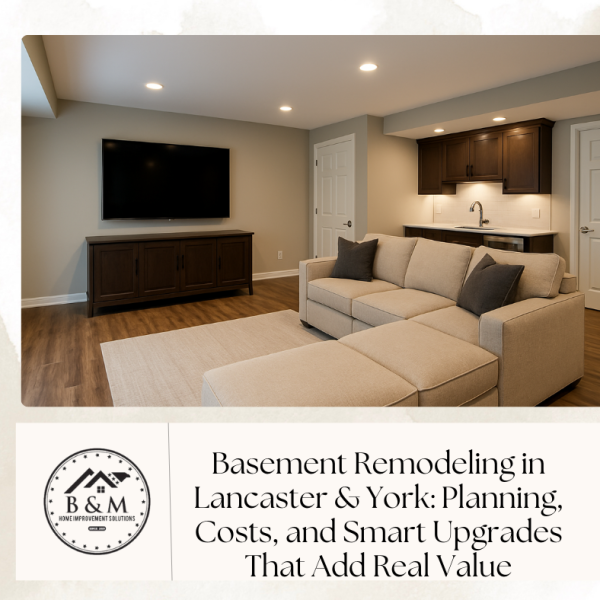
Basement Remodeling in Lancaster & York: Planning, Costs, and Smart Upgrades That Add Real Value
Finishing or remodeling a basement is one of the most effective ways to add living space and long-term value to a home in Lancaster and York. Done right, a basement can become a quiet home office, a guest suite for extended family, a media room, or a play space that keeps clutter out of the main floor. Done wrong, it can create moisture issues, cold floors, and a patchwork of code problems. This guide is written for Central PA homeowners who want a professional, durable result—without surprises. We cover planning, waterproofing, insulation, layout decisions, budget ranges for our market, and the key selections that separate a “nice attempt” from a space you’ll love for years. When you’re ready, B&M Home Improvement Solutions manages design, permitting, scheduling, and quality control from start to finish.
The Problem/Homeowner Pain (Central PA Reality)
Typical Issues We See
Basements in Lancaster and York Counties often start as partially finished spaces with low ceilings, makeshift rooms, and uneven temperatures. Common pain points include seasonal dampness, musty odors near bulkheads, cold floors, drafts, DIY wiring, and rooms without egress.
Why These Problems Persist
Older homes were rarely insulated below grade; consequently, air leaks and thermal bridging remain. Moreover, ad-hoc finishes hide moisture pathways, which, in turn, complicate future repairs.
What Success Looks Like
Therefore, the goal is simple: balance moisture control, code compliance, comfort, and design so the space feels like a true extension of the home, not an afterthought.
Solutions/Options Overview
1) Family Room / Media Zone
Purpose & sizing. Aim for 14’–18′ clear wall-to-wall so seating faces a 65–85″ display at 1.2–1.6× screen diagonal. Provide a 36″ circulation path behind seating.
Power & low-voltage. Therefore, include 2 dedicated 20A circuits (media + general). Pre-wire HDMI/optical, Cat6 to router, and 5.1/7.1 speaker runs before drywall. Add a recessed TV box and conduit for future upgrades.
Lighting. Layer light: 6–8 recessed LEDs on 2 zones, plus two wall sconces on a third dimmer. Consequently, glare drops and viewing comfort improves.
Acoustics. Add mineral wool in joists and one sound-damping drywall layer (or clips + channel) on the media wall. As a result, upstairs noise transmission is reduced.
Finishes. Choose LVP with underlayment for warmth. A darker accent behind the TV reduces eye strain; low-sheen paints prevent reflections.
Nice add-ons. A compact wet bar with under-cab lighting, quartz top from Natural Stoneworks, and a quiet beverage center. Use Hajoca for an air-gap faucet and supply lines.
2) Guest Suite or In-Law Space
Bedroom & egress. If you call it a bedroom, you must add code-compliant egress. Typically: 5.7 sq. ft. clear opening minimum (check your municipality). Moreover, plan egress toward grade where excavation is feasible.
Bath. A 60″ shower or curbless 48″ x 36″ works well; specify a quiet 80–110 CFM fan vented outdoors. Consequently, humidity remains controlled.
Privacy. Use solid-core doors, door sweeps, and sound-insulated interior walls. In addition, add a small linen closet.
Comfort. Balance supply/return air and add a dedicated thermostat or smart sensor. Warm LVP floors and layered lighting keep the suite comfortable year-round.
Millwork & storage. Built-ins from Red Rose Cabinetry can integrate a dresser, wardrobe, and desk. Coordinate trim and doors through Lezzer Lumber for a consistent profile.
Plumbing. For new fixtures, confirm fall to the main drain and vent paths early; order rough-ins through Hajoca to match finish selections later.
3) Home Office / Learning Zone
Lighting & screens. Position desk perpendicular to windows to reduce glare. Use 4000K task lighting with a high CRI; then, add dimmable ambient cans.
Power & data. Provide 2 general circuits and at least two Cat6 home-runs to the router. As a result, video calls are stable.
Acoustics. Add acoustic panels or bookcases on the back wall. Door gaskets help during calls.
Storage & ergonomics. Custom built-ins from Red Rose Cabinetry with file drawers, printer cubbies, and wire pass-throughs keep cords hidden.
Air quality. Because basements can be still, include a return, a supply, and—optionally—an ERV tie-in for fresh air.
4) Fitness Area
Flooring. Use 8–12 mm rubber tile with beveled edges; transition to LVP in adjacent zones. Consequently, impact and sound are minimized.
Wall protection. Install durable, washable paint or PVC wall panels in impact zones. Mirror wall anchored to studs improves visibility and form.
Ventilation. A dedicated return and supply help. Pair with a correctly sized dehumidifier (set 45–50% RH).
Power. Provide outlets at 6′ spacing and a dedicated 20A if using a treadmill/rower combo.
Storage. Vertical racks, ceiling hooks, and a small bench keep gear organized, which in turn maintains clear circulation.
5) Hobby/Workshop & Storage
Work surface. 30″–36″ deep bench with task lighting at 50–75 fc.
Utilities. Slop sink with trap primer and shutoffs (spec via Hajoca). Add GFCI outlets every 4′ along the bench and a 240V receptacle if you might use stationary tools later.
Floor & walls. Epoxy-coated slab or LVP for easy cleanup; French cleat wall or pegboard for adjustable storage.
Safety. Because dust travels, consider a basic dust collection point and a self-closing door if adjacent to finished zones.
6) Combination Plans
Zoning first. Group “quiet” (office/guest) away from “active” (media/gym). Place wet bar/bath near existing plumbing runs to contain cost.
Sight lines. Use half-walls or open shelving to define zones without closing light paths.
Circulation. Maintain 36″–42″ walking lanes between zones; consequently, the space feels larger.
Shared storage. A single wall of built-ins (from Red Rose Cabinetry) with doors/drawers can serve all zones while keeping clutter hidden.
Step-by-Step Considerations
1) Assessment & Scope
Moisture & structure. Map moisture with a meter; inspect slab cracks, bulkhead doors, and sill plate. Verify foundation wall plumb and any bowing.
Mechanical & clearance. Measure headroom under ducts/beam; note furnace/water-heater service clearances. Consequently, you’ll know where soffits must stay.
Electrical capacity. Confirm panel amperage and available spaces; many basements require 4–8 new breakers.
Futureproofing. Run empty conduit to the media wall and to any potential office to allow upgrades without demolition.
2) Budget Ranges for Lancaster & York (What’s Included)
-
Basic finish ($45k–$70k): open plan + storage, insulated walls, LVP, painted drywall ceiling or premium tile grid, 6–10 recessed lights, base trim, minimal built-ins.
-
Mid-range ($70k–$110k+): defined media zone + office/gym, upgraded lighting package with sconces, sound insulation at joists, 1–2 feature walls, premium trim/doors, small wet bar.
-
Premium ($110k–$175k+): guest suite w/ egress + full bath, custom built-ins (Red Rose Cabinetry), quartz/solid-surface tops (Natural Stoneworks, Henry H. Ross & Son), extensive sound assemblies, curbless shower, and higher-end finishes.
Allowances: flooring $4–$8/sf (installed) baseline; bar tops/vanity tops vary by slab and edge; lighting fixtures vary by brand. Therefore, numbers are tuned at selections.
3) Timeline (Typical)
-
Design & permitting (2–6 weeks): field measure → drawings → selection board → permit.
-
Construction (4–10+ weeks):
-
Week 1–2: water mitigation, framing, rough electrical/plumbing/HVAC.
-
Week 3: insulation, inspections, drywall hang.
-
Week 4: drywall finish/prime, order tops.
-
Week 5–6: flooring, doors/trim, paint.
-
Week 7–8: cabinets, wet bar, bath tile/fixtures.
-
Week 9–10: tops, punch, finals, clean.
Complex scopes (egress cutting, custom built-ins) extend durations accordingly.
-
4) Moisture & Warmth First (Details That Matter)
-
Water path: correct exterior grading and downspout extensions first; if needed, add interior perimeter drain to a sump with check valve + battery backup.
-
Thermal layer: continuous rigid foam (R-10 to R-15) at foundation walls with taped seams; then stud wall with mineral wool.
-
Air sealing: foam board at rim joists and top plates; therefore, drafts and energy use drop.
5) Layout & Electrical Planning
-
Walls/soffits. Keep a 1/2–1″ gap off concrete walls. Maintain 6’8″ clear headroom under soffits where possible.
-
Circuits. Media (20A), general (20A), bar/appliance (20A GFCI), bath (20A GFCI), dehumidifier (dedicated).
-
Controls. 3–4 lighting zones with dimmers; smart switches where desired. Pre-wire Cat6 to the office and media for reliability.
6) Selections & Lead Times (Local Sourcing)
-
Framing/doors/trim: Lezzer Lumber (2–3 weeks typical).
-
Plumbing rough & finish: Hajoca (stock to 2 weeks; specialty finishes longer).
-
Built-ins/cabinetry: Red Rose Cabinetry (design + 4–8 weeks production).
-
Solid surface/quartz: Henry H. Ross & Son / Natural Stoneworks (template after cabinet set; install ~1–2 weeks later).
-
Trade supplies: Too the Trades for fast-moving items.
Ordering early, therefore, prevents schedule gaps.
7) Permits & Inspections (What to Expect)
-
Plan review: layout, egress details, smoke/CO, stair geometry, headroom.
-
Inspections:
-
Rough framing
-
Rough electrical/plumbing/HVAC
-
Insulation/air-sealing
-
Final (after fixtures, trims, and guard/handrails)
Having drawings and an inspection calendar avoids rework and, consequently, keeps momentum.
-
8) Typical Build Sequence (With Notes)
-
Water mitigation & slab prep → test dehumidifier, confirm RH.
-
Framing & MEP rough-ins → photograph walls before drywall for future reference.
-
Insulation & air sealing → tape/seal rigid foam; fire block as required.
-
Drywall & prime → use low-sheen finish to minimize glare.
-
Flooring & millwork → acclimate materials to basement RH first.
-
Paint & finishes → install doors/hardware; set cabinetry.
-
Final fixtures, tops, punch → run systems test (fans, GFCI/AFCI, breakers); deep clean and handoff.
Materials/Specs Deep Dive
Framing & Wall Systems
Use pressure-treated bottom plates with a capillary break; keep framing 1/2–1 in. off concrete walls. When persistent moisture exists, steel studs reduce risk; otherwise, kiln-dried wood performs well.
Moisture Management
Install interior perimeter drains and a sump—when needed—with a check valve and battery backup. Additionally, size a dehumidifier to the volume so humidity stays stable year-round.
Insulation & Air Sealing
Best practice: rigid foam (R-10 to R-15 continuous) against foundation walls with taped seams, then a stud wall with mineral wool batts. At rim joists, use foam board plus mastic or closed-cell spray foam; consequently, drafts drop and comfort rises.
Ceilings (Access & Acoustics)
Drywall ceilings feel most residential; however, include large access panels. For frequent service needs, premium acoustical tiles with concealed grid offer convenience. Add insulation and, if needed, sound-damping drywall in media zones.
Electrical & Lighting
Recessed LED on dimmers for ambient light, plus wall sconces or task lighting. In addition, provide dedicated media circuits and surge protection; pre-wire for data, speakers, and future projector locations.
Flooring
Avoid solid hardwood on slab. Instead, use luxury vinyl plank with integrated underlayment, engineered wood rated for below grade, porcelain tile in wet zones with an anti-fracture membrane, and rubber in gyms. As a result, floors stay warm and stable.
Baths & Wet Bars
Curbless or low-threshold showers require precise slopes and drains. For finishes, specify quartz from Natural Stoneworks or solid surface tops from Henry H. Ross & Son. Moreover, install leak sensors at sinks for early warnings.
HVAC & Ventilation
Balance supply/return air to avoid stale zones. Bath fans must vent outside; for larger suites, an ERV improves air quality.
Code & Egress
Bedrooms require an egress window or exterior door meeting clear-opening rules. Likewise, smoke/CO detectors, stair geometry, and headroom must meet code.
Design & Selection Guidance (Lancaster/York Examples)
Zone the Space Intentionally
In Manheim Township and Lititz, longer basements often support a media area plus a tucked-away office. Conversely, in Spring Garden Township and nearby York suburbs, posts and ducts frequently divide the plan into three functional zones.
Built-Ins & Cabinetry
For timeless media walls and offices, Red Rose Cabinetry provides inset doors and custom storage. Pair with Lezzer Lumber millwork packages to keep profiles consistent throughout.
Color, Light, and Texture
Select warm neutrals to reflect limited daylight; then layer recessed, sconce, and task lighting to eliminate shadows. A darker acoustic accent behind the TV reduces glare; meanwhile, a lighter area rug adds perceived warmth.
Fixtures & Hardware
Source durable fixtures through Hajoca for long-term parts support. For tops, choose quartz from Natural Stoneworks or seamless solid surface from Henry H. Ross & Son; both clean easily and resist stains.
Installation & Project Management (What B&M Handles)
Our Process
-
Design & drawings: measured as-builts, layout options, and selections board.
-
Permitting & inspections: we manage submittals and on-site visits; consequently, the schedule stays predictable.
-
Scheduling & logistics: materials are timed to reduce downtime.
-
Quality control: site protection, daily cleanup, and photo logs.
-
Trade coordination: electricians, plumbers, and HVAC pros in the right order.
-
Warranties & handoff: final walk-through, punch-list closeout, and documentation.
Cost & ROI (Local Context)
What Drives Cost
Moisture remediation, egress cutting, bathroom rough-ins, custom built-ins, premium flooring, and sound assemblies shape the budget. Additionally, ceiling choices (drywall vs. acoustic) and access needs influence labor.
What You Gain
Finished square footage, code-compliant bedrooms, and full baths significantly improve marketability in Lancaster County and York County. Because permits and workmanship are documented, buyers gain confidence—and appraisals often reflect that.
Common Mistakes We Fix
Problems We See Repeatedly
-
Building over damp slabs without drainage
-
No thermal break at the slab, causing cold floors
-
Inadequate sound control under living areas
-
Improper bath venting and undersized fans
-
“Bedroom” without egress, limiting resale
-
Low-quality laminate on slab without vapor control, leading to cupping
How We Prevent Them
We sequence moisture work first, specify the right insulation, and verify code items early. Consequently, rework is minimized and comfort improves.
Next Steps
If you’re in Lancaster, Lancaster County, York, or York County, we can help plan a basement that truly feels like part of your home. Start with a moisture and layout assessment; then we’ll present a clear design, schedule, and budget. Contact B&M Home Improvement Solutions to schedule your consultation.
FAQs
Yes. Expect plan review and inspections for framing, electrical, insulation, plumbing, and final.
Can I add a bedroom in the basement?
Luxury vinyl plank, engineered wood rated for below-grade, porcelain tile in wet areas, and rubber for gyms.
We assess sources, improve drainage where needed, air-seal/insulate, and specify dehumidification sized to the space.
With proper insulation, air sealing, and balanced HVAC, yes. Radiant or insulated underlayment further improves comfort.
Yes. We have done bathrooms in a finished basement, and we would absolutely be able to take a look to see how this could work for your space.