

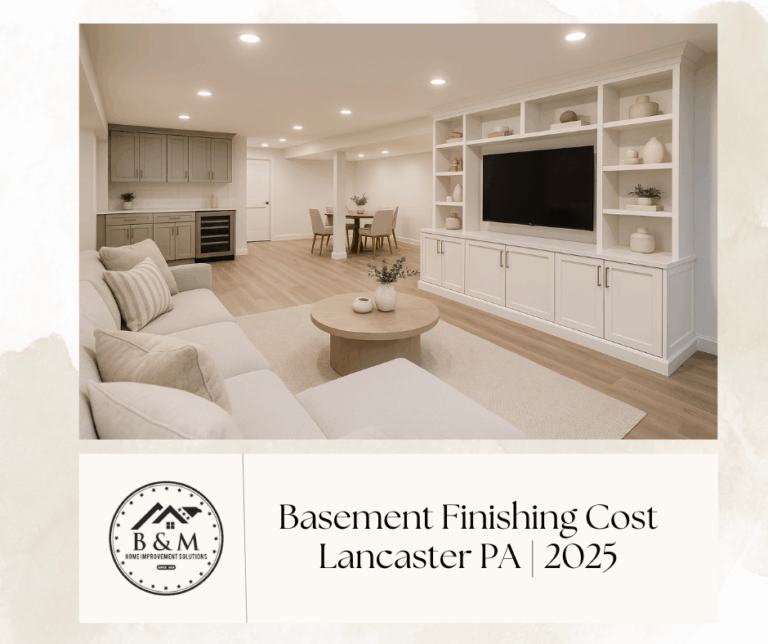
Basement Finishing Cost Lancaster PA (2025): Price per Sq. Ft., Egress, Moisture Fixes, Timelines & ROI
Basement finishing cost Lancaster PA homeowners can expect depends on four levers: moisture/insulation strategy, egress requirements, scope (bath, wet bar, built-ins), and finish level. This deep-dive pillar walks you through each—grounded in Central PA realities for Lancaster County and York County. You’ll see transparent price-per-square-foot ranges, line-item cost drivers, planning checklists, and how code (egress, ventilation, insulation) affects budget and timelines. We also explain ROI using industry benchmarks you can verify and link to authoritative resources for ventilation and energy code. When you’re ready, B&M Home Improvement Solutions coordinates design, permitting, material sourcing (Hajoca, Red Rose Cabinetry, Lezzer Lumber, Too the Trades, Henry H. Ross & Son, Natural Stoneworks), and turnkey execution across Lancaster & York.
What Drives Basement Finishing Cost in Central PA
Moisture, Insulation & Comfort (the foundation of your budget)
Below-grade rooms behave differently than upstairs spaces because concrete and soil store moisture and heat. Budget is shaped by:
Water management. Exterior grading/downspouts, sealing bulkhead leaks, and—where needed—an interior perimeter drain and sump.
Insulation & air sealing. Pennsylvania’s adoption of 2021 energy provisions defines basement wall strategies like “10/13” (R-10 continuous or R-13 cavity) and “15/19” pathways. Choosing the right approach raises comfort and reduces condensation risk in finished space. (Pennsylvania Government)
Dehumidification. A right-sized, ENERGY STAR–rated unit keeps relative humidity ~45–50% and protects finishes; ENERGY STAR publishes capacity guidance by space size and dampness. (ENERGY STAR)
Why it matters: Investing in the envelope first prevents costly callbacks and makes the finished space feel like true living area—warm surfaces, quieter, cleaner air.
Egress Windows/Doors & Safety
If you add a bedroom, code requires an emergency escape and rescue opening from that sleeping room—not just elsewhere in the basement. Commonly cited IRC criteria include a minimum net clear opening of 5.7 sq. ft., with specific height/width and maximum sill height limits (confirm locally; jurisdictions can vary). Egress adds cost for concrete cutting, well/drainage, structural support, and finishes, but it also adds appraisal clarity. (ICC)
Bathrooms, Wet Bars & Built-ins
Bathrooms: Rough-in drains/vents, upflush or gravity options, bath fan ducted to exterior (never into joists), and finish choices (solid-surface vs tile). For performance, plan bath fans to meet 50 CFM intermittent or 25 CFM continuous baseline per ASHRAE 62.2/EPA guidance and choose ENERGY STAR models for tested airflow and low noise. (ASHRAE)
Wet bars: Short plumbing runs save money; leak-sensing valves and pan protection are smart.
Built-ins: Red Rose Cabinetry elevates storage/media walls; pair with quartz or solid surface from Natural Stoneworks or Henry H. Ross & Son.
Ceilings, Sound & Access
Ceilings: Drywall looks most residential; premium acoustical tiles keep service access.
Sound: Mineral wool in joists + selective sound-damping drywall over media rooms.
Access: Planned panels at valves/cleanouts reduce future service costs.
Price Ranges & Price-per-Sq-Ft (Local Benchmarks)
Your costs in Lancaster/York reflect scope, conditions, and selections. Use these planning ranges to size the project before a site visit:
Basic finish (open plan): ~$50–$115/sf. Insulated walls, drywall or premium tile-grid ceiling, LVP flooring, base trim, standard lighting, minimal built-ins. (Local ranges balance material/labor trends and align to regional remodel benchmarks.)
Mid-range (family/media + office/gym): ~$115–$165/sf. Adds sound control, upgraded lighting, a feature wall, small wet bar, elevated millwork.
Premium (guest suite + full bath/wet bar): Often six-figure totals, driven by egress cutting/well drainage, bathroom rough-ins, custom glass, extensive built-ins, and specialty ceilings.
Important: We finalize pricing after measuring moisture, confirming envelope strategy, verifying egress feasibility, and locking selections. ROI expectations should reference industry reports rather than anecdote; see Cost vs Value guidance for Harrisburg-region market framing (we cite, not republish).
Egress in Lancaster & York — Safety, Appraisal & Cost
When Egress Is Required
Any sleeping room in the basement requires a code-compliant egress opening. That opening must be in the sleeping room itself. (ICC)
Opening Size, Sill, and Window Wells
Common IRC targets include: ≥5.7 sq. ft. net clear opening, minimum width/height, and sill ≤ 44 in. above the floor (check your adopting code and inspector). Window wells usually need a minimum dimension and ladder/steps above defined depths, plus drainage to keep wells dry. (ICC)
Cost Drivers
Concrete cutting and lintel support (if needed)
Window well, drain to daylight/sump, and exterior grading
Interior trim and exterior finishes
Access constraints and utilities near the opening
Why appraisers care: Legal bedrooms with documented permits and photos simplify valuation—buyers and underwriters see clear compliance.
Basement Bathroom Costs (Rough-in, Venting, Finishes)
Rough-ins & Venting
Drain/venting: Tie into existing stacks where available; upflush systems can avoid slab trenching but alter fixture selection.
Fans: Size to 50 CFM intermittent minimum (or 25 CFM continuous) and vent to exterior. Selecting ENERGY STAR fans helps ensure delivered airflow at real static pressures and lower sones (noise). (ASHRAE)
Shower Systems & Impact on Budget
Solid-surface systems (e.g., Samuel Müeller) deliver grout-free maintenance and faster installs—useful in basements where humidity management is a priority.
Tile showers add design flexibility but increase labor/time.
Glass: Framed sliders cost less; custom hinged/steam enclosures cost more.
Typical Adds
Niches/benches, upgraded valves/trim from Hajoca, quartz or solid-surface tops from Natural Stoneworks/Henry H. Ross & Son, and lighting layers (ambient + task).
Moisture & Comfort Upgrades Worth the Money
Insulation & Air Sealing (what the PA code pathways mean)
Pennsylvania’s 2021 UCC adoption document clarifies basement wall options such as “10/13” (R-10 continuous or R-13 cavity) and “15/19.” Translating that: rigid foam against masonry (taped and sealed) plus framed wall with batt insulation is a best-practice hybrid that warms surfaces and reduces condensation potential. (Pennsylvania Government)
Dehumidification & IAQ
ENERGY STAR guidance helps size dehumidifiers by area and dampness. For slightly to moderately damp basements, 20–30 pints/day (<2,000 sf) is typical; larger or very damp spaces call for 30+ to 40+ pints/day—and continuous drain routing avoids bucket maintenance. Pair this with good bath fan control and balanced supply/return air. (ENERGY STAR)
Radon Considerations (Central PA reality)
Lancaster and York sit in a state with many homes above the EPA action level of 4.0 pCi/L. If your test is high, active soil depressurization systems can be installed (usually independent of finishing scope); PA DEP publishes homeowner resources and mitigation standards. Plan radon discussions before closing walls. (Pennsylvania Government)
Price Scenarios (with real-world levers you can control)
800–1,000 sf Open Plan (No Bath)
Includes: Insulated perimeter walls, drywall (or premium tile-grid) ceiling, LVP, base trim, 8–12 LED cans, 2–3 circuits, painted doors/trim.
Levers: Moisture fix scope, ceiling choice, and millwork drive the number.
Planning range: ~$50–$115/sf.
900–1,200 sf Family + Office + Small Wet Bar
Includes: All of the above plus sound batts at joists, small bar (Red Rose Cabinetry), quartz top (Natural Stoneworks), under-cab lighting, bar sink/faucet (Hajoca).
Levers: Plumbing tie-in location, glass shelving, and built-in complexity.
Planning range: ~$115–$165/sf.
1,000–1,400 sf Guest Suite + Full Bath + Media Zone
Includes: Egress bedroom, full bath (solid-surface or tile), custom built-ins, glass, and acoustics where appropriate.
Levers: Egress cutting/well costs, bath features, custom glass, ceiling system.
Planning: Six-figure totals are common at this scope. Use Cost vs Value to frame ROI expectations with buyers/partners.
Scope saver: Keep wet areas near existing plumbing runs. Where framing is out-of-square, trimmable shower bases and scribe-friendly wall systems prevent extra labor.
Timeline in Central PA (Design → Permits → Build)
Design & Selections (2–6 weeks): Measured drawings, layout options, selections board, allowances.
Permitting (parallel): We prepare submittals and build an inspection calendar (framing, rough MEP, insulation, finals).
Construction (4–10+ weeks):
Water mitigation & slab prep
Framing & MEP rough-ins
Insulation/air sealing (inspection)
Drywall & prime
Flooring & millwork
Paint, built-ins, tops
Finals, punch, clean
Straight finishes trend short; egress cutting, bathrooms, or extensive built-ins extend duration.
ROI & Resale in the Harrisburg/Lancaster Region
How to talk about ROI honestly: Use the Remodeling “Cost vs. Value” report as a third-party benchmark for project value retention and resale context in the Harrisburg region. You can excerpt findings narratively (no tables/charts) and direct homeowners to the source for more detail; this keeps expectations realistic and documented.
Local proof-points that help appraisals:
Documented permits and photo logs of insulation/air sealing and egress details.
VENT & IAQ compliance: Fans sized to ASHRAE/EPA guidance and ENERGY STAR models help performance and reduce noise—buyers notice quieter, drier baths. (ASHRAE)
Comfort upgrades: Meeting the R-10/R-13 basement wall pathways supports energy efficiency and comfort that show in walk-throughs. (Pennsylvania Government)
Planning & Specs Checklist (Copy/Paste)
Moisture plan: grade/downspouts → interior drain & sump (if needed) → slab prep → right-sized dehumidifier (continuous drain). (ENERGY STAR)
Envelope: Basement walls via R-10 continuous or R-13 cavity pathways; seal rim-joists; manage vapor where assemblies require. (Pennsylvania Government)
Egress (if bedroom): verify opening size, sill height, well dimensions/ladder, and drainage. Document with photos for appraisal. (ICC)
Electrical: Dedicated circuits for media/office; GFCI/AFCI as required; 3–4 lighting zones with dimmers.
HVAC/IAQ: Balance supply/return; bath fans 50 CFM intermittent or 25 CFM continuous; prefer ENERGY STAR for delivered airflow/low sones. (ASHRAE)
Flooring: Below-grade-rated LVP/engineered wood; porcelain tile in wet areas; rubber in gyms.
Selections & lead times:
Hajoca: plumbing valves, drains, bath fans.
Red Rose Cabinetry: media walls, bars, office built-ins.
Lezzer Lumber: doors, trim, framing packages.
Too the Trades: trade supplies and hardware.
Henry H. Ross & Son / Natural Stoneworks: vanity/bar tops, sills, caps.
Ceilings: Drywall for residential look; premium acoustical tile for frequent access.
Sound: Mineral wool in joists; sound-damping drywall in media rooms.
Documentation: inspection photos, product data, warranty packet at handoff.
Next Steps / Consultation (Lancaster & York)
If you’re planning a basement in Lancaster, Lancaster County, York, or York County, we’ll start with a moisture and layout assessment, then present a clear plan, budget, and schedule. We coordinate Hajoca (plumbing/vent), Red Rose Cabinetry (built-ins), Lezzer Lumber (millwork), Too the Trades (trade supplies), and tops by Henry H. Ross & Son/Natural Stoneworks to deliver a clean, durable result. Request your consultation with B&M Home Improvement Solutions.
FAQs
Planning ranges often start around $50–$115 per sq. ft. locally for insulated walls, residential ceiling finish, LVP, and basic lighting. Moisture fixes, millwork, and feature walls move the number.
Costs vary with foundation thickness, utilities, and site drainage. Code requires a compliant emergency escape and rescue opening from any sleeping room; many jurisdictions reference a 5.7 sq. ft. net opening with width/height minimums and a ≤44 in. sill height—verify locally. (ICC)
Yes. Finished basements are conditioned space. Pennsylvania’s 2021 energy adoption outlines R-10 continuous or R-13 cavity basement wall strategies (and “15/19” alternatives). We choose what fits the assembly and comfort goals. (Pennsylvania Government)
Plan for 50 CFM intermittent (or 25 CFM continuous) per ASHRAE 62.2/EPA guidance and select ENERGY STAR fans so delivered airflow and sound meet spec in real installations. (ASHRAE)
Yes—an ENERGY STAR unit sized to square footage and dampness is best. Guidance suggests 20–30 pints/day for slightly damp <2,000 sf spaces, and 30–40+ pints/day for larger/very damp basements. Continuous drain is worth it. (ENERGY STAR)
It can be. PA DEP provides homeowner guidance and mitigation standards. If tests exceed the EPA action level, coordinate mitigation before you close walls. (Pennsylvania Government)