

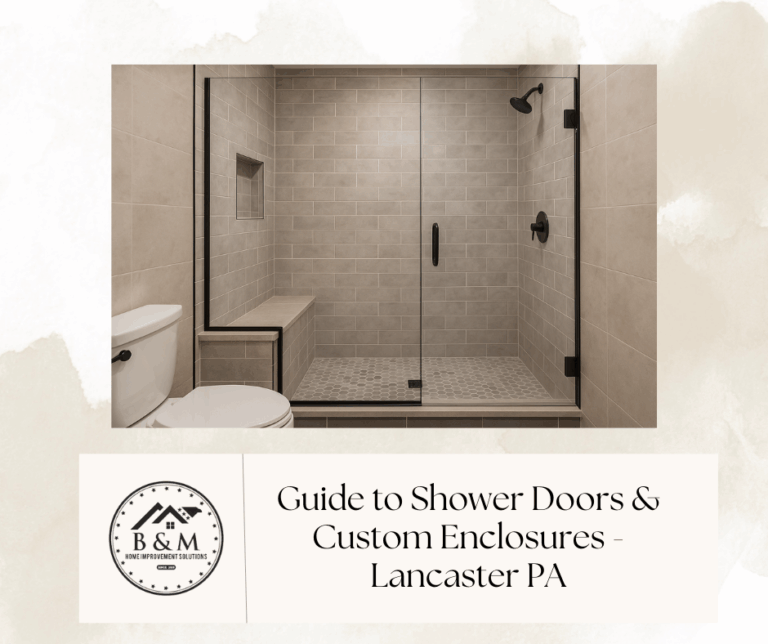
The Complete Guide to Shower Doors & Custom Enclosures (Lancaster & York, PA)
Designing the right shower door is about more than closing off a wet area. It’s how you finish the room, control splashing, preserve heat, showcase tile or solid-surface walls, and make daily routines feel easy. In Lancaster and York—where home styles range from classic farmhouses to new construction—a well-designed shower enclosure can elevate your bathroom’s function and resale appeal while keeping maintenance low.
This in-depth guide walks you through every decision: door types, glass thickness, finishes, layout choices, steam options, ADA-minded details, ventilation, safety, cleaning, timelines, and cost planning. Throughout, we’ll point to related resources from our library so you can build a complete plan:
Bathroom Remodel Roi Lancaster 2025 (wet-area allowances & sequencing)
The Definitive Countertop Guide (materials coordination mindset that also applies to bath surfaces)
Why the Shower Door Matters
A shower door sets the user experience for temperature retention, water containment, reachability of controls, cleaning effort, and how the space looks day one and year ten. For homeowners in Lancaster and York, the choice often boils down to three priorities:
Ease of use & accessibility: low thresholds, wide clear openings, comfortable handle/hinge heights, integrated benches and grab bars.
Maintenance: glass coatings, minimal metal, hardware finishes that resist spotting, smart squeegee habits.
Aesthetics & value: frameless sightlines to premium tile or solid-surface panels, metal finishes to match fixtures, and proportions that make small rooms feel bigger (see Small Bathroom—Appear Spacious).
When we design enclosures, we start with the layout and walls (tile vs. solid surface) and then fit the glass to the reality of the space—not the other way around. That prevents costly rework and keeps reveal lines crisp.
Door Types: Framed, Semi-Frameless, Frameless
Framed
What it is: Glass captured on most edges by metal channels.
Why choose it: Budget-friendly, good water seal, many finish options.
Trade-offs: Heavier visual lines; more places for soap residue to collect.
Best for: Secondary bathrooms, rental properties, tight budgets.
Semi-Frameless
What it is: Thinner metal perimeter with exposed glass edges on the door panel.
Why choose it: Cleaner look than fully framed; lower cost than frameless.
Trade-offs: Still has some channel cleanup; sightlines not as transparent as frameless.
Best for: Midrange projects where value and style meet.
Frameless
What it is: 3/8″ or 1/2″ tempered glass with minimal hardware (hinges, clips).
Why choose it: Premium, open look that showcases tile or solid-surface walls; fewer places for buildup.
Trade-offs: Higher cost; walls/plumb conditions matter; requires precise installation.
Best for: Primary baths, custom layouts, low-threshold or curbless entries, steam enclosures.
Lancaster/York tip: Frameless doors are the go-to for making a small room feel bigger. If you’re renovating to convert a tub to a shower, see our guidance on pan sizes, benches, and niche placement (Tub-to-Shower Conversions).
Opening Styles: Hinged, Pivot, Sliding, Barn-Style, Bi-Fold, and More
Hinged (Side-Hinged)
Swings like a regular door; often outwards per code.
Needs swing clearance; ideal for wider bathrooms.
Cleanest look when paired with a fixed panel inline (door + panel).
Pivot
Hinge pin is set into floor and header/ceiling, allowing large, heavy doors to rotate smoothly.
Excellent for taller glass and when wall structure is limited for hinged anchors.
Sliding (Bypass)
Two panels slide past each other; no swing space required.
Great for alcoves and narrow bathrooms.
Consider smooth, quiet rollers and easy-clean bottom guides.
Barn-Style (Single Slider)
One panel fixed, one panel slides; a contemporary, minimal look.
Ensure you’ll still have access to controls and towels from the open side.
Bi-Fold / Folding
Panels fold to create a wider opening in tight spaces.
Useful in very small baths where you need maximum clear width.
Neo-Angle & Corner Setups
For corner showers, door sets into angled panel layout; hinges and clearances require careful planning.
Steam Enclosures
Full-height glass to ceiling with operable transom for venting; tighter gaskets and precise slopes on headers.
Glass Options: Thickness, Clarity, Privacy, and Protection
Thickness
3/8″ (10mm): Standard for frameless; balances rigidity and weight.
1/2″ (12mm): Ultra-premium feel and stability; heavier hinges and anchors required.
1/4″ (6mm): Typical on framed or sliders; lighter, more economical.
Clarity
Clear: Bright, open; can show water spots if not treated.
Low-Iron “Ultra-Clear”: Removes green cast, ideal for white tile/stone and high-contrast patterns.
Tinted/Bronze/Gray: Adds privacy and softens glare; check how it plays with your finish palette.
Privacy & Texture
Acid-etched/frosted: Diffused privacy; modern look.
Patterned/obscure textures: Classic privacy; verify squeegee-ability and cleaning.
Striping/banding (frosted bands): Keeps sightlines while shielding specific zones.
Safety
Tempered glass is standard: shatters into small pieces if broken.
Laminated options available for special conditions (sound, security, design); adds weight and cost.
Coatings
Hydrophobic coatings repel water and reduce spotting/soap scum.
Ask for factory-applied, warranted coatings; plan a squeegee station to extend performance.
Hardware & Finishes: Form Meets Function
Hinge types: wall-to-glass, glass-to-glass, pivot systems.
Handles: ladder pulls, C-pulls, finger pulls for sliders; check hand feel and towel reach.
Clamps/Channels: clips for minimal look; low-profile channels when walls are slightly out of plumb.
Finish palette: polished chrome, brushed nickel, matte black, satin brass, oil-rubbed bronze. Match to faucets, drains, and cabinet hardware for cohesion.
Thresholds & sweeps: water management parts are small but critical—good seals keep the bath dry without ruining the aesthetic.
Layout & Measurement: Getting the Geometry Right
Start with the pan/curb
Plumb walls and level curbs are non-negotiable for frameless. We check before rough-in to avoid surprises.
Curbless entries demand a proper pre-slope, linear or point drain strategy, and room-side water control (door sweep, return panel).
Clearances & reachability
Verify door can open fully without hitting vanities, toilets, or towel bars.
Place controls so you can turn on the shower without stepping under the water—a daily luxury.
If installing a bench, confirm door swing clears bench face or design a fixed panel + door offset.
Ventilation & steam
Steam units need sealed perimeters, gaskets, and an operable transom for purge.
Non-steam enclosures still need air exchange; an open gap or panel height can keep the bathroom fresher.
Tolerances
Older Lancaster homes rarely have perfectly square openings. Custom glass is field-measured to 1/16–1/8″ and notched to fit out-of-plumb walls.
We choose clips vs. channels based on how much correction is needed while preserving the frameless look.
Tile vs. Solid-Surface Walls: Which Plays Nicer with Glass?
Tile & Stone
Gorgeous, especially with large-format porcelain or marble looks.
Requires precise wall flatness; lippage can introduce gaps under seals.
Grout lines: choose narrow joints with quality grout for easier squeegee paths.
Solid Surface (Corian®, Meganite®, etc.)
Seamless panels with coved corners are incredibly glass-friendly: fewer joints, ultra-flat faces, and low maintenance—a natural partner for frameless.
Integrated shelves/ledges reduce hardware clutter.
If you’re still choosing wall systems, see our comparison mindset in The Definitive Countertop Guide; many trade-offs mirror shower decisions (seams, maintenance, repairability).
Pro move: If you’re planning a tub-to-shower conversion, pick the wall system and pan first, then measure for glass after surfaces are installed (Tub-to-Shower Conversions).
Accessibility & Aging-in-Place (Without Looking Clinical)
Low-threshold or curbless entries reduce tripping hazards.
Wider clear openings: target 30–36″ where space allows.
Benches: fold-down or built-in, sloped slightly to drain.
Grab bars: mount to blocking; match finishes to hinges/handles.
Anti-slip flooring: smaller tiles with more grout or textured solid-surface pans.
Controls at entry: turn on, set temp, then step in.
Handheld shower on a slide bar near bench; easy rinse down of glass.
We design these features so they feel resort-grade, not institutional. For more planning ideas, see Small Bathroom—Appear Spacious.
Steam Showers: Requirements & Rewards
If you want a true spa experience in Lancaster winters, steam transforms daily routines.
Full-height glass with ceiling closure and gaskets; trimmed penetrations.
Operable transom vents steam post-use to dry the enclosure.
Sloped ceilings (≈2″ per foot) prevent drips from forming overhead.
Seat/bench is essential; radiant heat just outside the enclosure increases comfort.
Controls & generators sized for cubic footage and surface materials.
Finishes: select hinges and seals rated for steam conditions.
Cleaning & Care: Keep Glass Crystal Clear
Daily squeegee after the last shower prevents mineral spotting.
Soft microfiber and pH-neutral cleaner weekly for seals and hinges.
Hydrophobic coatings: refresh if water no longer beads.
Avoid abrasives and high-ammonia cleaners that can dull hardware and coatings.
Vent the room (fan or transom) to reduce moisture load.
For households on well water or hard city water, we can specify coatings and cleaning kits that make maintenance simple.
Timeline, Lead Times & What to Expect
Design & rough-in: We finalize enclosure type, handing, and panel sizes while plumbing and wall prep are underway.
Install wall surfaces/pan: Tile or solid-surface must be complete before final measurement.
Laser template: Field measurement to the finished surfaces ensures precision.
Fabrication: Custom glass typically takes 1–3 weeks, depending on coating and finish selections.
Install day: 2–5 hours for typical setups; steam units and complex geometries can run longer.
Cure & seal: Many silicones need 24 hours before use. We’ll leave written care instructions and schedule a quick follow-up if needed.
Cost Planning (No Surprises)
Prices vary with glass thickness, panel count, finishes, steam gaskets, and labor. Here’s how we help Lancaster and York clients stretch value without sacrificing the look:
Use frameless where it matters most (primary suite), and choose semi-frameless for secondary baths.
Pick 3/8″ glass with a premium handle rather than 1/2″ with basic hardware if budget is tight—you’ll notice the handle every day.
Keep panel counts efficient; a single door + fixed panel often looks cleaner and costs less than multiple small segments.
Reserve special glass (low-iron, heavy texture) for the most visible elevation.
If you’re budgeting a larger remodel, see allowances and sequencing tips in Bath Remodel Cost in Lancaster & York.
Common Mistakes (and How We Avoid Them)
Measuring before walls are finished: results in misfit glass. We template after surfaces are installed.
Ignoring plumb/level realities: frameless needs plan-B strategies (channels/clips) to stay watertight and beautiful.
Door hitting valves/towels: we check swings and stops against every fixture.
Poor water management: door sweeps, thresholds, bench overhangs, and head placement all work together to control splash.
Uncoordinated finishes: hinges, handles, bars, and drains should read as one story.
No drying plan: fans, transoms, or a slightly gapped top keep moisture under control.
Design Ideas You’ll Love in Lancaster & York
Minimalist frameless sliders with low-profile rails for a contemporary farmhouse.
Matte black hardware against warm white solid-surface panels—soft modern without the upkeep of dark stone.
Low-iron glass around a veined feature wall—show off what you invested in.
Steam enclosure with transom and a stone or solid-surface bench, paired with radiant heat just outside the door.
Curbless entry with large-format floor tile and a linear drain, door handing set so water stays contained.
Spec Checklist (Copy/Paste for Your Project File)
Configuration: alcove / corner / neo-angle / inline panel + door / steam
Opening style: hinged / pivot / sliding / barn / bi-fold
Glass: 3/8″ or 1/2″; clear vs low-iron; privacy texture; hydrophobic coating Y/N
Hardware finish: chrome / brushed nickel / matte black / satin brass / ORB
Handles & accessories: pull style, towel bar combo, robe hook, grab bars
Seals & thresholds: door sweep, magnetic latch, drip rail
Ventilation: fan CFM; steam transom Y/N; door gap strategy
Accessibility: clear width target (30–36″), bench, control location, handheld on slide bar
Walls: tile vs solid-surface; flatness verified; niche & bench alignment with glass
Drain strategy: linear vs point; slope checked; curb height or curbless details
Heat comfort: radiant zones outside enclosure
Template timing: after surfaces set; blocking confirmed for bars/hinges
Maintenance plan: squeegee station, recommended cleaners, coating care
Lancaster & York Process: How We Deliver a Zero-Stress Shower Upgrade
Design consult: We confirm needs (access, steam, style), finishes, and budget.
Wet-area planning: Pan, drain, bench, and wall system are designed first so the glass has a perfect home.
Selections: Glass type, thickness, hardware finish, handle style, and coating are chosen from curated options.
Rough-in & surfaces: We coordinate trades; tile or solid-surface walls are installed to our flatness and plumb standards.
Laser measuring: Final template off finished surfaces for precision.
Fabrication & install: Glass is produced to spec and installed with clean, watertight details.
Care handoff: You get a care kit and simple maintenance plan to keep everything spotless.
Ready to Design Your Shower?
B&M Home Improvement Solutions creates custom shower enclosures that look stunning, perform reliably, and suit your exact routine—whether that’s a quick morning rinse or a nightly steam session. We serve Lancaster and York, PA, handling design, planning, project management, and installation with craftsmanship you’ll notice every day.
Schedule your design consultation and let’s tailor the perfect door and enclosure for your space.
Internal Links Recap for more info!
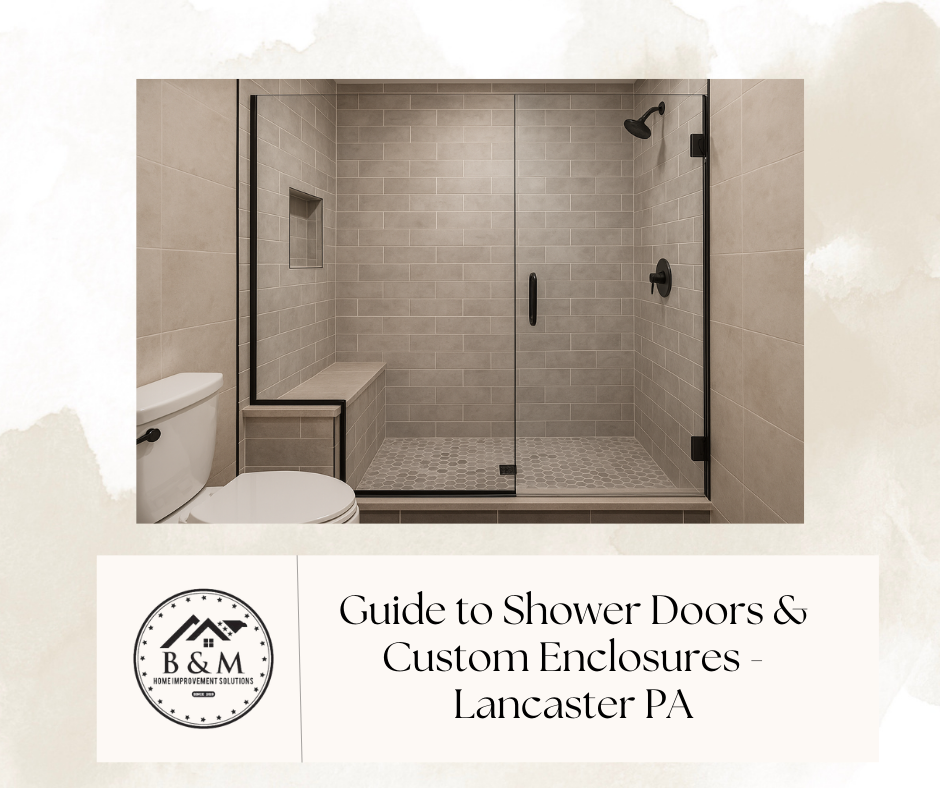
FAQ: Shower Doors & Custom Enclosures
What’s the best shower door for a small bathroom?
Frameless glass (3/8″) with a sliding or hinged + fixed panel layout keeps sightlines open and makes the room feel larger. If swing space is tight, choose a slider or bi-fold. See design tricks in Small Bathroom—Appear Spacious.
If you want a premium, easy-to-clean look that showcases beautiful walls, yes. Fewer metal channels mean fewer “crud lines,” and with coatings plus good habits, frameless stays clear longer.
If your walls are white or very light, low-iron avoids the green cast and keeps colors true. On darker or patterned walls, standard clear is often fine.
They go full height with tighter gaskets and an operable transom. Headers and hinges are rated for steam, and the ceiling inside should be sloped to prevent drips.
Tempered glass is standard; it breaks into small pieces if shattered. We also verify clearances so a swinging door cannot trap someone (most codes require outswing capability).
After surfaces are installed, template to install usually runs 1–3 weeks, depending on options and coatings. We’ll give you a specific timeline during design.
Hydrophobic coating + daily squeegee + weekly microfiber wipe with a pH-neutral cleaner. We provide a simple care card at the end of your project.
Yes—plan slope, drain type, and door sweep strategy carefully. We design the whole water management system during the planning phase so it works flawlessly.