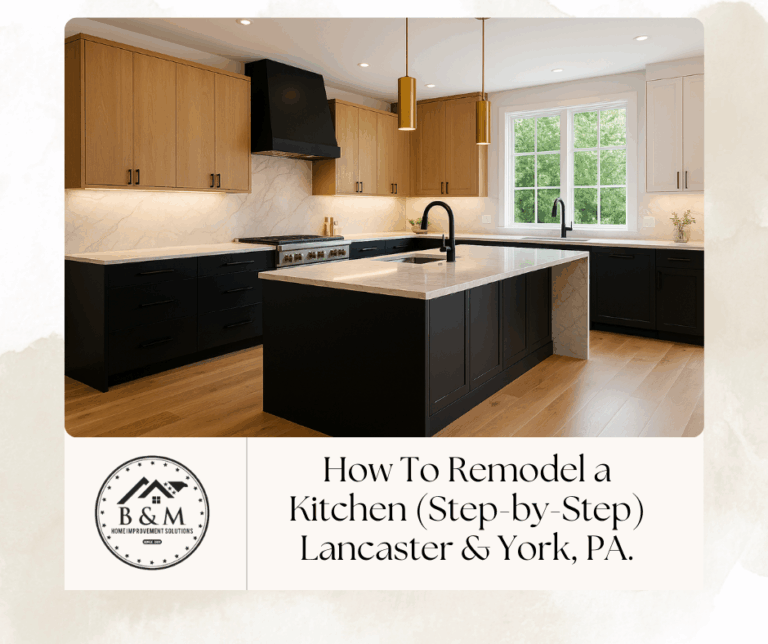
How to Remodel a Kitchen (Step-by-Step) in Lancaster & York, PA
Remodeling a kitchen is equal parts planning, craftsmanship, and coordination. The choices you make at the start—layout, materials, budget, and sequencing—determine how smoothly the project runs and how happy you’ll be with the space ten years from now. This in-depth guide is written for Lancaster and York homeowners who want an honest, practical game plan: the right order of work, how to choose durable materials, what to expect from timelines and inspections, and where professional installation makes a lasting difference. You’ll also find local notes for older farmhouses and colonials, plus a plain-English FAQ that answers the most searched questions about kitchen remodeling today. Throughout, we’ll point to companion articles on our site so you can dive deeper into specific topics.
Start With a Plan (and a 15–20% Cushion)
Every successful kitchen remodel begins with clarity. Before a single cabinet is measured, define the problems you’re solving and the outcomes you want.
Diagnose the “why.” Make a short list of what isn’t working: cramped prep space, poor lighting, insufficient storage, awkward traffic, aging appliances, or finishes that don’t withstand daily life. Prioritize the list: must-fix (safety, function) and nice-to-have (style upgrades, specialty appliances).
Budget by category—not just a single number. Break your budget into realistic buckets so you can control trade-offs without losing the overall goal.
Cabinets & hardware
Countertops & backsplash
Appliances & ventilation
Plumbing fixtures & sink
Flooring & tile setting materials
Lighting & electrical upgrades
Paint, trim, doors, and finishing
Design, project management, permits, inspections
Contingency (15–20%) for surprises in older homes (out-of-level floors, hidden plumbing/electrical, subfloor repairs)
Define scope and phasing. Scope creep is the #1 budget buster. Decide what’s in (full gut vs. partial update, wall removal vs. existing layout) and what can be a phase-two item. For some clients, phasing counters/backsplash or appliance upgrades helps manage cash flow while still moving forward.
Lock selections early. Counter slabs, cabinet door styles, finish colors, and appliance models determine measurements and lead times. Early choices minimize change orders and delays.
Helpful companion reads:
Choose Layout First (Triangle vs. Zones)
A beautiful kitchen that doesn’t work is a daily frustration. Layout decisions come before finishes because they set the bones of the space.
Work triangle basics. The classic triangle (sink–range–fridge) reduces steps between the three most used areas. It still works well in smaller kitchens and galley layouts.
Work zones for modern living. In larger kitchens—or homes that entertain—zones outperform the triangle. Plan distinct areas for prep, cooking, clean-up, coffee/beverage, and baking. Zones let two or more cooks work without bumping into each other. A beverage center off the main path keeps guests away from the chef’s workflow.
Clearances and comfort. In tight homes, aim for 36–42 inches in primary aisles; 42–48 inches is ideal for multi-cook spaces. Allow 15 inches minimum landing space on the latch side of wall ovens and 12–15 inches on at least one side of the cooktop. Ensure the dishwasher can open fully without blocking traffic.
Islands that help, not hinder. An island should support prep and seating without choking circulation. As a rule of thumb: 24 inches of counter width per stool, 15 inches of knee clearance for seating, and 42 inches minimum for the aisle behind seated guests.
Local home realities. Many Lancaster County stone farmhouses and York colonials have out-of-square walls and uneven floors. Expect scribing cabinetry to walls, shimming bases for perfect reveals, and careful beam sizing when removing bearing walls. These details separate a “looks fine on day one” kitchen from a precision installation that still looks laser-straight years later.
The Proven Order of Operations
Remodels succeed when everyone follows a disciplined sequence. Here’s the order B&M follows to keep projects on time and on spec:
Design & Selections → Permits/Approvals → Site Protection → Demolition → Rough-Ins → Inspections → Close-In → Surfaces → Cabinets → Countertops → Trim-Outs → Backsplash → Appliances → Final Punch
Design, selections, and approvals. We finalize the plan set, elevations, and spec sheet with you. If you’re removing walls or altering structure/electrical/plumbing, we coordinate stamped drawings and apply for permits with your township.
Site protection. Before demo, we protect floors and stairs, set up dust control (zip walls, air scrubber if required), and create safe paths for crews. We also help you set up a temporary kitchen.
Demolition. We remove cabinets, tops, old flooring, soffits, and any non-structural partitions scheduled to go. We cap plumbing and make safe all circuits. If we find hidden issues (soft subfloors, corroded piping), we document them and align on a fix using your contingency.
Rough plumbing, electrical, HVAC. We place lines for the sink, dishwasher, refrigerator, pot filler, and any filtered/instant-hot taps. We run circuits for appliances and lighting zones, add dedicated lines where needed, and route ductwork for the hood. It’s far easier and cheaper to do this now than after drywall.
Inspections. Township inspections at rough stage ensure safety and code compliance. We schedule and attend so you don’t have to.
Close-in: insulation & drywall. Once approved, we insulate exterior walls as needed, hang/finish drywall, and prime. Priming before cabinets catches imperfections early and prevents visible seams in raking light.
Flooring vs. cabinets: what goes first?
Tile/LVP: Often installed before cabinets for a continuous plane and clean transitions.
Hardwood: In many homes we install hardwood before cabinets and finish after, with protection, to maintain height continuity. In some cases we install after bases are set—your existing conditions dictate the best approach. We’ll advise based on leveling needs, radiant heat, and height at thresholds.
Cabinet installation. We laser-level, set bases, scribe to walls, and check reveals continually. Panel-ready appliances are dry-fitted to confirm tolerances. This is where craftsmanship shows—tiny errors now become big alignment issues later.
Countertop template & fabrication. Once cabinets are locked, the fabricator templates the tops. Lead times vary by stone type and shop capacity; expect 1–3 weeks. We confirm sink reveals, faucet hole locations, edge profiles, and seam strategies before cutting.
Trim-outs. After counters are set, we install plumbing trim (faucet, disposal, filtration, dishwasher connection) and electrical trim (switches, under-cabinet lighting, dimmers, outlet covers). We level and test every component.
Backsplash & detailing. Tile is set with expansion joints where needed; outlets are aligned with grout lines or concealed under the cabinets. We use the right trowel size for your tile, set lippage expectations, and grout with the correct product for stain resistance.
Appliances & ventilation. Final appliance set happens after countertops and backsplash (except in rare sequences we plan up front). We balance hood ventilation and confirm quiet performance and make-up air requirements.
Punch list & hand-off. We caulk, adjust doors/drawers, test soft-close action, and walk with you to confirm every promise. Then we clean, label, and hand you care guides and finish samples for future touch-ups.
Cabinets 101 (Stock, RTA, Semi-Custom, Custom)
Cabinets are the backbone of your kitchen—functionally and visually. Understanding types and construction helps you invest wisely.
Stock cabinets. Pre-sized SKUs, fastest lead time, fixed door styles/finishes. Great for tight budgets or rentals. Limitations: fewer size options, fillers needed, limited customization.
RTA (ready-to-assemble). Shipped flat; assembled on site or in a shop. Can offer surprising value in secondary spaces or tight schedules. Quality varies widely; assembly skill matters for long-term squareness and durability.
Semi-custom. Most popular for primary kitchens. You choose door style, wood species, finish, and can tweak dimensions in 1/4″ or 1″ increments. Storage accessories, furniture ends, and special moldings allow a near-custom look with predictable lead times and warranties.
Custom. Built to your drawings and measurements with few limits on size, wood, or finish. Ideal for tricky rooms, flush/panel-ready appliances, and exacting reveals. Expect longer lead times and higher cost; the results are bespoke.
What separates a lasting cabinet from a disposable one?
Box material & thickness. ¾” plywood boxes with full ¾” plywood backs hold screws, resist deflection, and simplify installation. Thin backs rely on rails and hangers—fine in a pantry, less ideal for heavy kitchen loads.
Joinery. Dadoed or doweled construction locks the box; confirmat screws add mechanical strength in frameless lines. Face frames should be pocket-screwed and glued.
Drawer boxes. Solid hardwood dovetail boxes with ½” or 5/8″ sides and ¼” or 3/8″ captured bottoms last; stapled melamine does not.
Slides & hinges. Full-extension, soft-close undermount slides with high load ratings; 6-way adjustable soft-close hinges. Durable hardware matters more than many realize.
Finish. Factory-applied conversion varnish has exceptional chemical and moisture resistance compared to typical site paints. Painted doors often use engineered cores (HDF/MDF) for smoother faces; frame/stile construction controls movement.
Framed vs. frameless. Framed (American) cabinets have a face frame; inset or overlay doors affect the look. Frameless (European) offers maximum interior space and modern lines but demands tighter installation tolerances.
Lead times & local sourcing. In Lancaster and York we coordinate with trusted suppliers and cabinetmakers—ranging from semi-custom lines to local shops capable of true bespoke work. Our role is to align your budget, style, and timeline with the right source so you get durability, not just looks.
Doors, Drawers & Storage That Simplify Daily Life
A great kitchen hides complexity behind clean lines. The right interior fittings make every day easier—without cluttering your countertops.
Trash & recycling: A double pull-out near the prep sink is non-negotiable for most families.
Cooking zone storage: Pull-outs for oils/spices; tray dividers for sheet pans; deep drawers for pots.
Corner solutions: Super Susans and LeMans units beat dead corners if you need every inch; otherwise consider a blind corner with a wide drawer bank elsewhere for efficiency.
Pantry options: Tall pull-outs, uppers with roll-outs, or a separate walk-in/butler’s pantry keep the main kitchen clear.
Small appliances: Appliance garages or lift-ups (for mixers) maintain a streamlined look.
Aging-in-place comforts: More drawers, fewer deep base cabinets; D-shaped pulls; gentle-close hardware; and adequate task lighting reduce strain and improve safety.
Surfaces That Last (Counters, Backsplash, Floors)
Countertops.
Quartz: Consistent patterning, low maintenance, excellent for busy households.
Quartzite: Natural stone beauty with good hardness; seal and care properly.
Granite: Durable and varied; modern finishes (honed/leathered) update the look.
Porcelain slabs: Thin, heat-resistant, non-porous; requires a fabricator comfortable with the material.
Butcher block: Warmth and repairability; best as an accent or island top with proper care.
Choose edge profiles that fit the style and function—eased for modern, small bevel for transitional, ogee for traditional, mitered waterfall for a dramatic island. Plan seams intelligently: book-match dramatic veining; minimize seam visibility at sinks and corners.
Backsplash. Decide between tile or full-height slab. Full-height slabs are stunning and easy to clean; tile adds texture and pattern. Preplan outlet locations (or use under-cabinet plugmold) so you don’t interrupt a beautiful pattern.
Flooring.
Site-finished or engineered hardwood: Warm, resilient underfoot; confirm species/hardness and finish system for kitchens.
Porcelain tile: The king of durability; compatible with radiant heat; requires a flat substrate for large formats.
LVP: Value-oriented, water-tolerant, forgiving; choose quality wear layers and stable cores.
Radiant heat: Electric mats for targeted areas or hydronic for whole-home systems—both transform winter mornings in Lancaster and York.
Grout and caulks. High-performance grouts resist stains; color-matched silicone at change-of-plane lines prevents cracking. Small, thoughtful choices like these extend the “new” look for years.
Lighting, Power & Ventilation (Don’t Skimp)
Lighting and air control are the secret weapons of a kitchen that feels expensive and performs effortlessly.
Layered lighting plan.
Ambient: Discreet recessed lights spaced to avoid shadows; aim for high CRI (90+) and comfortable color temperature (usually 2700–3000K).
Task: Continuous under-cabinet LEDs with quality diffusers—no “dotty” glare—transform meal prep and make stone sparkle.
Accent: Pendants above the island, toe-kick lights for night paths, in-cabinet lighting for glass uppers.
Power planning. Dedicated circuits for major appliances; enough small-appliance circuits for today’s kitchens; and strategic outlet placement along counters and at the island (pop-ups or end-panels) keep cords tidy. GFCI/AFCI protection is standard; we handle compliance details so you don’t have to.
Ventilation & make-up air. Size the hood in relation to the cooking equipment, capture area, and ducting. Long or restrictive runs need careful planning to stay quiet and effective. In higher-CFM scenarios, make-up air may be required; addressing it during design keeps inspections smooth and your home comfortable.
Appliances, Plumbing & Fixtures—Pick Early, Install Right
Appliances. Lock models and sizes during design. Panel-ready fridges and dishwashers require precise panel thickness and hinge clearances; pro-style ranges may need larger vents. Double ovens, steam ovens, and built-in coffee machines change cabinet layouts—decide before drawings are finalized.
Sinks & faucets. Workstation sinks add prep space without expanding the footprint. Stainless remains a workhorse; fireclay and quartz composite offer style options. Choose reliable valves and finishes for faucets; pull-down sprayers with magnetic docks and ceramic cartridges last longer.
Water quality & protection. Lancaster and York homes frequently benefit from filtration at the sink or whole-home softening. Leak detection/shutoff systems are small investments that can prevent major damage.
Timeline: How Long a Kitchen Remodel Really Takes
Timelines vary with scope, permitting, and selections, but this is a realistic framework:
Design & selections: 2–6 weeks (complex or custom work may extend this)
Permits/ordering: 1–3 weeks (cabinet lead times can be 4–12+ weeks; we order early)
On-site construction: 4–8+ weeks depending on structural changes, flooring, and tile complexity
Countertops: template to install 1–3 weeks (material/fabricator dependent)
Total typical range: 8–16+ weeks end-to-end for a full remodel
Living through the remodel. We help set up a temporary kitchen, manage dust control, and create daily cleanup routines. Pets and kids get special planning attention—barriers and safe zones keep everyone comfortable.
DIY vs. Pro in Lancaster & York
Some upgrades are great DIY projects: paint, decorative hardware, and simple shelving. Others should be left to licensed pros: electrical panel work, gas lines, structural modifications, and complex waterproofing/tile assemblies. A design-build partner like B&M coordinates every specialty, keeps the schedule realistic, and takes accountability for the result—fewer change orders, fewer surprises, and a neater job site.
2025 Choices With Staying Power
Trends come and go, but certain choices look fresh for years:
Warm woods (white oak, walnut accents) paired with painted tones
Mixed metals—polished nickel with matte black or antiqued brass used intentionally
Refined modern lines—slab or simple Shaker profiles with careful proportions
Full-height backsplashes in slab or large-format tile for a tailored look
Integrated, layered lighting (under-cabinet + toe-kick + inside glass uppers)
Beverage stations and walk-in or cabinet-style pantries to keep counters clear
Quiet technology—induction cooking, whisper-quiet dishwashers, smart leak sensors
On the way out: high-gloss whites everywhere, overly busy mosaics, trend-for-trend’s sake. Choose details that reflect your home and lifestyle; timeless beats trendy.
Local Notes for Lancaster & York Homes
Older structures, straighter reveals. Stone and timber homes often bring out-of-level floors and twist in walls. We plan shimming strategies, thicker scribes, and custom fillers to achieve crisp, even reveals at doors and drawer heads.
Electrical realities. Upgrading circuits is common in older kitchens. Microwaves, induction, double ovens, and panel-ready fridges add load. We assess your panel capacity early to avoid late surprises.
Plumbing considerations. If moving a sink or adding a prep sink, we verify slope, venting, and access. Homes on well water sometimes benefit from filtration and scale management to protect fixtures and appliances.
Permitting culture. Townships across Lancaster and York Counties vary. We build inspections and review times into your schedule and handle communication so the job keeps momentum.
Sourcing & coordination. We work with trusted regional suppliers for cabinets, surfaces, plumbing (including partners like Hajoca), and lumber/hardware (including Lezzer Lumber), along with local specialty shops for true custom pieces. You get one accountable team managing a curated network.
Working With B&M Home Improvement Solutions
Our design-build approach keeps your project coherent and predictable:
Discovery & Measure. We listen first—how you cook, entertain, and store. We laser-measure and photograph the space for accurate drawings.
Design Development. We present layouts (triangle vs. zones), elevations, and 3D views. We price multiple options so you can choose where to invest.
Selections. In our studio and local showrooms, we help you choose cabinets, counters, tile, floors, fixtures, lighting, and hardware. You’ll approve everything in a single, organized spec sheet.
Project Roadmap. You’ll receive a written scope of work, allowances, a realistic schedule, and clear site-protection standards.
Build. You’ll have a dedicated project lead, routine updates, tidy daily cleanup, and steady progress. We coordinate inspections, keep trades on sequence, and protect your home.
White-Glove Handoff. Final adjustments, finish care guides, and a structured warranty. We stand by the work.
More deep dives on our site:
Conclusion & Next Steps
A kitchen remodel touches almost every part of your home: structure, mechanicals, finishes, and daily life. When you start with a clear plan, lock critical selections early, and follow a proven order of operations, the process is predictable—and the results are unmistakable. In Lancaster and York, older homes make precision installation even more important: level bases on unlevel floors, clean reveals against wavy walls, ventilation that’s quiet and effective, and electrical capacity that meets modern demands.
B&M Home Improvement Solutions manages the complexity for you—from design concepts and selections to permits, inspections, and precise installation. We protect your home, communicate clearly, and deliver craftsmanship you’ll notice every day, from the gentle close of a drawer to the way morning light washes a full-height backsplash.
If you’re ready to start planning, we’ll meet you where you are: a quick consult to explore scope, a measured layout session, or a full selections workshop. You bring the wish list; we’ll bring a roadmap that respects your home, your budget, and your time.