

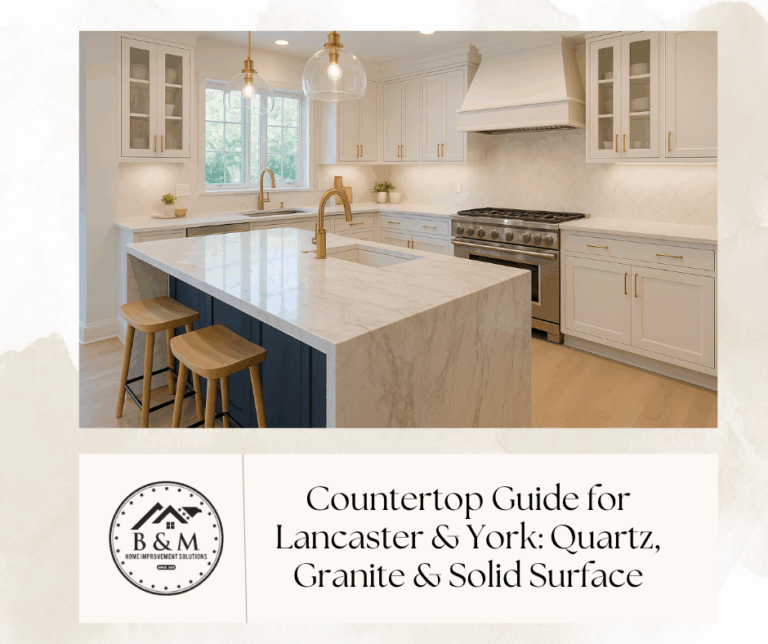
The Definitive Countertop Guide for Lancaster & York: Quartz, Quartzite, Granite & Solid Surface
Designing a kitchen or bathroom you’ll love for decades starts with the surface you touch every day: the countertop. In Lancaster and York, PA, homeowners ask us the same core questions—Which material is most durable? Which is easiest to maintain? Which looks best with my cabinetry and lighting? This deep dive explains the real-world pros, cons, and use cases of quartz, granite, quartzite, and solid surface (e.g., Corian®, Meganite®)—plus how B&M Home Improvement Solutions engineers clean seams, strong overhangs, and waterfall edges that look (and perform) like furniture.
We specify and coordinate fabrication with Natural Stoneworks (quartz, granite, quartzite) and Henry H. Ross & Son (solid surface). Throughout, we’ll link to related resources in our library so you can explore specific decisions in more detail.
What “best countertop” really means (for your home)
There isn’t a single winner; there’s a best fit shaped by your lifestyle:
Durability & risk tolerance: heat, scratch, chip, etch, and stain resistance.
Upkeep: sealed vs non-sealed, daily cleaning habits, kids and guests.
Aesthetics: veining, color consistency, finish (polished, honed, leathered, matte), edge profile, and how it pairs with your cabinets and hardware.
Fabrication realities: slab size, vein direction, required support, seam placement, and bookmatching potential.
Budget & ROI: where to invest vs where to save without looking “value engineered.” See the local cost picture here: Kitchen Remodel Cost in Lancaster & York.
We help you weigh each factor—and then we build the installation plan to protect that choice for the long term.
Quartz (engineered stone): consistent, low-maintenance, design-forward
What it is: ~90–94% ground natural quartz bound with resins and pigments.
Why Lancaster/York homeowners pick it: consistent color/veining, low maintenance, wide palette from warm creams to bold marblesque veining.
Strengths
Excellent stain resistance for everyday cooking.
Nonporous and easy to wipe clean (no annual sealing).
Vast style range: from soft limestone looks to dramatic calacatta visuals that pair beautifully with two-tone cabinetry.
Limitations to plan for
Heat: resins don’t love thermal shock. Use trivets for hot pots/pans and countertop air fryers.
UV exposure: prolonged direct sun can cause discoloration on some lines—consider window treatments in sun-drenched spaces.
Edges: very sharp corners can chip if struck; we often specify a slight eased edge for durability without losing the crisp look.
Best uses
Busy family kitchens, hardworking islands, powder and full vanities.
Designs needing color consistency across long runs or multiple slabs.
Waterfall islands where continuous pattern is preferred over bold natural shifts.
Fabrication partner: Natural Stoneworks (precision slab selection, vein mapping, and seam control).
Granite (natural stone): character, strength, and time-tested performance
What it is: an igneous natural stone slab, quarried and polished.
Why people love it: authentic mineral movement, crystals, and a sense of permanence that ages gracefully.
Strengths
Very heat tolerant (still use trivets to protect the finish and adhesives).
Broad range from subtle to dramatic; leathered finishes disguise fingerprints and add tactile richness.
Excellent value range: some colors are competitive with mid-tier quartz while delivering one-of-a-kind movement.
Limitations to plan for
Sealing: most granites benefit from periodic sealing; modern sealers are long-life and simple.
Variation: expect slab-to-slab differences. We slab-shop with you to select and tag the exact pieces.
Best uses
Statement islands where natural variation is the hero.
Kitchens aiming for warmth and texture that complement inset or shaker cabinetry—see How to Select Kitchen Cabinets for construction details that pair well with stone massing.
Fabrication partner: Natural Stoneworks.
Quartzite (natural stone): luminous veining, marble look, granite hardness
What it is: a metamorphic natural stone—not the same as quartz.
Why it’s coveted: the marble-like elegance (feathering, translucence) with greater hardness and scratch resistance.
Strengths
Harder than many granites; stands up well to daily wear.
Striking veins and painterly movement that elevate custom kitchen and bath designs.
Pairs beautifully with waterfall edges where veining can “flow” down the sides.
Limitations to plan for
Sealing still recommended; some quartzites can etch with strong acids—daily habits matter.
Fabrication requires experienced shops; we coordinate vein mapping during templating.
Best uses
High-impact islands, full-height slab backsplashes, luxury master vanities with open grain patterns.
Fabrication partner: Natural Stoneworks.
Solid Surface (Corian®, Meganite®): seamless, repairable, hygienic
What it is: A nonporous, homogeneous sheet material (typically acrylic or acrylic/polyester blends) available in many colors and patterns. Standard sheets are ~½” thick (≈12 mm) and can be seamed invisibly with color-matched adhesives, thermoformed into curves, and renewed by sanding/polishing.
Why Lancaster/York homeowners choose it: Seamless look (including integrated sinks and coved backsplashes), warm-to-the-touch feel, hygienic performance, and the unique ability to repair scratches or small chips later—great for long-term ownership.
Strengths
Seamless integration: Invisible, sanitary seams; elegant coved backsplash transitions eliminate grime-catching caulk lines.
Integrated sinks & drainboards: Fabricate sink bowls and sloped drain areas as one continuous surface.
Renewable surface: Minor scratches, stains, and burn marks can often be sanded/buffed out, extending life dramatically.
Thermoforming: Curves, wrapped edges, and custom shapes that stone can’t easily achieve.
Nonporous & hygienic: Excellent for food-prep zones and bathrooms; easy day-to-day cleaning.
Limitations to plan for
Heat sensitivity: Can scorch or deform with direct, sustained heat. Always use trivets and heat pads near cooktops and small appliances.
Scratch resistance: Softer than stone/quartz; shows scuffs sooner—but can be refinished.
Sheen management: Dark, high-gloss colors can highlight wear; we often recommend matte/satin for busy kitchens.
UV exposure: Some colors may discolor with prolonged direct sunlight—consider window treatments in bright spaces.
Best uses
Seamless, sanitary runs in kitchens and baths where you want integrated sinks and backsplashes.
Shower/tub surrounds with minimal seams, coved corners, and integrated shelves (excellent for easy cleaning).
Laundry/utility rooms and family kitchens where repairability outweighs ultimate hardness.
Curved islands or wrap-around details that benefit from thermoforming.
Fabrication partner: Henry H. Ross & Son (local experts in solid-surface fabrication, seamless coved splashes, integrated sinks, and thermoformed edges).
Countertop edges & profiles: where style meets durability
Edge selection changes both the look and longevity of your tops:
Eased/Slight Radius: clean, modern, less chip-prone than a knife edge.
Mitered Waterfall (stone/quartz/quartzite): continuous face grain down the sides; requires tight fabrication and structural support—our crews glue, clamp, and block for invisible seams.
Ogee/Bullnose: classic and soft; excellent for traditional or transitional kitchens.
Solid surface built-up & thermoformed edges: thicker, furniture-like faces and smooth curves without visible joints.
Laminated thick edges (stone): 2–3″ visual mass; we align veining at the lamination for a seamless look.
We match edges to cabinet door styles and hardware finishes; for inspiration on pairings, see our Two-Tone Cabinets & Mixed Metals Guide.
Sinks, seams, and support: the details that separate “fine” from “phenomenal”
Undermount sinks (stone/quartz/quartzite): we finish the cutout with a polished reveal or zero-reveal per your cleaning preference; workstation sinks get accessory clearances planned in.
Integrated sinks (solid surface): continuous bowls with no seam lines; add integrated drainboards and coved splashes for a true “wipe-and-go” experience.
Farmhouse sinks: we block and brace cabinets and set reveal lines so the apron sits perfectly flush to door faces—no “smiles” or gaps.
Seams (stone/quartz/quartzite): we place at low-visibility lines, color-match adhesives, and align veining/bookmatch when crossing.
Overhangs & brackets: anything beyond ~10–12″ unsupported typically needs hidden steel or corbels; we design supports into the cabinet layout so they disappear.
All of this is engineered during design, not discovered on install day.
Backsplashes & wet walls
Tile backsplashes excel at texture, pattern, and cost control.
Full-height slab backsplashes (quartz/granite/quartzite): stunning and wipe down fast; ideal behind ranges and wet zones.
Solid surface backsplashes: seamless and coved, eliminating the caulk line at the wall and making daily cleanup effortless.
Showers/tub surrounds: Solid surface offers large, hygienic panels with coved inside corners and integrated shelves—spa-clean looks with minimal joints.
Heat, stain & scratch—quick comparisons
Heat tolerance: Quartzite ≈ Granite > Quartz > Solid Surface (use trivets on all; solid surface is most heat-sensitive).
Stain resistance: Quartz ≈ Solid Surface excellent (nonporous). Granite/Quartzite good with periodic sealing.
Etch/acid: Granite/Quartz generally resist common kitchen acids; some Quartzites can etch; Solid Surface doesn’t “etch” like calcite stones, but harsh chemicals can dull finish (refinishable).
Scratch: Quartzite & Granite strongest; Quartz good; Solid Surface more prone to scuffs but repairable (sand/polish).
Cost & ROI in Lancaster & York
Exact pricing depends on thickness, edge work, brand/color rarity, and the number of cutouts or miters. A smart way to budget is to put dollars where impact and use are highest:
Primary island: invest in your statement slab (quartzite, dramatic granite, or premium quartz) via Natural Stoneworks, or a bold, sculpted solid surface island via Henry H. Ross & Son if you want seamless curves or integrated drainboards.
Perimeter runs: save with a calmer, coordinated material.
Bathrooms: prioritize the primary suite vanity and shower accents—then choose durable, attractive values for kids/guest baths. If you’re re-thinking the bath layout entirely, start here: Tub-to-Shower Conversions & Wet-Area Upgrades.
For allowances and contingencies in full remodels, see Kitchen Remodel Cost in Lancaster & York.
Fabrication & installation excellence: our Lancaster/York process
1) Material selection & tagging
Natural Stoneworks (quartz/granite/quartzite): we meet you to select specific slabs, reviewing size, veining, and yield for your layout.
Henry H. Ross & Son (solid surface): we review full-sheet color lots, seam plans, and possibilities for coved splashes, integrated sinks, and thermoformed edges.
2) Digital templating
Laser templates map your actual walls/floors (older Lancaster homes aren’t always square). We use those files to plan seam locations, vein alignment, sink reveals, and bracket placement.
3) Engineering the details
Waterfall miters (stone): 45° cuts and bookmatched faces with concealed steel support.
Solid surface radius & coved details: heat-formed curves, invisible seams, and integrated drain areas.
Appliance panels & clearances: aligned with cabinet specs (see How to Select Kitchen Cabinets for the construction fundamentals that support precise countertop work).
4) Trade coordination
We coordinate faucet and sink specs, power/lighting for clean backsplash layouts, and schedule with our fabrication partners so holes, cutouts, and structure are right the first time.
5) Protected delivery & white-glove install
We stage access, protect floors, and maintain climate/cleanliness during set. After install, you’ll get care instructions and a walkthrough to confirm every seam, reveal, and edge meets expectations.
Countertops in bathrooms: vanity tops, shower ledges, and surrounds
Vanity tops:
Solid surface: shines here with integrated bowls, coved backsplashes, and a seamless deck for easy cleaning (Henry H. Ross & Son).
Quartz/granite/quartzite: luxurious, durable tops with undermount bowls and tailored faucet spreads (Natural Stoneworks).
Shower benches & niches:
Solid surface: coved corners, invisible seams, and sloped tops for drainage.
Stone/quartz: elegant benches and sills with precise slopes and mitered corners.
Slab or panel walls:
Solid surface: minimal joints, warm touch, low maintenance.
Stone slabs: dramatic, spa-like walls with natural veining.
Pair bathroom surfaces with radiant heat outside wet zones for comfort.
Maintenance cheat sheet (save this)
Quartz: mild soap/water; avoid abrasive pads and prolonged heat.
Granite/Quartzite: pH-neutral cleaner; reseal per fabricator guidance; wipe spills promptly.
Solid Surface (Corian®, Meganite®): mild soap/water; use trivets for heat; remove scuffs with non-woven pads; professional refinishing restores sheen.
All materials: cutting boards for knives; trivets for heat; felt pads under heavy appliances.
How to choose—our decision framework
Lifestyle first: Do you cook often? Host big groups? Prefer a pristine or organic look?
Aesthetic direction: Do you want calm consistency (quartz), natural drama (granite/quartzite), or seamless curves and integrated features (solid surface)?
Care commitment: Are you OK sealing stone annually? Do you want set-and-forget maintenance (quartz/solid surface)?
Edge & form: Waterfall (stone), thick laminated (stone), or thermoformed curves with coved splash (solid surface)?
Cabinet pairing: Warm woods vs painted perimeters; explore pairings in Best Cabinets in Lancaster.
Budget placement: Put dollars where eyes and hands land most—usually the island and primary bath. See Kitchen Remodel Cost in Lancaster & York for allocation tips.
FAQ: quick answers we give Lancaster & York homeowners
Is quartz better than granite?
“Better” depends on goals. Quartz is nonporous and consistent; granite offers natural variation and heat tolerance. If you want low maintenance and uniform veining, choose quartz. If you want authentic stone character and don’t mind periodic sealing, choose granite.
Is quartzite just fancy quartz?
No. Quartzite is natural stone; quartz is engineered. Quartzite is typically harder than many granites, with marble-like looks.
Where does solid surface make the most sense?
Anywhere you want seamless, hygienic, and repairable surfaces—kitchen runs with integrated sinks, coved splashes, and shower/tub surrounds with minimal joints.
Can I put hot pans on my counter?
Use trivets on all materials. It’s critical for solid surface (heat can scorch/deform) and still good practice for quartz and natural stone to protect finishes and adhesives.
Will seams be visible?
Solid surface: seams can be made virtually invisible.
Quartz/granite/quartzite: seams are minimized, color-matched, and placed in low-visibility areas; large islands may still require seams.
Tile backsplash or slab/panel wall?
Tile offers texture and cost control; slab stone creates monolithic drama; solid surface panels give you seamless, coved cleanliness. We often mix approaches strategically.
How do countertops pair with cabinet quality?
High-end tops deserve well-built cabinets: plywood boxes, quality joinery, and correct reinforcements. See How to Select Kitchen Cabinets for the construction checklist.
Ready to pick your surface?
B&M Home Improvement Solutions guides you from material selection and vein/cove planning through precision templating and white-glove installation. We coordinate fabrication locally with:
Natural Stoneworks — quartz, granite, and quartzite.
Henry H. Ross & Son — solid surface (Corian®, Meganite®) with seamless coved splashes, integrated sinks, and thermoformed edges.
Schedule a design consultation for your Lancaster or York home, and we’ll create a countertop plan that fits how you live—then install it so it stays beautiful for years.
Incase you need more info!
FAQ: quick answers we give Lancaster & York homeowners
“Better” depends on goals. Quartz is nonporous and consistent; granite offers natural variation and heat tolerance. If you want low maintenance and uniform veining, choose quartz. If you want authentic stone character and don’t mind periodic sealing, choose granite.
No. Quartzite is natural stone; quartz is engineered. Quartzite is typically harder than many granites, with marble-like looks.
Anywhere you want seamless, hygienic, and repairable surfaces—kitchen runs with integrated sinks, coved splashes, and shower/tub surrounds with minimal joints.
Use trivets on all materials. It’s critical for solid surface (heat can scorch/deform) and still good practice for quartz and natural stone to protect finishes and adhesives.
Solid surface: seams can be made virtually invisible.
Quartz/granite/quartzite: seams are minimized, color-matched, and placed in low-visibility areas; large islands may still require seams.
Tile offers texture and cost control; slab stone creates monolithic drama; solid surface panels give you seamless, coved cleanliness. We often mix approaches strategically.
High-end tops deserve well-built cabinets: plywood boxes, quality joinery, and correct reinforcements. See How to Select Kitchen Cabinets for the construction checklist.