

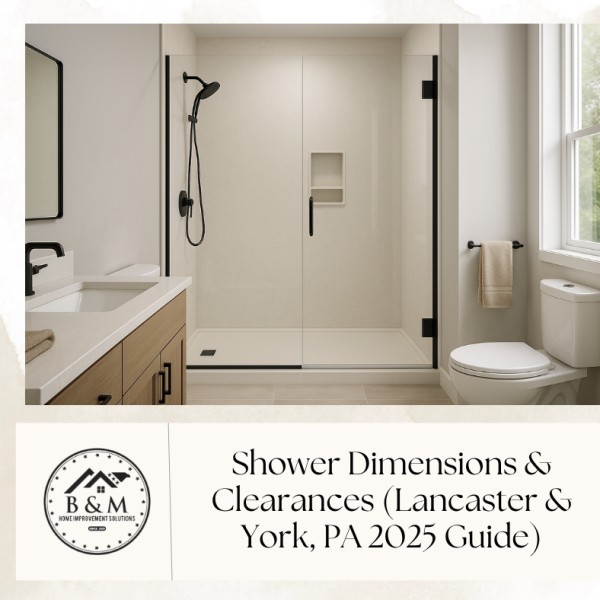
Walk-In Shower Dimensions & Clearances (Lancaster & York, PA 2025 Guide)
Focus audience: Homeowners in Lancaster County and York County planning a bath remodel or tub-to-shower conversion.
What you’ll learn: Practical walk-in shower dimensions and clearances for comfort, safety, and inspection success—plus layout tips, door choices, bench and niche sizing, grab-bar planning, waterproofing basics, glass options, and sequencing. We also include local context, vendor notes (Hajoca, Basco/custom glass), and a step-by-step path to a clean build.
The Homeowner Problem (Localized)
Older Central PA baths weren’t designed for today’s needs: narrow tubs, cramped alcoves, leaky surrounds, slippery floors, and awkward door swings. When you switch to a walk-in shower in Lancaster or York, you want three things:
a layout that feels roomy,
passes inspection, and
stays watertight for the long haul.
This guide gives you the numbers and nuances we use in design reviews, so you can plan confidently, minimize surprises, and get a stunning result.
New here? See exactly how we manage design, permits, daily updates, and QC in How We Work (SOP).
Solutions & Options Overview (What Type of Walk-In?)
Alcove walk-in: Three walls, glass at the front (door or fixed panel). Fastest conversion from a standard tub.
Corner walk-in (neo-angle or 2-wall): Great in tight rooms; glass does more of the visual work.
Curbless (zero-threshold): Best for accessibility and sleek design. Requires subfloor planning and precise slope.
Low-curb shower: A practical middle ground that controls splash and keeps build simple.
Surface options: Solid-surface (e.g., Samuel Mueller) for speed and easy cleaning; porcelain tile for custom aesthetics; stone/quartz slabs for ultra-premium.
Glass options: Basco stock lines (sliding/pivot) or custom frameless panels/doors to fit your final opening.
For quick, low-maintenance projects, many Lancaster/York homeowners choose solid-surface wall systems and a matched pan, then finish with Basco or custom frameless glass. For a deeper dive on wall materials, compare Solid Surface vs. Acrylic Shower Walls and Onyx vs. Samuel Müller.
Must-Know Dimensions & Clearances (Field-Tested)
These are best-practice targets we use in Central PA homes. Your final plan must comply with local code and inspection notes; we prepare permit-ready drawings for that.
1) Interior footprint & feel
Absolute minimum interior most people can tolerate: 30″ × 30″ (tight).
Comfortable minimum for everyday use: 36″ × 36″.
Premium feel in an alcove: 36″ × 48″ or 42″ × 60″.
Linear walk-in with fixed glass (no door): Aim for 60″+ length with 24–30″ open entry, sized to control splash.
2) Door / entry opening
Clear opening for a hinged door: ≥ 22″ clear is the bare minimum many inspectors expect; 24–28″ feels better.
Sliding (bypass) door tracks can reduce needed swing space in tight baths.
No-door designs rely on longer stalls and smart head placement to avoid spray escape.
3) Curb or no curb
Low curb height: ~2″–3″ finished curb is typical; keep top of curb ~2″ above drain to manage splash.
Curbless: Requires floor recess or build-up to achieve ¼” per foot slope to drain; plan transitions at the bath floor and waterproof carefully.
4) Bench sizing (if included)
Seat height: 17″–19″ (chair-height comfort).
Seat depth: 15″ minimum, 16″–18″ feels better.
Width: The more the better for comfort; ensure it doesn’t choke the main aisle.
5) Niche placement
Typical center height: 48″–60″ above finished floor for bottles.
Bar soap niche: 40″–48″ (below main niche), away from direct spray.
Width/depth: Fit largest bottle + pump stroke; 12–16″ wide × 3.5–4″ deep common in tile; in solid surface, integrate shelves.
6) Valve & head locations
Valve height: 38″–48″ above finished floor is comfortable; offset so you can turn on water without stepping under the spray.
Shower head: 78″–84″ AFF (depending on height of users/ceiling).
Handheld on slide bar: Center 42″–48″ to reach seated and standing users.
7) Grab bars & future-proofing
Bar height (horizontal): 33″–36″ AFF is common.
Blocking: We add 2× blocking during rough-in at planned bar locations and hinge points for heavy glass—even if bars are “future.”
8) Splash control & drying
Keep 18–24″ from head to opening on no-door designs.
Use fixed glass panels to “shepherd” spray.
Add a squeegee hook and quiet exhaust fan to dry surfaces quickly.
Door & Glass Choices (Comfort, Safety, Cleaning)
Basco sliding (bypass): Saves clearance in small rooms; overlapping doors keep water in; easy entry width on 60″ alcoves.
Basco pivot/hinged: Clean look, wide access; needs swing clearance (plan against vanities/toilets).
Custom frameless: ⅜” tempered, precise reveals after the walls/pan are installed; ideal for curbless and large openings.
Fixed panel + walk-in gap: Minimal hardware, spa look; requires a longer stall and smart head placement.
Hardware finishes: Coordinate with valve trim; support hinges/handles with in-wall blocking.
For more on doors, see Custom Shower Doors (Lancaster & York).
Materials & Waterproofing (What Actually Keeps It Dry)
Solid-surface surround + matched pan: Fast, grout-free, easy to clean; seams are silicone-sealed on a flat backer.
Porcelain tile: Unlimited looks; needs competent waterproofing (membranes, pans, corners).
Slab (stone/quartz): Minimal seams with premium feel; requires careful fabrication/handling.
Backer & blocking: ½” moisture-resistant board or plywood behind panels; blocking for grab bars and glass hinges.
Sealants: High-quality, mildew-resistant silicone at all seams and pan junctions.
Ventilation: Size the bath fan for real-world cubic footage; aim for quiet (low sones) so it’s used daily.
We source plumbing trim, valves, pans, drains, and accessories through Hajoca (Lancaster); glass via Basco or custom fabricators, depending on the opening.
Layout Scenarios (What Works in Central PA Baths)
Standard 60″ alcove tub → walk-in
Best bet: 60″ x 32–34″ pan with sliding (bypass) doors.
Premium option: 60″ x 36–42″ pan with hinged door and fixed panel.
No-door: 60″ stall can work with a large fixed panel and head aimed away from entry, but splash risk rises—plan wisely.
Narrow city bath
Consider a neo-angle or pivot door with tight swing control.
Keep vanity pulls/handles from clashing with door swings.
Use lighter finishes and task lighting to expand the feel.
Primary suite upgrade
Go curbless with custom frameless glass.
Add bench + handheld; integrate niches on the dry wall.
Dial in lighting scenes (task + ambient + night path).
Step-by-Step Considerations (Planning to Punch List)
Discovery & measurements – We confirm wall straightness, ceiling height, and door/path constraints.
Selections at Hajoca – Valve/trim finish, head/handheld, drain cover, and any accessories.
Wall system – Solid surface (fast and grout-free) vs tile/slab (custom look).
Glass plan – Basco (stock) vs custom frameless (measure after walls/pan).
Blocking & backer – We add framing for future bars and heavy hardware, plus flat backer for panel adhesion.
Waterproofing details – Corners, penetrations, and pan-to-wall transitions matter most.
Ventilation & lighting – Quiet fan, bright task lighting, dimmable ambient, and a night-light path.
Inspection & close-out – We host inspectors (if required), deliver photo logs, and review care tips.
Curious how we manage it all with zero drama? Read our SOP.
Cost & ROI (Local Context)
Alcove conversion with solid-surface & stock glass: Works well for value, speed, and low maintenance.
Curbless with custom frameless: Adds labor for floor re-build and lead time for glass; delivers a luxury feel.
Value drivers: Subfloor condition, plumbing moves, custom glass, bench/handheld, and tile vs solid-surface choices.
For budget planning, pair this with How Much Does a 2–3 Day Shower Replacement Cost (2025)?
Common Mistakes We Fix
Door collisions with vanities or toilets (hinge side planned wrong).
Too-short stalls in no-door designs (constant splash).
No landing shelf near the valve for razors/bottles.
No blocking for bars or glass (hardware pulls out over time).
Under-ventilated baths (moisture lingers, finishes age quickly).
Uneven walls that cause glass fit and panel seam headaches.
Next Steps / CTA
If you’re in Lancaster, York, or Central PA, we’ll measure your space, confirm walk-in shower dimensions and clearances, and produce permit-ready drawings. Choose Design-Build (our designer + project manager) or Build-Only with your plans. Either way, you’ll get fixed-price clarity after design lock, daily updates, and a clean jobsite.
Explore installation paths: How We Work (SOP)
Compare wall systems: Solid Surface vs. Acrylic
See timing & budget: 2–3 Day Shower Replacement Cost (2025)
FAQs: Walk-In Shower Dimensions & Clearances
We recommend 36″ × 36″ as a comfortable minimum; 30″ × 30″ is tight and best avoided if space allows.
Shoot for 24–28″ clear. Many inspectors accept ≥22″ clear as an absolute minimum; wider is safer and more comfortable.
Not always. Curbless looks great and improves accessibility but needs subfloor planning and slope. A low curb (2–3″) is simpler and controls splash.
Place it where you can reach it without standing under the spray, usually 38–48″ high and offset from the head.
17–19″ high and 15–18″ deep. Keep bench edges softened and out of the main traffic line.
Most homeowners like 48–60″ to center, with a lower soap niche around 40–48″.
Yes—we add blocking during rough-in where bars may go. That way you can install now or later with solid anchorage.
Sliding (bypass) saves space; pivot needs swing clearance; custom frameless fits any final opening perfectly.
Not if the stall is long enough, the head is aimed away from the opening, and a fixed panel is used to guide spray.
Flat, solid backer; proper membranes or solid-surface seams; premium silicone at changes of plane; and a quiet fan to dry moisture.