

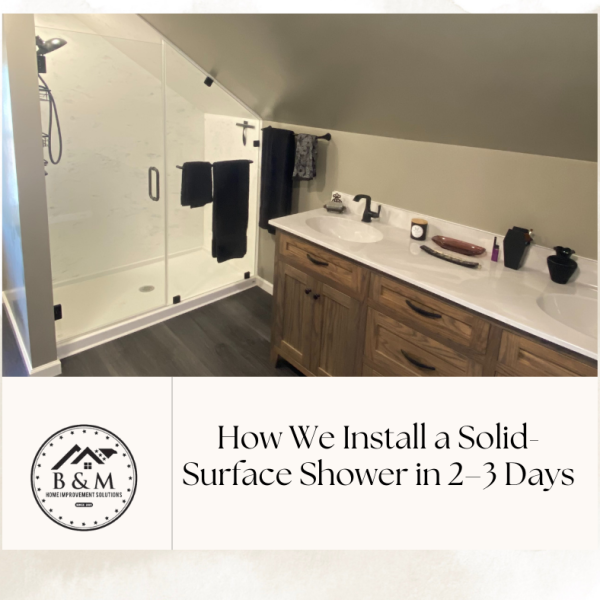
How We Install a Solid-Surface Shower in 2–3 Days (and Why It Lasts)
Last updated: September 2025 • Serving Lancaster & York County, PA
Most homeowners feel stuck right here: “Where do I even start? Who can I trust? And how do I know the price is fair?” This guide shows, in plain English, how a solid-surface shower replacement actually happens—from jobsite protection to final caulking—so you know what to expect, what “right” looks like, and where quality (not shortcuts) shows up in the price.
If you’re still deciding which system to choose, compare materials here: Solid-Surface vs. Tile Showers (Lancaster). For budget ranges and timeline factors, see Shower Replacement Cost in Lancaster, PA. If you’re vetting contractors, bring this list from our Bathroom Remodel Contractor Guide to your estimates.
What We’re Installing (and Why Homeowners Love It)
Solid-surface wall systems are engineered, non-porous panels that look like stone but don’t have a grout grid to maintain. They come as large format panels with matched trim and inside-corner moldings. Key benefits:
Fewer joints → fewer places to fail.
Non-porous → wipes clean; no grout sealing.
Predictable install → often 2–3 days once materials are on site.
Great fit for older Lancaster & York homes where walls are rarely perfect.
Safety & Jobsite Prep (Before Any Panel Goes Up)
What you’ll see us do when we arrive:
Protect the home
Floor runners, door jamb protection, and dust containment. Daily clean-up is part of our routine—we treat your home like it’s ours.Power, venting & PPE
Cutting solid-surface requires dust control and ventilation. We wear eye/ear/respiratory protection and run collection at the cut station. The manufacturer also stresses working in a well-ventilated area and using approved dust protection when cutting or drilling.Electrical & plumbing awareness
We verify shut-offs, test for live circuits before drilling, and keep water away from cords and tools (GFCI-protected).Grab-bar planning
If you want grab bars now—or later—we add blocking in the walls so bars can anchor into structure (never just the panel).
Substrate Matters (This Is Where Leak Prevention Begins)
Panels don’t go straight onto studs. Behind every long-lasting shower is a prepared, dry, plumb, and primed wall:
Acceptable substrates include ½” moisture-resistant drywall (greenboard), marine-grade plywood, or cement board—installed dry and plumb. Only install over clean, sound surfaces (never over damp or moldy walls).
When installing over plaster, concrete, old tile, wallpaper, or masonite, the wall must be sealed with a water- or oil-based primer/sealer so the silicone can bond, and may require additional silicone to achieve full contact.
Mind the base lip: we hold the wallboard ½” above the shower base side lip to prevent wicking—then bring the finish face to the front edge of the base for a clean line.
Our added QC: we correct for plumb/flatness before panels go up. If a wall is bowed, we plane/sister studs or skim as needed. Trying to “force” a panel to a bowed wall is a recipe for a poor bond and stress cracks.
Adhesives: Why We Don’t Use Screws (Ever)
Solid-surface panels are bonded with 100% silicone, not mechanical fasteners. No nails, no screws—just silicone—and the manual is unequivocal about it.
We use clear 100% silicone (manufacturer-approved) and follow the panel maker’s pattern and coverage. Specifically:
Clean the back of each panel with denatured alcohol or another non-oil-based cleaner before bonding.
Apply silicone in 1¼-inch “dot” beads every 8–10 inches across the entire back of the panel. This produces even contact and allows curing.
Ventilation during and after silicone application is important (fume hazard noted).
Day-by-Day: The 2–3 Day Solid-Surface Install
Day 1 — Protection, Demo, and Substrate Correction
Demo the existing surround in a controlled way (we keep the path protected and haul debris out each day).
Inspect studs, subfloor, and previous penetrations.
Rough-in & blocking: adjust valve height/centering, add blocking for doors/benches/grab bars.
Sheath with ½” moisture-resistant board (or confirm existing acceptable substrate); prime/seal when required by surface type. Hold board ½” above base lip.
Plumb & flat: correct framing so panels sit true.
Layout & scribe: dry fit panels, scribe to walls, and mark the centerline of the back panel so cutouts the next day land perfectly. The manual details measuring from the back wall and ledge for accurate plumbing cut-outs.
Homeowner tip: You’ll see us take lots of measurements and draw reference lines. This is time well spent—the clean, “seamless” look you want is born here, not in the last hour.
Day 2 — Cutting, Dry-Fitting & Bonding Panels
We cut with a 60–80 tooth carbide blade (or bi-metal sabre saw) and mask the finished face to avoid marring.
Back panel first
Confirm the shower base is square to the walls; if out of square, we mark a level line around the alcove and trim the panel bottoms to follow the base contour so the bottom seam is tight.
Transfer measurements (left and right) from the centerline to each wall, then transfer to the panel; this ensures the panel matches the exact wall contour.
Dry-fit and make adjustments; do not try to bend a panel into a bowed wall.
Side panels
We scribe side panels to the back panel for a true 90° corner; precisely scribing/cutting produces clean corners without needing a cover molding (though the system supplies them if used).
Drill plumbing cutouts from the finished face with a hole saw/router and a sacrificial backer for clean edges (as instructed).
Bonding
Clean backs with denatured alcohol, then run the 1¼” silicone dots every 8–10″. Set back panel → left → right, pressing across the entire field to ensure contact.
Temporary bracing is critical: we wedge gentle 2×4 braces to hold panels until the silicone cures (about 24 hours). The manual shows where braces go and to remove them after curing.
Homeowner tip: Bracing isn’t about “holding something that wants to fall”—it’s about guaranteeing full, even contact while silicone cures. That’s what makes panels feel like stone when you knock on them.
Day 3 — Corners, Finishing, Caulking & Glass
Inside corners (if we use the supplied moldings):
Measure and cut, then run a ⅛”–¼” bead of silicone on the back in an S-pattern and press into place; tape until cured.
Final caulking
We run 100% silicone at all inside seams and at the exterior edges (non-paintable). Follow cure times on the tube—don’t use the shower until cured.
Accessories & glass
For accessories, pilot holes slightly larger than fasteners (so hardware doesn’t stress the panel), and 100% clear silicone under/around penetrations to seal to the wall.
Glass may be stock or custom; custom doors are often templated after panels set and installed when ready. We verify door swing and clearances during design so you don’t learn the hard way on install day.
Homeowner hand-off
We water-test, review care, give you the adhesive cure window, and add the project to our warranty tracker. The manufacturer warranty covers products installed per their instructions (we keep your documentation on file).
What We Do That Cheap Bids Skip (and Why It Costs Less Up Front)
When bids are far apart, it’s usually one of these shortcuts:
No substrate correction → panels “rock” on the wall, seams telegraph, or corners open.
Thin adhesive coverage (or random bead patterns) → hollow spots that echo and can fail; We ensure intentional bonding occurs.
No bracing → poor contact as silicone skins; we brace per the manual for 24 hours.
Unsealed penetrations → water finds the path; we use 100% silicone behind any accessory fastener and around valving.
No documentation → if there’s ever an issue, you’re on your own. We photograph behind-the-wall conditions, record models/serials, and store your care/warranty docs.
Homeowner’s Visual Checklist (What “Right” Looks Like)
Use this as you walk the bathroom with any installer (including us):
Walls plumb and flat before panels go up; blocking installed where needed.
Backs of panels cleaned with denatured alcohol before adhesive.
1¼” silicone dots every 8–10″ over the full panel field; not just perimeter beads.
Braces installed to hold panels in full contact 24 hours; removed after cure.
Inside corners sealed (with or without molding) and all seams caulked in 100% silicone; exterior edges sealed too.
Penetrations sealed and any accessory fasteners piloted/slightly oversized; silicone under/around hardware.
Care briefing: cleaners to use (no oil-based cleaners; wipe down, rinse), cure time before first use, and warranty file.
Cleaning & Care (Exactly What to Use)
Daily/weekly: wipe with a clean towel and mild household cleaners compatible with solid-surface (e.g., non-abrasive options). Always rinse within five minutes of application. Do not use oil-based cleaners or sprays that require time-to-work without immediate rinsing (some products can react with the finish).
Caulk inspection: monthly, look for hairline gaps or separation. Re-caulk any joint showing wear; neglecting caulk maintenance can void warranties.
Tip: Replace your squeegee as soon as it nicks—scratched silicone lines from a rough blade are the #1 culprit behind early mildew streaks.
Timeline: Why “2–3 Days” Is Realistic (and When It Isn’t)
It is 2–3 days when:
Plumbing stays in the same location, framing is sound, you pick a standard door, and we’re using matched solid-surface panels and pan.
It extends when:
We discover hidden damage (rot, prior leaks).
You choose custom glass (template-to-install lead time).
The room needs reframing or ventilation upgrades (we advise them when the inspector would require it or experience suggests it’s smart).
Either way, you’ll get a schedule with real dependencies (not wishful placeholders) before we start.
Hiring Confidently (Even If You Don’t Pick Us)
Ask each contractor:
“What adhesive pattern will you use?” → Listen for 1¼” dots every 8–10″ across the panel.
“Will you brace for 24 hours?” → If not, why not?
“How do you handle penetrations and accessories?” → Look for pilot holes and 100% silicone behind/around hardware.
“How do you prepare plumb/flat walls and keep an even reveal?”
“What is the care routine you recommend?” → They should mention no oil-based cleaners and prompt rinsing.
“Can I see your rough-in and finish checklists and a sample daily update?”
Good installers are happy to show their process—it protects you and them.
Why Premium Pricing Makes Sense (Where the Money Goes)
Time on substrate: correcting out-of-square corners so seams are tight.
Coverage and cure discipline: enough adhesive, correct pattern, and bracing—no shortcuts.
Documentation & support: photo logs, serial numbers, care sheets, and a service line that actually answers.
Warranty that means something: manufacturer warranty assumes correct installation and maintenance; we align to that standard and back our labor.
When you pay for craftsmanship up front, you’re buying fewer headaches later.
FAQ
Can you go over existing tile?
Often yes, if it’s sound, clean, and properly primed/sealed; we add silicone where needed to ensure full contact and may add filler boards where old tile doesn’t reach full height.
Why not nail the panels so they “never move”?
Because mechanical fasteners can crack panels or puncture waterproofing. This system is designed to bond with 100% silicone—no nails/screws.
How long until we can use the shower?
After final silicone cures per the tube (we’ll tell you the exact hours), typically after the 24-hour brace period is complete.
What if we want a bench, grab bars, or niche?
We plan blocking and penetrations during rough-in and seal everything during finish. Grab bars must anchor to structure, not just the panel.
Next Steps
Want to see real numbers and timelines? Start here: Shower Replacement Cost—Lancaster, PA
Still comparing materials? Read Solid-Surface vs. Tile Showers
Ready for a measured, line-item estimate? Contact B&M Home Improvement Solutions—we’ll bring sample panels, map your layout, and give you a clean schedule.
SEO Pack (optional for your editor)
Focus keyphrase: solid-surface shower installation
Synonyms: install solid-surface shower; 2–3 day shower replacement; shower wall panel installation; Samuel Mueller shower install
Slug:
solid-surface-shower-installation-lancasterMeta title (≤58): Solid-Surface Shower Installation | 2–3 Day Process (Lancaster)
Meta description (≤155, includes keyphrase): Solid-surface shower installation in Lancaster & York: see our 2–3 day process, adhesive pattern, bracing, and final caulking so your new shower lasts.
Notes on the manual we used
Adhesive + no nails: 100% silicone, no nails/screws.
Surface types & primer/sealer: acceptable substrates; sealing requirements for plaster, concrete, tile, wallpaper, etc.
Dot pattern & panel prep: clean with denatured alcohol; 1¼” dots every 8–10″.
Bracing: wedge braces kept ~24 hours for full contact while silicone cures; then removed.
Seams/edges & accessories: final 100% silicone at inside seams and exterior edges; pilot holes; silicone under/around hardware.
Care: compatible cleaners, rinse within five minutes, no oil-based cleaners; inspect caulk regularly.
Warranty: applies when products are installed per instructions.
If you’d like, I can convert this into a printable homeowner handout (one-page checklist) and an on-site “what to expect” email template you can send the week before each project.
FAQ – Frequently Asked Questions.
Quick answer yes, if it’s sound, clean, and properly primed/sealed;
9/10 times we advise to do full replacement of the wall systems to know you have a solid substrate for your new shower to perform optimally.
Because mechanical fasteners can crack panels or puncture waterproofing. This system is designed to bond with 100% silicone—no nails/screws. These Panels should never have exposed Fastners.
After final silicone cures per the tube (we’ll tell you the exact hours), typically after the 24-hour brace period is complete.
We plan blocking and penetrations during rough-in and seal everything during finish. Grab bars must anchor to structure, not just the panel.
Tile showers offer extensive design customization and timeless aesthetics but require significant maintenance, especially for grout. Solid surface showers are low-maintenance, non-porous, and grout-free, but they provide fewer design options and can be more prone to scratches than tile. Choose tile for ultimate customization and budget flexibility, or opt for solid surface for superior ease of cleaning and faster installation.
The Cost of a Solid surface Shower is discussed 2-3 day Shower Guide – Solid Surface Shower