

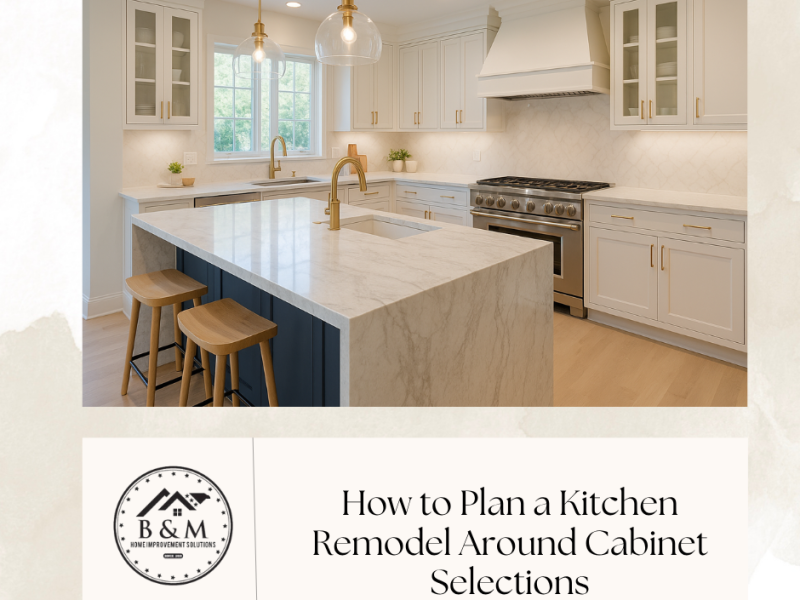
How to Plan a Kitchen Remodel Around Cabinet Selections
Planning a kitchen remodel starts with choosing the right cabinetry. Cabinets define your kitchen’s style and layout, provide essential storage, and significantly impact your budget and timeline. In residential kitchens, cabinets come in several types – stock, RTA (ready-to-assemble), semi-custom, and custom – each with its own advantages. This comprehensive guide will walk you through every detail of these cabinet options, standard cabinet dimensions, and professional layout planning tips. By understanding your cabinetry choices, you can plan your kitchen remodel more effectively and create a beautiful, functional space that fits both your needs and budget.
Types of Cabinets: Stock, RTA, Semi-Custom, and Custom
When remodeling a kitchen, selecting the type of cabinets is one of the first big decisions. Cabinet types range from off-the-shelf models to fully bespoke creations. Let’s break down what each category means and how it can influence your kitchen design:
Stock Cabinets (In-Stock Cabinets)
Stock cabinets are pre-manufactured cabinets in standard industry sizes and styles. They are mass-produced and ready for quick installation, often available immediately or within a few days of ordering. Because they are pre-built to common dimensions, stock cabinets offer limited choices in door styles, finishes, and sizes – this is how they keep costs low. Typically, stock lines come in fixed increments (usually 3-inch width increments and set heights) and a handful of colors or wood species. You might find them at big-box stores or kitchen suppliers. Some stock cabinets come pre-assembled, while others are sold in ready-to-assemble (RTA) form (more on RTA below).
Pros: Stock cabinetry is usually the most affordable option and has the shortest lead time. If you’re on a tight budget or timeline, stock cabinets can be a great choice – they are often available off the shelf or delivered within days. Modern stock cabinets can still be decent quality, especially if you look for features like all-plywood box construction and soft-close hardware. Installation can be DIY-friendly for those with skills, further saving cost.
Cons: The biggest limitation is lack of customization. With stock cabinets, you’re restricted to standard sizes and a small range of styles/finishes. This means your design has to adapt to the cabinet sizes available, rather than the other way around. You may need to use filler panels to fill gaps, since stock cabinets come in set widths and may not perfectly fit wall-to-wall in your space. Quality can also vary widely – some stock lines use particleboard and thin veneers to cut costs, so you have to choose carefully. In short, stock cabinets offer no design freedom beyond the catalog choices.
Cost (High-Level): Stock cabinets are the least expensive category. Prices generally range around $60 to $200 per linear foot for the cabinets themselves. (A “linear foot” includes the cabinets that would fill a 12-inch width of floor or wall space.) For an average kitchen (say 20 linear feet of cabinets), stock cabinetry might cost roughly $3,000–$8,000 for the cabinet materials. Keep in mind this is a broad range – opting for premium stock lines or special finishes will hit the higher end. (It’s wise to budget on the high side to avoid surprises.) Installation is usually not included in stock cabinet pricing, so if you’re not installing them yourself, remember to account for labor costs too.
RTA (Ready-to-Assemble) Cabinets
RTA cabinets are essentially a subset of stock cabinets that come unassembled, typically flat-packed in boxes. Many budget-friendly cabinet lines (and virtually all IKEA kitchen cabinets) are sold as RTA. Instead of receiving a pre-built cabinet box, you get all the parts (panels, hardware, etc.) and assemble the cabinets on site. This DIY aspect can save money – RTA products often cost less because you’re shouldering the assembly labor. RTA cabinets are widely available online and through some retailers, with quick shipping times.
Pros: RTA cabinets are usually very economical – often among the cheapest ways to get new cabinets, because you aren’t paying for factory assembly. They can be a good option for skilled DIYers or contractors comfortable with building cabinets. Quality can be decent if you purchase from a reputable RTA supplier; some offer plywood construction and solid wood doors at affordable prices. Another pro is that RTA options online have proliferated, so you can find a surprising variety of styles and sizes beyond what local stores stock.
Cons: The flip side of savings is the time and effort of assembly. If you’re going the RTA route, be prepared to spend hours assembling dozens of cabinet boxes (or budget to pay a contractor or handyman to assemble them). Mistakes in assembly can affect the durability and alignment of the cabinets. Additionally, material quality is often lower in RTA lines – many use thinner materials, cam-lock or bracket construction, and inferior finishes to keep costs down. RTA cabinets will work for a basic kitchen on a tight budget, but they may not have the longevity or premium feel of semi-custom or custom cabinets. Finally, because they share the same standard sizes as stock cabinets, RTA products have no custom sizing either. You’ll still be working with standard widths and might need fillers to make the layout fit your walls.
Cost: RTA cabinet costs are comparable to regular stock cabinets, or even cheaper. Expect roughly $60 to $150 per linear foot for many RTA lines, depending on the brand and materials. Even after factoring in assembly supplies and extra hardware, RTA often remains one of the most budget-friendly options for cabinetry. Just remember to budget either your own time or a labor cost for assembly when comparing to pre-assembled cabinet prices.
Semi-Custom Cabinets
Semi-custom cabinets are a mid-range option that offers a balance between the limited choices of stock and the “anything goes” approach of custom. These cabinets are made to order by larger manufacturers, and come in standard sizes with the ability to modify certain dimensions or details. With semi-custom, you typically can choose from a wider array of door styles, finishes, and storage features than stock. You also can get modifications such as increased depth, different width increments, or added organizational accessories, depending on the manufacturer. Essentially, semi-custom lines let you personalize the design within a defined set of parameters – giving you a tailored kitchen without the full custom price tag.
Pros: You get some design freedom without paying for completely bespoke cabinets. Semi-custom cabinets often allow adjustments in 1-inch or 3-inch increments (e.g. you might order a 27″ wide cabinet instead of just 24″ or 30″). You can usually pick from many more finishes and door styles than stock lines offer. Quality is generally higher than basic stock – semi-custom cabinets are usually built sturdier and with better materials because they target the mid-to-high-end market. Many semi-custom manufacturers use all-plywood construction, hardwood faces, and offer upgrades like dovetail drawers and soft-close glides as standard. They also often come fully assembled from the factory (not flat-pack), which ensures a solid build. Because semi-custom cabinets are made per your order, you’ll often work with a kitchen designer or the cabinet supplier to plan your layout, giving a more personalized experience (often with professional guidance included).
Cons: Semi-custom cabinets are more expensive and have longer lead times than stock. You’re paying for better construction and the ability to tweak sizes or styles, so costs land in the middle-to-upper range for cabinetry. The variety of options, while great, can also be overwhelming and can extend the planning phase. It’s important to note that each manufacturer’s semi-custom line has its own limits – one brand might let you adjust width to the 1″, another only in larger steps. Some semi-custom lines still won’t solve unusual design challenges; you might find certain configurations (like a very specific angled cabinet or an exact match to a color sample) that they can’t do. Also, while semi-custom quality is generally high, it can vary by manufacturer – you’ll want to choose a reputable brand. Finally, the production time is longer: expect several weeks lead time (often 4–8 weeks) since these cabinets are built to order.
Cost: Semi-custom cabinets are priced in the mid-range, roughly $300 to $600+ per linear foot depending on the brand and options. Industry sources put typical semi-custom pricing around $300 to $1,100 per linear foot encompassing the broadest range from basic semi-custom up to near-custom quality. To put it in perspective, a 20-linear-foot kitchen might invest $6,000 to $22,000 or more on semi-custom cabinetry. This is a wide range because of the many choices available – exotic wood finishes, special glaze techniques, or lots of custom storage inserts can drive the price to the upper end. If you only need a few modifications from stock (say, extra tall wall cabinets or a non-standard depth), semi-custom can be very cost-effective. But if you try to add too many custom features, the price may approach or exceed fully custom cabinets. Always compare quotes; in some cases a long list of semi-custom add-ons ends up costing more than a local custom cabinet shop would charge for the same layout.
Custom Cabinets
Custom cabinets are built from scratch to your exact specifications. Going custom means no limitations on dimensions, style, or materials – the cabinets will be completely tailored to your kitchen’s layout and your design vision. Custom cabinetry is typically made by local or regional cabinetmakers (or high-end national brands) who will often work closely with you or your designer. When you opt for custom, you start with a blank canvas: you can choose any wood species or material, any finish or paint color, any door style, and specify exact dimensions to fit every nook of your space. Oddly shaped kitchen corner? Want cabinets that reach an 10-foot ceiling with no soffit? Desire a unique stain color to match an heirloom table? Custom makes it possible. With custom cabinets, skilled craftsmen build each unit to order, often with furniture-grade joinery and meticulous attention to detail.
Pros: The primary advantage is total design freedom. Custom cabinets can maximize every inch of a kitchen, yielding zero wasted space and no filler strips unless you want them. You can get specialty cabinets that stock lines don’t offer – say a built-in plate rack, sliding spice columns, or an appliance garage with pocket doors – integrated seamlessly into the design. The quality of custom cabinets is often superb: you’re usually getting top-tier materials and construction, since reputable custom shops build to high standards (and their reputation depends on it). Features that might be upgrades in semi-custom (like all-plywood boxes, or full-extension soft-close drawers) often come standard in custom builds. Another pro is the personalized service – custom cabinetmakers (or custom lines through kitchen design studios) typically include design consultation, detailed drawings, and installation as part of the package or available services. This means you have an expert guiding the process, and the cabinets will be installed correctly to look and function their best. Aesthetically, custom cabinets often have a refined, furniture-like look – with options like inset doors, intricate moldings, or distressed finishes that mass-produced lines can’t fully replicate. For high-end kitchen remodels or historic home renovations, custom cabinetry provides an uncompromising fit and finish.
Cons: The obvious downside is cost. Custom cabinetry is the most expensive option, and for good reason – you are paying for individual craftsmanship and nearly unlimited choices in materials. Lead times are also longest: since nothing is built until you finalize the design, it can take several weeks to a few months for custom cabinets to be constructed and finished. This requires careful planning so that the kitchen remodel doesn’t start (or the old kitchen isn’t demo’d) too early. Another consideration is that not all custom shops are equal – “custom” simply means non-standard, so quality can range from a lone carpenter building in his garage (perhaps not using the best techniques or finishes) up to elite cabinetmakers with state-of-the-art facilities. Do your homework and choose a reputable custom cabinet source so you truly get top quality for the price. Lastly, because custom is a very personalized process, it often requires more of your time up front – you’ll be making many decisions on design details, and you might have multiple meetings to nail down the plans and review drawings or samples. It’s a fun process for many homeowners, but it is more involved compared to picking from a catalog.
Cost: Custom cabinets will almost always cost more than stock or semi-custom – how much more depends on your choices. It’s hard to pinpoint an average, but custom cabinetry often ranges from about $900 up to $2,000 (or more) per linear foot for high-end work. For example, a custom kitchen of 25 linear feet could easily run $20,000 to $50,000+ for the cabinetry, depending on materials and complexity. In some luxury kitchens, the cabinets alone might be six-figure investments. That said, there is a huge spectrum: a small local shop might build simple Shaker-style custom cabinets for less than a fancy semi-custom brand, especially if expensive finish upgrades are added to the latter. But as a safe guideline, plan for custom cabinetry to be at least 2-3 times the cost of equivalent stock cabinets. We prefer to give high-end ballparks, so clients aren’t surprised – it’s not unusual for custom kitchen cabinets to total tens of thousands of dollars. The upside is that you are getting exactly what you want, and high-quality custom cabinets can last for decades, potentially adding value to your home as well.
Which Should You Choose?
Choosing between stock, RTA, semi-custom, and custom will come down to budget, timeline, and desired customization. If you have a tight budget or need a quick remodel, stock or RTA cabinets may be the best fit. If you want a personalized look and better quality but without breaking the bank, semi-custom is a popular middle ground. And if you have specific design requirements or are aiming for a premium kitchen makeover, custom cabinetry is the way to go for a perfect fit. Many homeowners fall somewhere in between – for instance, using semi-custom cabinets for the main kitchen, but getting one or two custom pieces (like a custom range hood or island) to elevate the design.
Our Services: In our remodeling projects, we offer cabinetry from all these categories. We partner with local suppliers and manufacturers so our clients can find the perfect cabinets for their needs. For example, we work with Lezzer Lumber design centers, which carry lines like Wolf, Wellborn, and Yorktowne cabinets – these brands cover excellent stock and semi-custom options. We also source from GR Mitchell, which offers Marsh, Yorktowne, Wolf, and Bertch cabinetry – a mix of value-friendly lines and high-quality semi-custom lines. And for those seeking one-of-a-kind cabinets, we collaborate with Red Rose Cabinetry, a custom cabinet manufacturer based in Lancaster County known for their craftsmanship for over 35 years. This wide range of offerings allows our clients to compare styles and pricing across the spectrum – whether they want a quick makeover with in-stock cabinets or a truly custom dream kitchen, we can accommodate it.
Standard Cabinet Dimensions (Sizes for Wall, Base, and Tall Cabinets)
Understanding standard cabinet sizes is crucial for planning your kitchen layout. Cabinets come in a range of standard dimensions that modularly fit together. Knowing these typical sizes will help you envision how cabinets fill the space and where you might need adjustments or fillers, especially if you’re using stock or semi-custom lines. Here we’ll cover the common dimensions for base cabinets (the lower cabinets that sit on the floor), wall cabinets (the uppers mounted on the wall), and tall cabinets (pantry or oven cabinets). All references are for residential kitchen cabinets (the focus of our planning):
Base Cabinets: These form the foundation of your kitchen layout – they sit on the floor and support your countertops. Standard base cabinets are 34.5 inches tall without the countertop, and about 36 inches tall once you add a standard countertop thickness (1½” to 2″). The height includes a recessed toe-kick at the bottom (typically ~4″ high), which gives space for your feet as you stand at the counter. Base cabinets have a standard depth of 24 inches (front to back) not including the countertop overhang. In tighter spaces or on the back side of an island, shallower base cabinets (like 12″ or 18″ deep) can be used – these are often achieved by using wall-cabinet boxes or special order cabinets. Widths for base cabinets generally range from 9 inches up to 36 inches per cabinet, and they increase in 3-inch increments (common widths are 12″, 15″, 18″, 21″, 24″, 30″, 33″, 36″). For example, a typical sink base might be 33″ wide, a drawer bank might be 15″ or 18″, etc. Deeper specialty base cabinets like farmhouse sink cabinets or oven cabinets might be 27″ deep or more, but 24″ is the normal base depth for storage cabinets. In summary, a standard base cabinet is ~34½″ H x 24″ D, and comes in modular widths of 9″–36″.
Wall Cabinets (Upper Cabinets): Wall cabinets hang on the wall and are used for storing dishes, glassware, and pantry items. Standard wall cabinet heights are 30 inches, 36 inches, or 42 inches tall. Which height to use depends on your ceiling height and design preference. For instance, with an 8-foot (96″) ceiling, 42″ cabinets will typically run all the way to the ceiling (often topped with crown molding), whereas 30″ cabinets will leave a gap above (which could be open or have a soffit). A 36″ wall cabinet is often used with an 8′ ceiling when you plan to add a crown molding to just touch the ceiling (36″ + a few inches of crown = ~96″). Distance from countertop: Wall cabinets are usually mounted so there’s an 18-inch clearance above the countertop (this is an ergonomic and code consideration for workspace and appliance clearance). So, if you have a base cabinet + counter at 36″ high, the bottom of the wall cabinets typically starts at 54″ off the floor. Then a 30″ tall wall cab reaches 84″ high, a 36″ one reaches 90″, and a 42″ reaches 96″ (ceiling height). Wall cabinet depth is shallower than bases: the standard wall cabinet depth is 12 inches. This depth is deep enough for plates and glasses, but it keeps things within reach and ensures you don’t hit your head on a cabinet that’s too deep. There are exceptions: for example, cabinets above a refrigerator or a microwave cabinet over a range are often 24″ deep so they align with the appliance depth. Some semi-custom lines also allow 15″ or 18″ deep wall cabinets for extra storage or to accommodate large platters. Wall cabinet widths generally mirror base cabinets: they come in 9″ to 36″ widths in 3″ increments as well. Standard wall cabinets are often 12″ wide for a single-door unit up to 36″ for a double-door unit. In summary, standard wall cabinets are 12″ deep (except special cases), commonly 30″, 36″, or 42″ tall, and come in widths from 9″ to 36″.
Tall Cabinets (Pantry or Utility Cabinets): Tall cabinets are the vertical pantry units or oven cabinets that can extend from the floor almost to the ceiling. Not every kitchen has a tall cabinet, but they are popular for pantry storage or housing wall ovens and microwaves. Standard heights for tall cabinets are often 84 inches, 90 inches, or 96 inches. These correspond to ceiling heights and the other wall cabinet sizes (for example, an 84″ pantry lines up with the top of 30″ wall cabinets plus 18″ above counter = 84″). A 96″ tall cabinet would touch an 8′ ceiling. Tall cabinets usually have the same 24″ depth as base cabinets if they’re full-depth pantry units. Some pantry cabinets can be ordered 12″ deep as well (to act as a shallow broom closet or for tight spaces), but full-depth 24″ is common to maximize storage. Widths for tall cabinets can vary by manufacturer, but typical pantry cabinets range from 18″ wide up to 30″ wide, and oven cabinets are often 30″ or 33″ wide (to fit single or double ovens). We often use 24″ or 30″ wide pantry cabinets in designs as those provide significant storage. The interior of tall cabinets can often be configured with rollout shelves, trays, or other pantry accessories in semi-custom/custom lines.
Knowing these standard sizes helps you plan the cabinet layout so it fits your kitchen’s dimensions. For instance, if you have a 10-foot (120″) wall to fill with base cabinets and appliances, you might combine a 36″ base, a 33″ sink base, an 18″ trash pull-out, and a 33″ stove (which is not a cabinet but takes space) to approximate 120″ with some filler for adjustment. Because stock cabinets increment in set widths, sometimes you can’t get an exact fit – that’s where filler strips (1″ or 2″ wide pieces) come in to close small gaps and ensure everything lines up. Semi-custom lines might allow a 1″ increment to avoid a filler in that scenario, and custom of course would just make the cabinets whatever exact width needed.
Standard countertop height & spacing: As mentioned, base cabinets + counter usually end up around 36″ high, and the standard space between the countertop and the bottom of wall cabinets is 18″. This 18″ space is considered the minimum for practicality (to fit things like coffee makers or blenders on the countertop). You can adjust it slightly (some modern designs use 20″ backsplash height for more breathing room or to align with tile patterns), but 18″ is a safe norm. If you are tall or using the kitchen differently, these can be tweaked in custom designs. Also, if you plan to have a crown molding or decorative trim at the top of your wall cabinets, and you want it to meet the ceiling, you’ll choose the wall cabinet height accordingly: e.g., with an 8′ ceiling, use 36″ wall cabinets and a 3-4″ crown molding that touches the ceiling, or use 42″ cabinets with a simple riser or no crown for a full-height look.
In summary, understanding standard cabinet heights and depths allows you to visualize how your new kitchen will look and function. Most kitchens mix various units – base cabinets, wall cabinets, and perhaps a tall pantry – in these standard sizes. If your kitchen has unusual dimensions (say a 9.5′ ceiling or an odd corner), that might influence whether you go semi-custom or custom to get non-standard heights or angles. But for many remodels, even stock cabinets in these standard sizes can be arranged to create a functional design.
Planning Your Kitchen Layout (Tips from the Pros)
Once you’ve chosen the type of cabinets and learned the basic sizes, the next step is laying out your kitchen. Planning a cabinet layout is like putting together a puzzle – you have to consider how the pieces fit in the space and how the kitchen will be used. Here are some professional planning tips to help you design a kitchen that not only looks great but also works efficiently:
Start with Function and Workflow: Think about how you use your current kitchen and what could be improved. A classic guideline is the “work triangle” – the sink, refrigerator, and stove should form a reasonably spaced triangle to make cooking tasks flow well. But beyond that, consider zones for prep, cooking, and storage. For example, if you make smoothies every morning, you might plan a cabinet for the blender and glassware near the fridge (for easy access to fruits and ice). If you pack kids’ lunches, maybe a drawer for storage containers near the prep counter would be handy. Take stock of pain points in your old kitchen – say, if the only utensil drawer was right next to the range and caused traffic jams, you can plan for an extra narrow cabinet for utensils on the other side of the range. List your must-haves (like a spice pull-out, tall pantry, or deep drawers for pots) so these can be factored into the cabinet plan early. Remember, functionality must be planned before the cabinets are ordered to ensure your daily needs are met.
Use Standard Sizes Wisely: With the standard cabinet dimensions in mind, try to compose each wall of cabinetry to make the best use of space. In many cases, you’ll be balancing symmetry, storage needs, and the constraints of stock sizes. A pro tip: use the largest standard cabinets that make sense for your space to minimize filler and maximize storage. For instance, if you have a 30″ space for a base cabinet, a single 30″ cabinet (perhaps with a wide drawer and doors below) offers more usable space than two 15″ cabinets. Conversely, sometimes using two smaller cabinets is better if you want specific interior features (like pull-out trays) in separate sections. Corner areas often need special cabinets – you might use a diagonal-front corner cabinet or a blind corner unit with pull-out mechanism. Stock lines typically have a 36″ x 36″ Lazy Susan cabinet or a blind corner cabinet; semi-custom/custom lines offer more configurations. Plan for whatever your cabinet source provides to handle corners, and don’t forget filler space if using a blind corner (often at least 6″ of dead space is needed in one direction for clearance). If all this sounds complicated, don’t worry – this is where working with a kitchen designer or our team can be invaluable.
Consider Cabinet Elevations (Heights): Decide early how you want your wall cabinets to meet the ceiling. Do you prefer cabinetry that goes all the way up, or do you like the look of a gap or soffit above? From a storage perspective, taller wall cabinets (36″ or 42″ high) obviously give more space and avoid a dust-collecting gap. They are great for small kitchens where every inch counts. If you have very high ceilings (9 ft or more), an option is to add a second tier of cabinets on top (stacked cabinets) for a grand look and bonus storage for rarely-used items. This typically requires at least semi-custom cabinets for a good fit. On the other hand, if you like a classic look with a soffit or simply don’t need ceiling-height cabinets, 30″ uppers might suffice and could save cost. Just be sure the choice aligns with your ceiling height and that you cover or utilize any open space above appropriately. As one pro tip: if your kitchen is small, taking cabinets to the ceiling can make it feel taller and give you extra storage. In a very large kitchen, you might not want everything towering to the ceiling – some variation (like some glass-front display cabinets above and open space elsewhere) can add visual interest.
Ensure Enough Clearance: A functional layout also respects clearances and codes. Maintain at least 36 inches of walkway space in tight areas, and ideally 42-48″ in work areas for multiple cooks. Plan for appliance doors: for example, leave at least 15″ of counter space on the latch side of your fridge and oven if possible (landing space for items). Make sure the dishwasher isn’t right next to a corner where opening it blocks all traffic. If you have an island, ensure there’s sufficient room between the island and the perimeter cabinets – usually 42″ or more clearance is recommended so people can pass even if someone is working at the counter. For seating at a peninsula or island, be mindful that you need about 24″ width per stool for comfort, and an overhang of ~12″-15″ for knee room. These considerations affect how you place and size the cabinets supporting that counter overhang.
Don’t Forget the Details: It’s often the small details that distinguish a well-planned kitchen. Filler strips are one detail – these are thin strips of matching material used to fill gaps between cabinets or between a cabinet and a wall. They ensure doors and drawers have clearance to open fully without rubbing the wall, and they accommodate any small length adjustments. A professional layout will include fillers as needed (for example, a 107″ wall might use two 36″ cabinets (72″) and one 33″ cabinet (33″) totaling 105″, then use 2″ of fillers to reach 107″). Our advice is to always order a little extra filler material just in case – it can be trimmed to perfect the fit. Another detail: end panels or skin panels on cabinet sides that are exposed. Plan to finish off any exposed ends of cabinet runs with a decorative panel or matching veneer so the cabinets have a completed look. Also consider molding and trim – crown molding at the top of wall cabinets can elevate the design, and light rail molding underneath the uppers can hide under-cabinet lighting and give a polished appearance. If you want these, ensure the cabinet line you select offers matching moldings. Toe-kick drawers or base molding are other options; semi-custom and custom lines might offer integrated toe-kick storage or furniture base details.
Plan Around Appliances: Appliances have a huge impact on cabinet layout. Always start with your appliance specifications – especially for the refrigerator, range, wall ovens, and dishwasher – and ensure the cabinet plan accounts for their sizes. Standard dishwashers and ranges are 24″ and 30″ wide respectively, and they fit into the layout in place of a cabinet. Refrigerators vary widely (30″ to 48″ or more in width). Tall cabinets can sometimes house appliances; for example, if you want a built-in look for your fridge, you might use a tall panel or a cabinet above the fridge. For wall ovens or microwaves, you might have a oven cabinet or a microwave cabinet as part of the plan. Make sure to leave proper clearances: for instance, not cramming a tall cabinet too close to the cooktop where it could be a fire hazard (building code often requires some distance or a range hood cabinet layout). Also double-check the door swings: a fridge next to a wall should have a filler or a wider space so the door can open 90° without hitting the wall, which is needed to pull out drawers. These are the kinds of issues kitchen designers pay close attention to – and why working with a pro can save headaches.
Work with a Kitchen Designer or Use Design Services: Speaking of professionals – nearly all cabinet suppliers (from the big home improvement stores to custom shops) offer design services to help lay out your kitchen. It’s highly recommended to take advantage of this. Designing a kitchen is like solving a puzzle of dimensions and clearances, and an experienced designer can often find solutions or improvements you might not think of. For example, our cabinet partners provide design consultations; even some RTA cabinet companies will assign you a designer free of charge to map out your kitchen and ensure you have all the right pieces (including those easy-to-miss fillers, trim, etc.). A good designer will make sure your cabinet plan is functional, code-compliant, and fits the product’s specifications. They can also often render 3D views of your kitchen so you can visualize it beforehand. Even if you plan to DIY the install, getting a professional layout drawn up is a wise step. It can prevent costly mistakes like realizing too late that a drawer will hit your oven handle, or an important cabinet won’t fit through the door on delivery.
Timing and Ordering: Plan your timeline around your cabinet choice. Stock and RTA cabinets can often be obtained quickly – some in-stock cabinets even same-day, RTA in a week or two, which is great for fast projects. Semi-custom cabinets will typically require a lead time of a few weeks (often 4–6 weeks after you place the order, sometimes longer in peak seasons). Custom cabinets usually take the longest – it could be anywhere from 6 to 12+ weeks from final design approval to delivery, depending on the cabinetmaker’s schedule and the complexity of your project. What this means for your remodel is you should order cabinets early enough so they arrive when you need them. Many contractors will not start demolishing a kitchen until the new cabinets are on hand (especially with custom, to avoid having a torn-up kitchen for months). Coordinate with your contractor or our team on when to place the cabinet order. Also, when the cabinets arrive, inspect them promptly and completely. If any damages or mistakes occurred, you want to resolve those immediately – missing or damaged cabinets can throw off the install schedule if not addressed. Ordering from local suppliers like Lezzer or GR Mitchell can offer peace of mind here, as they will facilitate any replacements and often have a local rep to assist if an issue arises.
Budgeting and Allowances: From a planning perspective, it’s smart to set a realistic budget for cabinetry early on. As we outlined, the cost can vary dramatically. A good rule of thumb: quality cabinets often consume around 25-50% of a full kitchen remodel budget. So if you’re planning a $40k kitchen renovation, don’t be shocked if $10k-$20k goes to cabinets alone. It’s better to know that upfront and allocate funds accordingly. We recommend budgeting on the higher side of what you think the cabinets might cost, so you have wiggle room to get the style and features you really want. If it turns out less, great – you saved money or freed up budget for something else like upgraded countertops or a backsplash. Also remember to include hardware (handles and knobs), which can add up, and installation costs if applicable. Many semi-custom and custom cabinet packages will include installation by pros (or offer it), whereas with RTA or stock you might be arranging install separately. Professional installation is worth it for most projects unless you have strong DIY carpentry skills – it ensures the cabinets are level, secure, and aligned properly (nothing is worse than a crooked cabinet or misaligned door after you’ve invested so much).
Think Long Term: Finally, approach your cabinet planning with the long term in mind. Kitchen trends come and go, but a well-built cabinet can last 20, 30, even 50 years. So choose styles and qualities that you’ll be happy with for a long time. If resale value matters, err on the side of classic designs that appeal to many and prioritize quality at least to a mid-level (flimsy cabinets can be a turn-off to buyers). Also, consider aging-in-place or future needs: for instance, more drawers in base cabinets can be easier to access than having to crouch down for shelf cabinets. Little choices like that can make your kitchen more user-friendly for everyone.
Planning a kitchen remodel around cabinet selections might seem complex, but with the right information and resources, it becomes an exciting part of the journey. By understanding the types of cabinets available (stock, RTA, semi-custom, custom) and how each aligns with your budget and needs, you can make an informed decision that sets the foundation for your whole project. Knowing standard cabinet sizes and layout conventions helps you visualize the new space and catch potential issues on paper (or screen) before they become real. And utilizing professional design help and tips ensures that the end result is both beautiful and practical. Cabinets are truly the heart of a kitchen’s design – they create the framework that everything else (countertops, appliances, lighting, flooring) works within.
So whether you opt for economical stock cabinets or invest in tailor-made custom pieces, take the time to plan carefully around those cabinet choices. We are here to guide our clients through this process, from selecting the right cabinet line (be it a quick-turnaround Wolf stock cabinet or handcrafted custom cabinets from Red Rose) to final installation. With thoughtful planning and the right cabinets in place, your kitchen remodel will come together smoothly and result in a space you’ll love for years to come. Happy remodeling!
Kitchen Cabinet FAQ
Stock cabinets are pre-made in standard sizes and finishes; RTA (ready-to-assemble) cabinets come flat-packed for DIY assembly; semi-custom cabinets allow size and finish modifications; custom cabinets are fully tailored in size, material, and design.
Stock cabinets can cost $3,000–$8,000, semi-custom cabinets $6,000–$22,000, and custom cabinets $20,000–$50,000 or more depending on size, material, and complexity.
Standard base cabinets are 34.5″ high and 24″ deep. Wall cabinets are 12″ deep and come in 30″, 36″, or 42″ heights. Widths for both types typically range from 9″ to 36″ in 3″ increments.
Semi-custom and custom cabinets often provide the best resale value due to better construction, modern finishes, and full design integration into the kitchen layout.
RTA (ready-to-assemble) cabinets are usually the most affordable option, followed by stock cabinets. They work well for quick remodels and rental properties when budget is the top concern.
Stock cabinets are often available immediately, RTA cabinets ship in 1–2 weeks, semi-custom cabinets take 4–8 weeks, and custom cabinets may take 8–12 weeks or longer depending on the maker.
In kitchens with 8-foot ceilings, 42″ wall cabinets typically reach the ceiling. You can also use 36″ cabinets with crown molding. Taller ceilings may require stacked cabinets or custom sizing.
Drawers offer easier access and better storage for pots, pans, and utensils. Most modern kitchen layouts use drawer banks in lower cabinets to improve function and reduce bending.
Filler strips are narrow pieces used to fill small gaps between cabinets or between a cabinet and a wall. They ensure doors and drawers open properly without rubbing or binding.
Choose semi-custom cabinets if you want design flexibility with lower cost. Choose custom if you need exact sizing, unique finishes, or cabinets built to match an older or unusual kitchen layout.