

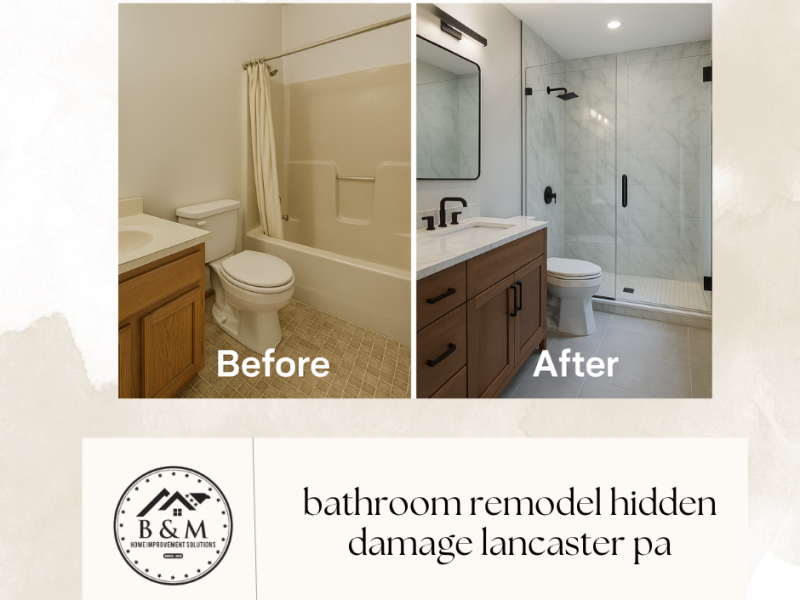
What Happens When We Find Hidden Damage During Your Bathroom Remodel in Lancaster or York, PA?
Mold, Rot, Old Plumbing, and “Surprise” Repairs Explained — and How We Protect Your Budget
When you remodel a bathroom, you’re not just choosing tile and fixtures. You’re opening up parts of the home that probably haven’t been exposed in 20, 30, sometimes 50+ years. Behind that old tub surround or under that vinyl floor is where the truth lives.
Here in Lancaster and York, PA, especially in older homes, we commonly uncover things like soft or rotted subfloor around the toilet, chronic water damage behind the shower walls, old plumbing that’s past its service life, framing that was cut or notched years ago to “make something fit,” and even minor mold that’s been quietly growing where water has been leaking. None of that is visible during the estimate. None of it is in the original contract yet. And just about every homeowner asks the same question at that moment:
“Is this going to blow up my budget?”
This article will answer that directly.
As a professional bathroom remodeling contractor serving Lancaster County, York County, and surrounding areas, we’re going to walk you through:
The most common “hidden problems” we find during bathroom remodels in this area
How we identify and document those problems so you see exactly what we’re seeing
How we handle change orders (added work discovered after demo) in a way that keeps you in control
How we repair the issue correctly so you’re not paying twice for the same bathroom down the road
What you, as the homeowner, can do on Day One to protect your budget and timeline
This is written for serious homeowners who are actively planning a remodel — not just gathering Pinterest ideas. If you’re investing in a new bathroom in Lancaster or York, PA, this is how the process should work.
Why Hidden Issues Don’t Show Up in Your Initial Estimate
Before demolition, we can only price what we can physically verify. We can walk the space, we can measure, we can inspect visible plumbing, we can note the age of the finishes, and we can ask questions about known leaks or past repairs. But unless we’re cutting into walls and pulling up flooring during that first visit (which homeowners understandably do not want), there are parts of the structure we simply cannot see yet.
Here’s what we can usually see and estimate accurately before demo:
Scope of work (example: “remove tub and convert to a walk-in shower”)
Fixture upgrades (new vanity, new toilet, new shower valve, etc.)
Finish level (solid-surface panels vs. full custom tile, niche locations, glass style)
Layout changes (moving drains, relocating a toilet, adding lighting)
Protection, demo, hauling, and disposal
Here’s what we usually cannot confirm before demo:
The condition of the subfloor under and around the toilet, tub, or old shower
Whether there’s mold or rot behind the current shower walls
Whether the framing in those wet areas is still solid and dry, or soft and decayed
Whether the plumbing lines behind the wall are corroded, pieced together with the wrong fittings, or at risk of leaking
Whether any previous homeowner or handyman “fixed” something in a way that is unsafe, not to code, or guaranteed to fail
Because those conditions aren’t visible yet, they are not part of the base contract. They’re not being hidden from you. They’re simply not known yet.
This is why experienced remodelers talk about “contingency” and why honest, process-driven contractors build transparency into the job. Surprises aren’t the problem. Surprises you’re not told about are the problem.
The 4 Most Common Problems We Find in Lancaster & York Bathrooms
Below are the issues we see most often when remodeling bathrooms in Lancaster County and York County. If you live in an older home, assume at least one of these will come up.
1. Rotted or Soft Subfloor (Especially Around Toilets and Tubs)
One of the most common discoveries is subfloor damage around the base of the toilet, under an old fiberglass tub, or directly in front of an older shower. Over time, even a slow leak at the toilet flange (the connection that anchors the toilet to the drain) can soak the wood below. You may never see water on the finished floor, but underneath, the plywood or OSB can be blackened, spongey, or completely crumbled.
Why this matters:
Tile, luxury vinyl plank (LVP), and shower bases all require a solid, stable, flat substrate.
If the floor flexes when you step out of the shower, grout will crack, tile will pop, waterproofing will move, and eventually water will find a way back through.
You don’t invest $15,000+ in a shower or $25,000+ in a full bathroom and then set it on a compromised floor.
The correct repair is not “just screw it down tighter.” The correct repair is:
Cut out all compromised subfloor.
Sister or reinforce any weakened joists or blocking in that area.
Install new proper subfloor material.
Reset the toilet flange securely, at the correct finished height, properly sealed.
That gives you a floor system that will actually support your finished bathroom long-term.
2. Mold or Water Damage Behind Shower/Tub Walls
We frequently open up old tile or plastic surrounds and find dark staining, crumbling drywall, mold growth on studs or insulation, or evidence of long-term moisture intrusion. Most of the time, the cause is simple: failed caulk lines, failed grout joints, old plumbing penetrations that weren’t sealed, or walls built incorrectly to begin with (for example, “green board” drywall used inside a wet zone instead of a proper tile backer and waterproofing system).
Why this matters:
Mold is not just cosmetic. It tells us that water has been getting past the finish layer and into the structure.
Wet framing can rot, twist, or lose strength.
If we cover that back up without addressing it, you are guaranteeing another failure later.
The correct repair is:
Remove all affected wallboard and any compromised insulation.
Treat and dry the framing.
Replace framing members if they’re structurally weakened.
Rebuild using modern waterproofing: cement board or appropriate foam-core backer, properly sealed seams, and a water management system that directs everything to the drain instead of into your walls.
This is the difference between a contractor who is installing a shower that just looks pretty today, and a contractor who is building you a shower that will still be solid in 10+ years.
3. Outdated, Corroded, or Improper Plumbing
We often open up a wall and find three different pipe materials hacked together, shutoff valves that don’t fully close, angle stops that drip, galvanized sections that are nearly closed with mineral buildup, or old copper that’s been bent and stressed so many times it’s one good bump away from splitting.
Now imagine putting a brand-new walk-in shower, custom glass, and upgraded fixtures on top of that plumbing… and then having to tear it all back open six months later because something bursts. That’s exactly what we are trying to prevent.
The correct repair is:
Remove the compromised runs.
Install updated supply lines (typically PEX or new copper, properly supported).
Install a modern pressure-balanced or thermostatic valve at the correct depth so the finished trim sits tight and clean.
Pressure test that work before we ever close that wall.
This step is not “extra upsell.” It’s protection. If we don’t address plumbing that’s clearly failing, we cannot warranty the new shower system in good faith.
4. Framing, Blocking, or Support That’s Missing or Wrong
Bathrooms carry load in more ways than people realize. Heavy glass panels need solid blocking. Floating vanities need anchoring into real structure, not just drywall. Shower benches and grab bars need backing built into the wall framing, not added after the fact with hollow-wall anchors.
We often open the wall and find:
No blocking for future grab bars (especially important if you’re planning aging-in-place accessibility)
No solid backing where a frameless glass door will hinge
Studs that were cut or notched to make old plumbing fit
Framing that’s out of plumb or twisted, which will fight against your new tile layout or shower panels
During a Lancaster or York bathroom remodel, we correct that framing before finishes go in. We true up walls, add blocking for benches, glass, and accessories, and structurally support anywhere that will hold weight. This is what keeps doors from sagging, niches from cracking, and benches from flexing.
Our Process the Moment We Find a Problem
Here’s what separates a professional remodel from a “we’ll figure it out later” job: process.
When we discover hidden damage, we do not quietly patch it, keep going, and hit you with a surprise bill at the end.
We stop, and we follow a defined sequence.
Step 1: We Pause Work in That Area
If we uncover mold behind the shower wall or a soft subfloor at the toilet, we do not immediately cover it back up and hope for the best. We pause work in that zone so you can understand exactly what’s going on.
This pause usually happens early in the project — during demo or during rough-in — which is good. It’s far better to deal with structural or moisture issues before tile is set, panels are up, or finish plumbing is trimmed out.
Step 2: We Document Everything for You
You see what we see.
We take clear photos and short videos of:
The damaged area
The cause (if obvious)
The surrounding structure
We point out what’s rotted, what’s wet, what’s soft, what’s out of code, what’s unsafe. We don’t expect you to “take our word for it.” We want you to feel confident in the decision, and that means you need to understand the problem visually.
Step 3: We Classify the Issue: Mandatory vs. Optional
Not every discovery is the same. So we separate what absolutely must be done from what’s smart to do while the wall is open.
Mandatory work
This is anything structural, waterproofing-related, safety-related, or code-related. Examples:
Subfloor that’s too weak to support tile or a shower base
Active mold or rot in framing
Plumbing that’s leaking or likely to fail
Electrical/safety issues in a wet area
Missing blocking that’s required to support glass or benches safely
Mandatory items must be corrected before we can move forward. You don’t want us installing a brand-new bathroom on top of a failure point.
Optional (recommended) work
These are upgrades that make sense now because the wall is already open:
Adding blocking in the walls so you can mount grab bars later without opening tile
Upgrading an old shower valve to a better fixture for long-term reliability and comfort
Improving insulation and vapor control on an exterior bathroom wall
Prepping for future accessibility (bench support, handheld shower wand height, low-threshold entry support)
We will clearly tell you which is which. There is no guesswork like, “Do I have to do this?” You’ll know.
Step 4: We Price That Work in a Written Change Order
This is a critical protection for you.
A change order is a written mini-agreement that gets added to your project. It spells out:
What we found
What we’re proposing to do
The specific scope of that added work
The added cost for that repair only
The expected impact (if any) to your timeline
You sign and approve before we proceed.
Why this matters:
You are never blindsided at final invoice with “extra charges.”
We are both aligned on what’s being fixed, how, and why.
The documentation becomes part of your permanent project record. If you ever sell the house in Lancaster or York and a buyer asks, “Was this bathroom done right?” you have proof showing the repair was identified and handled correctly.
Step 5: We Perform the Repair the Correct Way — Not the Cheap Shortcut
This is where contractor quality really shows.
A weak contractor will try to “band-aid and hide” the problem because it’s faster and it avoids an uncomfortable conversation with the homeowner. That’s how you end up paying twice for the same bathroom: once now, once again when the failure spreads.
Our approach is to correct the issue to current, durable standards so the new bathroom is something we’re both proud to put our name on.
How This Affects Your Timeline
Here’s the good news: most of these discoveries happen right at the beginning of the project.
Rotted subfloor? You find it on Day 1–2 during demo.
Mold behind shower walls? You find it when the surround comes off.
Plumbing that’s shot? You find it when the wall is open during rough-in.
Because the discovery happens early, the repair usually slots into that same early phase. That means the rest of the bathroom schedule (waterproofing, tile or solid-surface shower installation, vanity set, finish plumbing, paint, glass) can stay on track or only shift slightly.
Where timelines explode is when a contractor ignores an issue, keeps pushing forward to “stay on schedule,” and then has to tear back into finished work later to address something that never got resolved. That’s where you lose weeks. That’s also where finger-pointing starts.
Addressing hidden damage immediately is actually the fastest and most cost-controlled way to remodel.
How This Affects Your Budget (and How to Protect Yourself Up Front)
Let’s talk money, directly.
When you remodel a bathroom in Lancaster County or York County — especially in a home that’s 20+ years old, has visible staining around the tub, has a spongy feel around the toilet, or has had even one “buddy who does plumbing on the side” repair — you should plan for contingency.
A smart contingency cushion is typically in the 10–15% range. Here’s why that’s not “padding,” it’s just honest planning:
Older subfloors around toilets are very often compromised.
Old shower walls almost always have some level of water intrusion.
Original plumbing in older homes is rarely something we would put brand-new tile or solid-surface panels over without correction.
Framing in wet areas is often missing proper blocking for modern features like frameless glass, benches, or grab bars.
In other words: these aren’t rare edge cases. These are normal in Lancaster/York housing stock. Planning that 10–15% allows you to make fast, confident decisions on change orders without stress, and without stalling the job.
Now, here’s how you personally keep leverage during the remodel:
Ask for photo proof of any “surprise.”
If we say, “The subfloor is rotted and needs to be replaced,” you’ll see clear photos of the blackened, soft, or missing wood and the failed flange area. You’ll understand instantly why it cannot just stay as-is under your new tiled shower.Make us tell you: Is this mandatory or optional?
We should say, “You cannot install tile over this; it will fail,” versus, “This is a smart upgrade while we’re open, but technically we could leave the old valve if you want us to.”Get it in writing before the work is done.
The change order is not a suggestion. It’s your protection. It locks in the cost of that specific repair so there’s no “scope creep” argument later.Ask if the fix affects warranty.
If you tell us, “No, don’t replace that failing shutoff, just close the wall,” we may tell you, very honestly, “If we knowingly leave that in place, we can’t warranty that portion of the system.” That’s not pressure. That’s transparency.
Why This Matters for Long-Term Value (Not Just Today’s Look)
A bathroom remodel in Lancaster or York, PA is not just about today’s look. Buyers in this market pay attention to quality. Inspectors pay attention to moisture, safety, ventilation, and structural support. Appraisers get more aggressive about calling things “DIY” if they see obvious short-cuts, and that can affect perceived value and negotiating power when you sell.
When we identify hidden issues, document them, correct them properly, and tie that documentation back to your project file, you’re not just getting a nice shower. You’re getting proof that your bathroom was rebuilt correctly, structurally, and safely.
This does three things for you:
You sleep better because you’re not sitting on top of a known problem.
Your finish materials last longer because they’re installed on stable structure and modern plumbing.
Long-term resale is easier to defend because you’re not stuck explaining why the grout is already cracking or why there’s soft floor by the toilet in a “brand new” bathroom.
In short: the unglamorous part — subfloor repair, mold remediation, proper waterproofing, solid blocking, modern plumbing — is what protects your investment.
How We Handle This at B&M Home Improvement Solutions
Here’s exactly how we manage hidden damage on Lancaster and York bathroom remodels:
We build containment and floor protection first so demo doesn’t trash the rest of your home.
During demo/rough-in, we slow down on purpose any time we see subfloor rot, mold, corroded plumbing, or missing structural support.
We take photos/video and send them to you so you understand the situation with zero guesswork.
We classify what’s mandatory to fix versus what’s an optional upgrade (for example, we might suggest adding blocking for future grab bars even if you don’t want them yet — that’s optional, but smart).
We create a written change order so you know cost, scope, and impact before anything gets done.
You sign off, we repair it correctly, and we move forward on your new shower, tile, vanity, glass, and finishes with confidence.
That process protects three things at the same time: your budget, your schedule, and your finished bathroom.
This is how you should expect any responsible bathroom remodeling contractor in Lancaster, PA or York, PA to operate. If a contractor won’t follow this kind of process — if they’re vague about change orders, if they do work you never approved, if they “don’t bother you with details” — that is a red flag. That’s how homeowners end up feeling trapped halfway through a remodel.
Final Takeaway for Homeowners in Lancaster & York, PA
Hidden problems are normal. They do not mean your bathroom remodel is “going wrong.”
What matters is how they get handled:
You should see the issue.
You should understand why it matters.
You should be given a written change order before extra work is done.
The fix should be done to today’s standard — not patched and buried.
That’s how you avoid throwing good money on top of a bad base. That’s how you avoid paying twice. And that’s how you end up with a finished bathroom that isn’t just beautiful for photos the day we leave, but solid, dry, safe, and ready for daily use for years.
If you’re planning a bathroom remodel, walk-in shower conversion, or full bathroom rebuild in Lancaster County or York County and you want it handled this way — with clear pricing, photo documentation, proper change orders, and long-term durability, not shortcuts — we can help.
Service Area
B&M Home Improvement Solutions provides bathroom remodeling, tub-to-shower conversions, shower replacements (solid surface and custom tile), vanity upgrades, and full bath renovations in Lancaster County, York County, and surrounding areas within roughly 20 miles of 536 Norwood Rd, Columbia, PA 17512. We handle design, demo, structural corrections, plumbing and waterproofing, and final finishes — start to finish, with documentation.
Next Step
If you’re scheduling a bathroom remodel and you’re worried about “what if you open the wall and find something bad,” this is exactly the conversation we’ll walk you through on Day One. Send us a few pictures of the bathroom you’re planning to update, tell us where you’ve seen staining or soft flooring, and we’ll tell you what to expect before demo even starts.