

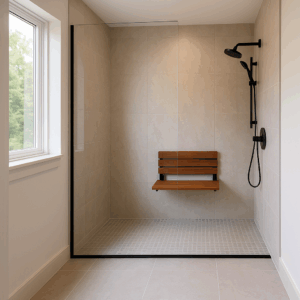
Curbless Showers for Aging in Place (Without the “Medical” Look)
By B&M Home Improvement Solutions
Published: August 11, 2025
Updated: August 11, 2025 (Initial publication)
Introduction
If stepping over a shower curb is starting to feel risky—or you’re planning ahead to stay in your Lancaster or York home for decades—a curbless shower (also called a zero‑threshold shower) delivers safer access without sacrificing style. Done right, these showers look streamlined and modern, drain perfectly, and are easy to clean. In this guide, we’ll explain what makes a curbless system work, how to plan one for older homes common in Lancaster County and York County, and which details (slope, waterproofing, glass, ventilation) make all the difference. You’ll also find an at‑a‑glance planning checklist, local pro tips, and answers to the questions we hear most.
The Problem Homeowners Face
Traditional shower curbs create two headaches:
Trip hazards and mobility limits. That 4–6 inch step can be dangerous if balance changes, a knee acts up, or you’re assisting a loved one. Wet tile plus a raised edge is a recipe for slips.
Cleaning and maintenance. Curbs and framed doors add grout lines and corners where soap film, hard‑water deposits, and mildew collect—especially with Lancaster/York’s moderate‑to‑hard water.
Older homes in our area add a third challenge: tight footprints and wood subfloors that weren’t designed for recessed shower pans. You’ll want a design‑build plan that achieves a truly flush entry while protecting structure and keeping water exactly where it belongs.
Options & What to Consider
A curbless conversion isn’t one‑size‑fits‑all. Here are the key choices to discuss during design:
Shower floor system
Solid‑surface pan (one‑level) with integrated linear or point drain—fast, low‑maintenance, excellent for aging in place. (We frequently install premium solid‑surface systems from trusted suppliers.)
Custom tiled pan (mud bed) for maximum customization of size/shape and drain location. Requires precise waterproofing and slope.
Drain style & placement
Linear drain along the entry or back wall. Allows larger floor tile and a single‑plane slope—great for wheel‑in access and clean looks.
Center/point drain with four‑way slope. Time‑tested and cost‑efficient, but smaller floor tiles are usually needed for traction and contouring.
How to achieve “zero threshold”
Recess the shower area into the joist bay/subfloor (common in wood‑framed floors) so finished tile/pan is flush with the bath floor.
Lift the bathroom floor slightly to meet the shower height when recessing isn’t practical.
Waterproofing approach
Sheet membranes or liquid‑applied membranes beneath tile; factory‑integrated waterproofing for solid‑surface systems.
Meticulous seam treatment at corners, niches, benches, and the glass channel is non‑negotiable.
Enclosure & splash control
Doorless (“walk‑in”) with a fixed panel and strategic drain placement to keep spray inside.
Frameless door for maximum splash control in tighter spaces.
Surfaces
Floor: matte or textured porcelain mosaics (often ≤2″), textured solid‑surface, or other slip‑resistant materials.
Walls: large‑format porcelain/tile or low‑seam solid‑surface panels for minimal upkeep.
Comfort & support
Built‑in bench or fold‑down seat, handheld shower on a slide bar, and blocking for future grab bars (installed now or later).
Heated floor outside the shower for comfort and faster drying.
Ventilation & lighting
A quiet, properly sized exhaust fan and glare‑free lighting improve safety and reduce maintenance.
Note: We avoid cost talk here because needs vary widely by structure, size, and finishes. We’ll price your options after a quick site visit and layout discussion.
Step‑by‑Step Planning & Build Guide
Below is the process we follow on Lancaster and York projects. Use it as your roadmap whether you hire us or just want to understand the work.
Assess needs and measure
Identify mobility goals (walker compatible? wheelchair turn radius?), preferred shower size, and must‑have features (bench, niche, hand shower). Document clearances around toilets/vanities.Structural check
Determine joist direction, span, and subfloor thickness. In many local homes, 2×10 or 2×8 joists and ¾” subfloor are common; we verify deflection is within spec and design recessing or floor build‑up accordingly.Choose the floor system
Solid‑surface pan with integral slope and linear drain: quick installation, very low maintenance.
Custom mud pan: ultimate flexibility for unique footprints; ideal with porcelain mosaics for grip.
Drain placement and slope plan
Aim for a consistent slope of about ¼” per foot toward the drain. For linear drains at the entry, slope the entire shower away from the opening; for back‑wall drains, slope toward the wall.Waterproofing spec
Select a continuous waterproofing system compatible with your floor/wall choices—factory systems for solid‑surface, or a proven membrane for tiled pans. Extend waterproofing at least several inches outside the shower to capture splash.Blocking & rough‑ins
Add solid wood blocking for future grab bars at 33–36″ heights, bench support, and glass channels. Rough‑in a pressure‑balance or thermostatic valve, plus a handheld on a slide bar for seated use.Recess or raise
Recess method: Carefully notch or sister joists as engineered, replace subfloor with appropriate thickness, and set the pan or mud bed so finished surfaces align flush with the bath floor.
Raise method: Add underlayment to the bath floor to meet the shower height while maintaining door clearances and smooth transitions.
Set the pan or build the mud bed
Install the solid‑surface pan per manufacturer spec or float the mortar bed to the exact slope. Integrate the drain body and ensure clamping surfaces are sealed.Waterproof the shower and adjacent floor
Seal seams, corners, niches, and the glass channel. Flood‑test when applicable to confirm performance before tile or panels go up.Walls and details
Install solid‑surface panels or tile. Include a recessed niche placed between 48–54″ to reach from a seated or standing position. Scribe panels/tile to the floor tightly for a clean, low‑seam look.Glass & splash management
Add a fixed panel sized to catch overspray from the main head. For tight rooms, use a flipper return or a frameless pivot door. Keep the main spray aimed away from the entry and toward the drain.Finishes, lighting, and ventilation
Use matte or lightly textured floor surfaces for traction. Select high‑CRI, warm‑white lighting and a quiet fan rated appropriately for the room. Caulk changes of plane with 100% silicone.Commissioning & care
Test drain performance, confirm slopes shed water, and review maintenance: squeegee after use, run the fan 20–30 minutes, and clean with neutral products.
Timeline: Straightforward conversions can be completed in 3–5 days. Projects involving framing changes, drain relocation, or large format tile may take longer. (Our standard curbed shower replacements often fit a 2–3 day window.)
Lancaster/York Pro Tips & Local Notes
Hard water: Choose glass coatings and matte hardware finishes that hide spots. Keep a daily squeegee handy.
Older subfloors: Many pre‑1990 homes in the city and county need subfloor reinforcement before recessing—plan for it early.
Ventilation: Target at least 50–80 CFM with a quiet fan; use a timer or humidity‑sensing control so it actually runs long enough.
Winter humidity swings: Silicone movement joints at changes of plane reduce cracking.
Local sourcing: We work with Lancaster‑area suppliers (Hajoca, Red Rose Cabinetry, Lezzer Lumber, Too the Trades) to keep timelines tight and materials consistent.
Common Mistakes to Avoid
Insufficient slope leading to puddles or splash migration.
Skipping a flood test on custom pans.
Glossy or large, slick floor tiles with poor traction.
No blocking for grab bars or future accessories.
Drain in the wrong place for a doorless design; the spray fights the layout.
Under‑sized exhaust fan—moisture problems follow, especially in tight Lancaster rowhomes.
When to Call a Pro (and Why)
Call a design‑build pro when:
You’re recessing a wood subfloor or moving a drain.
You want a linear drain and large‑format floor tile.
You’re choosing a solid‑surface wall/pan system and want seamless, low‑maintenance results.
You need ADA‑informed layout (clearances, bench height, grab‑bar placement) without the institutional look.
B&M Home Improvement Solutions specializes in bathrooms and 2–3 day shower replacements; for curbless builds we typically complete in 3–5 days depending on structure and finishes. We handle design, permits, carpentry, waterproofing, glass, and final punch so you’re not coordinating multiple trades.
FAQs
Do I have to move the drain for a curbless shower?
Not always. Linear drains can sit at the entry or back wall; we design the slope around your existing plumbing when practical. If drain location fights the spray pattern or slope, a move may be recommended.
Will a doorless curbless shower splash water into the bath?
With correct slope, drain placement, and a well‑sized fixed panel, everyday use stays dry. We mock up spray angles during design to be sure.
What floor tile works best?
Small porcelain mosaics (often 1–2″) or textured solid‑surface pans provide grip and follow the slope smoothly. Avoid glossy finishes on the floor.
Can I convert a small 5′ x 8′ hall bath to curbless?
Often yes. We may recess the shower bay or raise the bath floor slightly to stay flush. A linear drain along the back wall helps in compact rooms.
How do I keep it easy to clean?
Choose solid‑surface wall panels or large‑format porcelain to reduce grout lines, add a handheld for rinse‑down, and use a daily squeegee. Neutral cleaners protect grout and stone.
Get in touch- Lancaster and York PA Bathroom Contractor.
Ready to plan a safer, low‑maintenance curbless shower for your Lancaster or York home? Our design‑build team can show you doorless and glass options, linear drains, solid‑surface walls, and seating that look elegant—not medical.
Request a consultation:
Phone: 717‑449‑8789
Email: BMHomeImprovementSolutions@gmail.com