

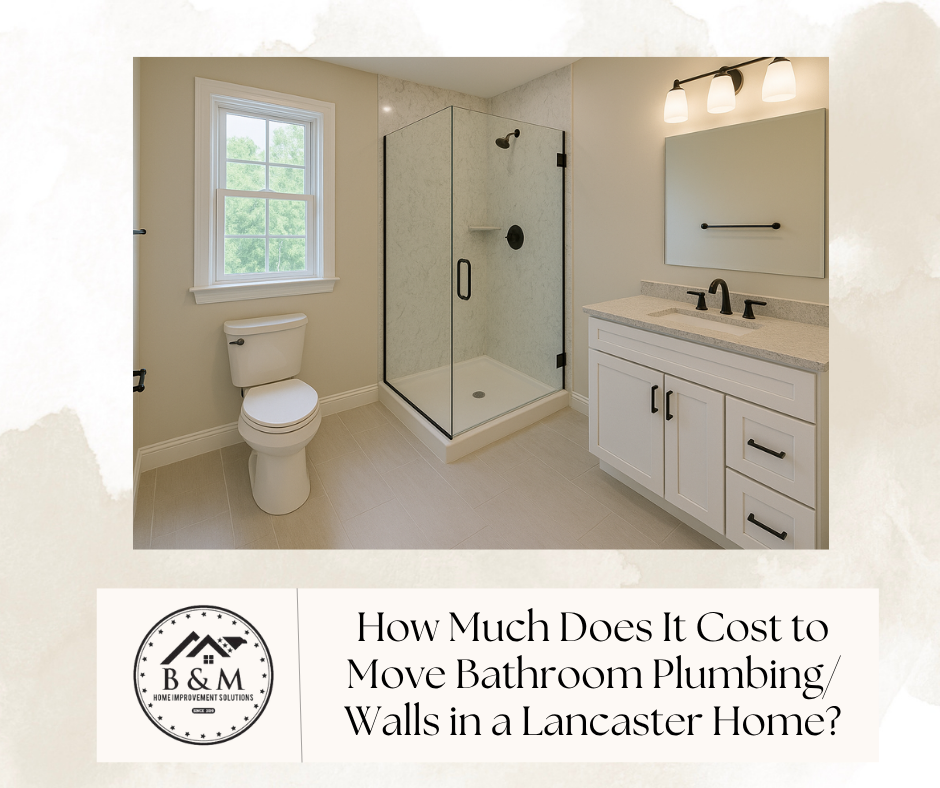
How Much Does It Cost to Move Bathroom Plumbing Walls in a Lancaster Home?
Moving bathroom plumbing or even relocating walls during a remodel can transform an outdated bathroom layout into your dream space. For homeowners in Lancaster, PA – especially those with older homes in Lancaster City, East Petersburg, Lititz, Manheim, and surrounding areas – one of the first questions is inevitably: How much will it cost? In this comprehensive guide, we’ll break down the costs of moving bathroom plumbing and walls, the factors that impact those costs, local code considerations in Lancaster County, and common challenges (like old cast iron pipes and tight joists) often encountered in our area’s older homes. By the end, you’ll have a clearer picture of what to budget and how to plan for a successful bathroom remodel.
Whether you’re reconfiguring a small city bathroom or expanding a master bath in a suburban Lancaster home, understanding these cost factors will help you make informed decisions. Let’s dive into the details.
Why Homeowners Move Bathroom Plumbing or Walls
Homeowners choose to move plumbing fixtures or even tear down/move walls in a bathroom for a variety of high-impact reasons. If the current layout “just isn’t cooperating” with your vision for a walk-in shower or double vanity, relocating plumbing might be the only way to achieve it. Here are some of the most common motivations for these changes:
- Improving Layout and Function: A poorly laid-out bathroom can feel cramped or awkward. Moving the toilet, sink, or shower to a new location can open up floor space and improve flow. For example, shifting a toilet out of the direct line of sight from the door or moving a vanity to a different wall can make the bathroom feel more spacious and functional. Homeowners often relocate fixtures to achieve a more comfortable layout (like making room for a double vanity or a larger shower). These practical changes provide better use of space without sacrificing utility.
- Adding New Features or Upgrades: New features often require new plumbing locations. Converting an old bathtub into a walk-in shower or adding a luxurious soaking tub might mean moving supply and drain lines. Likewise, if you want to upgrade to a smart toilet or install body-spray showerheads, you may need to reroute plumbing to those spots. Lancaster homeowners remodeling older bathrooms frequently aim to accommodate modern amenities that older layouts weren’t designed for.
- Expanding the Bathroom Space: In many Lancaster homes, especially older ones, bathrooms can be small. Homeowners might choose to move a wall to enlarge a bathroom – for instance, annexing a closet or part of an adjacent room. This structural change goes hand-in-hand with moving plumbing lines that were in or along that wall. The result can be a more open bathroom with space for a larger vanity or a separate tub and shower. (We’ll discuss the cost implications of moving walls in a section below.)
- Replacing Outdated or Failing Plumbing: Older homes in Lancaster County (think 50+ years old) often have outdated plumbing materials that need attention. Galvanized steel water lines, which were common decades ago, corrode over time and can significantly reduce water pressure. Cast iron drain stacks, while durable, eventually rust or crack. Homeowners undertaking a full bathroom remodel may decide to relocate and replace these old pipes proactively. In fact, experts advise that if you have 70-year-old galvanized pipes exposed during a renovation, it’s wise to replace them rather than leave them in place. Rerouting plumbing provides an opportunity to swap old pipes for new copper or PEX lines to improve water flow and prevent future leaks.
- Fixing Design Flaws or Code Issues: Sometimes the reason for moving plumbing is to correct problems. Perhaps the shower was improperly placed and always leaks water onto the floor, or the toilet clearance doesn’t meet modern code. By moving fixtures to better positions and updating the plumbing to current standards, homeowners can resolve long-standing issues. For example, building codes have specific requirements for fixture clearances and venting. During a remodel, relocating a fixture might be necessary to meet code requirements (like ensuring a toilet isn’t too close to a wall or that a sink has proper venting).
- Increasing Home Value: An updated bathroom layout can boost resale value. Today’s buyers generally prefer bathrooms with a modern layout – such as a spacious walk-in shower, a separate water closet, or a double-sink vanity. If your current bathroom’s plumbing layout is outdated (e.g. the only sink is across the room from the toilet, or the shower is cramped in a corner), a remodel that moves things into a more contemporary configuration can make your home more attractive on the market. Investing in a better layout and up-to-date plumbing is often seen as money well spent in Lancaster’s housing market, especially in hot areas like Lititz or Lancaster City where historic charm meets modern expectations.
These reasons often overlap. For instance, owners of an older Lancaster City rowhome might move plumbing to both improve function and replace old pipes at the same time. No matter the motivation, it’s important to understand the challenges and costs that come with moving plumbing and walls, which we’ll explore next.
Challenges of Moving Plumbing in Older Lancaster Homes
Lancaster is known for its historic homes – from 19th-century townhouses in the city to early-20th-century farmhouses in the county. Remodeling these older bathrooms can be both rewarding and challenging. If your home is older, you’ll need to plan for some potential hurdles that can impact the cost of moving plumbing or walls:
- Outdated Pipe Materials (Cast Iron & Galvanized Steel): Many Lancaster homes built before the 1970s have cast iron main drain stacks and galvanized steel supply lines. Cast iron was commonly used for sewer stacks; it’s very heavy and often 4 inches in diameter (with thick walls), which can be difficult to work with. Moving or tying into a cast iron stack may require extra labor or even replacing the stack with PVC for compatibility. Galvanized pipes for water supply are prone to internal rust and buildup. If you open up walls and find galvanized pipes, a plumber will likely recommend replacing them with copper or PEX while doing the remodel – this adds to the project scope. As one expert noted, in a gut renovation you should replace any 70-year-old galvanized pipe hidden in the walls because it’s near the end of its lifespan. Upgrading to modern piping ensures better water pressure and reduces the chance of leaks down the road, but it does increase material and labor costs upfront.
- Tight Floor Joists and Framing Constraints: Older homes were built with different standards than today. You might encounter floor joists that are closer together, smaller in dimension, or made of old hard lumber that’s tough to cut through. For example, some historic Lancaster houses have narrow joist spacing, which can complicate running new drains or moving a toilet line that needs a certain slope. If you’re relocating a tub or shower drain, the contractor may need to reinforce joists or adjust framing to fit the new plumbing without weakening the structure. All this extra carpentry work means higher labor costs. Walls in older homes might also be “out of plumb” or uneven, so aligning new plumbing can take more time. In summary, vintage construction often translates to unpredictable obstacles behind walls and under floors, requiring experienced professionals to navigate them.
- Accessibility of Existing Plumbing: How and where the current pipes run will affect the effort needed to move them. In older homes, plumbing may be hidden behind plaster walls, beneath old subfloors, or routed in unconventional ways. If pipes are easily accessible in an unfinished basement or crawlspace, a plumber can reroute lines with less demolition. But if you have to cut through thick plaster, or if pipes are buried in structural elements, the job gets more complex. For instance, moving a second-floor bathroom’s plumbing might require opening the first-floor ceiling below. Expect that removing and later repairing wall/floor surfaces (tile, drywall, hardwood, etc.) will add to the cost.
- Hazardous Materials in Older Construction: Homes built before the late 1970s can contain lead paint or asbestos, which must be handled carefully during any demolition. Lancaster’s historic homes often have layers of old paint (likely lead-based) on walls or older vinyl flooring and insulation with asbestos. If you’re opening up walls or floors to move plumbing, any disturbance of these materials needs proper mitigation. Specialized contractors might be needed to remove asbestos floor tiles or to do lead-safe renovation. This environmental remediation can be an unexpected cost. Lancaster City remodelers note that older homes frequently require OSHA- and EPA-compliant handling of lead paint, asbestos, and silica dust, which can add 15–20% higher costs in the city vs. remodeling a newer suburban home. It’s a price for safety that should be built into the budget if your home falls into this category.
- Non-Standard Sizes and Layouts: You might find that nothing is standard in an older bathroom – the wall studs might be spaced irregularly, or the main stack might run in a strange corner. Cast iron stacks in historic homes, for example, are sometimes too large to fit in a modern 2×4 wall bay, which means if you move or replace it, you may have to build a larger wall enclosure (stealing a bit of space from the room). Likewise, older bathrooms might not have vent pipes in the walls that meet today’s code. As you relocate fixtures, you may need to add venting or enlarge wall cavities, which is extra work that newer homes (with standard framing and pre-planned chases) might not require.
In short, remodeling an older Lancaster home’s bathroom is often full of surprises. A skilled local contractor will anticipate many of these (like replacing an old cast iron trap or navigating a floor with hand-hewn joists), but it’s wise for homeowners to include a contingency budget for unexpected issues. Hidden water damage, ancient wiring, or an unforseen structural quirk can reveal itself once walls are opened. Tackling these challenges is essential for a safe, lasting renovation, but they will increase the overall cost if they arise. The key is planning for the worst while hoping for the best – that way, you won’t be caught off guard mid-project.
Lancaster Building Codes and Permit Requirements for Moving Plumbing
Remodeling a bathroom in Lancaster County isn’t just about design and construction – there’s also the important aspect of building codes and permits. If your project involves moving plumbing or walls, you will almost certainly need permits and inspections to ensure everything is done to code. Here’s what Lancaster-area homeowners should know:
Plumbing and Building Permits: In Lancaster County (and York County), any significant changes to plumbing systems – like relocating a toilet, adding new supply or drain lines, or moving where a shower is – require a plumbing (mechanical) permit from your local municipality bmhomeimprovementsolutionsllc.com. Simply put, if you’re moving plumbing fixtures or altering the piping configuration, you cannot legally do the work without a permit and subsequent inspections by a certified inspector. As a local remodeling guide explains, kitchen and bath renovations in Lancaster, PA often require permits, “especially when they involve moving plumbing fixtures or electrical wiring.” This means even if you’re not altering the overall square footage of the room, the act of rerouting plumbing triggers the need for a permit.
For structural changes like moving a wall, a building permit is also required. Removing or building new walls (particularly load-bearing ones) involves plan review to ensure the changes meet structural code. If the wall you plan to move contains plumbing or electrical lines (as many bathroom walls do), you may need multiple permits: one for building/structural and separate trade permits for plumbing and electrical work.
Permit Process in Lancaster: Typically, you or your contractor will submit a permit application with plans detailing the changes. The City of Lancaster and various townships (East Petersburg, Manheim Township, etc.) follow Pennsylvania’s Uniform Construction Code (UCC), which incorporates the International Residential Code and International Plumbing Code. The submitted plans must show that relocated plumbing will be installed to code – for example, proper pipe sizes, traps, venting, and appropriate distances from other systems. Once the permit is approved and issued, work can begin, but key stages (like after rough-in plumbing is complete, and after the new wall framing is done) must be inspected. An inspector will verify that your plumbing relocation is leak-free and properly vented, and that any new framing or structural supports for moved walls are adequate.
Local Nuances: Lancaster County has some local variations and procedures to be aware of. In Lancaster City, permits often involve both a city fee and third-party inspection fees. (One source notes that Lancaster City doesn’t list a specific plumbing fee schedule publicly, but generally there’s a base permit fee plus a small state surcharge – $4.50 is added to every permit in PA for state training.) Some municipalities, like Manheim Township, offer an “over-the-counter” mechanical permit for simpler projects that don’t change structural or zoning elements. This can streamline the process if you’re only moving plumbing and not altering walls or room size. It’s still a permit, but it might be quicker to obtain. Always check with your township or borough’s permit office or website. The City of Lancaster’s permit office can guide you on what’s needed for a bathroom remodel within city limits cityoflancasterpa.gov.
Permit Costs: Permit fees in Lancaster County for a bathroom remodel that involves moving plumbing are generally a small percentage of the project cost, but they should be budgeted. For residential work, often the fee is based on the estimated cost of the project or a flat rate. For example, one local township might charge around $100 for the first $25,000 of project cost (plus a tiny increment for costs above that), while the City might have a minimum fee around a few hundred dollars for building permits. In addition, each permit will have that $4.50 state fee attached. If you need a separate plumbing permit, it could be on the order of $50–$150 or more, depending on the scope (some areas roll plumbing into a single building permit, others treat it separately). There may also be charges for plan review or multiple inspections. All told, you might spend a few hundred dollars on permits for a bathroom remodel that moves plumbing and walls – money that ensures the work is done safely and legally.
Skipping Permits Is Not Worth It: While it can be tempting to save time or money by forgoing permits, it’s never recommended. Unpermitted plumbing work could violate code (for instance, improper venting or pipe slopes) and lead to slow drains, sewer gas smells, or worse – leaks and water damage. If discovered, unpermitted work can result in fines and headaches when you go to sell your home (failed inspections or legal liability). Lancaster authorities, like those elsewhere, can require you to open up walls after-the-fact to inspect work if they suspect a remodel was done without permits. It’s best to do it right the first time: obtain the necessary permits and have the peace of mind that your new plumbing is up to code. Reputable Lancaster contractors will handle the permitting process for you and schedule the required inspections as part of their service, which is well worth it for a smooth remodel.
In summary, plan for permits and inspections as an integral part of your bathroom project timeline and budget. They might add a bit of cost and a few weeks of process, but they ensure your plumbing moves and wall changes meet all safety standards – protecting both your family and your investment in your home.
What Factors Impact the Cost of Moving Bathroom Plumbing (and Walls)?
Several key factors determine how much you’ll end up paying to relocate plumbing or move a wall in your bathroom. Costs can range widely because every project is unique. Let’s break down the major cost drivers:
1. Labor Costs for Skilled Trades
Labor is often the largest component of plumbing relocation projects. When you move bathroom plumbing, you’re typically paying for a licensed plumber’s time, as well as potentially a carpenter and maybe an electrician if wiring is affected. The complexity of the work will heavily influence the hours (and thus labor cost) required.
- Plumbers in the Lancaster area might charge an hourly rate roughly between $80 and $130 per hour, depending on their experience and the difficulty of the job (this rate is in line with national averages, where plumbers often charge $75–$150/hour, and some local companies reporting ~$107–$125/hour typical in Lancaster). A simple relocation like moving a sink a foot or two might take a few hours of work. In contrast, relocating a toilet line under a floor or a shower drain across a room could take multiple days of work when you factor in cutting, rerouting, and testing.
- Carpentry labor comes into play if walls or subfloors need to be opened and later repaired. If you’re moving a wall, carpenters will handle demolition, new framing, drywall, and finishing. The labor to remove a non-load-bearing wall and rebuild a new wall elsewhere could be a couple of days of work for a crew, whereas a load-bearing wall might involve a structural engineer’s design and several carpenters installing a beam, which is more time and coordination.
- Additional trades: Don’t forget the tile installer if moving plumbing means re-tiling a shower or floor section, or the electrician if any outlets, switches, or light fixtures on a moved wall need to be relocated too. Their labor will add to the total cost. In Lancaster, many bathroom remodelers have all these trades on hand, and their labor costs are bundled into the project estimate.
Overall, labor can account for a significant portion of the cost – one source notes that the bulk of cost in moving bathroom plumbing goes toward labor, since it includes the plumber’s time to assess, dismantle, reroute pipes, and reinstall fixtures. For example, an average plumbing relocation might involve $5,000–$6,500 in labor alone, especially if multiple fixtures are being moved. High-quality, experienced labor ensures the job is done right (which is crucial for something as essential as plumbing), but it does come at a premium. Lancaster homeowners should always get a detailed breakdown of estimated labor hours for each aspect of the project when reviewing quotes.
2. Materials and Plumbing Supplies
Moving plumbing requires new materials, though compared to labor these usually make up a smaller share of the budget. Key material costs include:
- Pipes and Fittings: Depending on the type of pipe you choose or that code requires, costs can vary. PEX tubing (a flexible plastic pipe) is popular today because it’s affordable and easy to run through walls; it’s often cheaper than copper. However, local building codes in some areas might limit PEX use (though in PA, PEX is generally allowed and common for water lines). Copper pipes are more expensive but very durable; if you or your plumber prefer copper for water lines, expect a higher material bill. For drains, PVC piping is standard now (replacing old cast iron or galvanized drains) and is relatively inexpensive per foot. Even so, lots of pipe adds up.
- Fixtures and Connectors: If you move a sink or toilet, you may need to purchase some new parts like an extended toilet flange, new traps, or additional connectors. Each sink or toilet move might require new shutoff valves, flex supply lines, etc. These parts are not very costly individually (a valve or P-trap might be $10–$20), but a full relocation will require a cart full of various small fittings, elbows, couplings, and PVC glue or solder.
- Specialty Items: Consider if you are upgrading anything during the move. For example, swapping an old galvanized line for copper will increase material costs due to copper’s price. Or if you’re adding a better venting system (like installing an automatic air admittance valve or running a new vent stack for a relocated fixture), there are small material costs for those components. In an older Lancaster home, you might also need lumber or blocking to reinforce framing after drilling larger holes for new pipes.
On average, for a bathroom plumbing relocation, you might spend on the order of $1,500 (give or take a few hundred) on the plumbing materials. One detailed breakdown showed plumbing supplies for a relocation averaging $1,380–$1,570. This included pipes, fittings, connectors and all the “building blocks” needed to reroute water supply and drain lines. Notably, moving a fixture just a short distance might only need minimal new piping, whereas an extensive reconfiguration with all new lines will require a lot more materials (and thus higher cost).
Using quality materials is important – for instance, using the right type of pipe for hot water (CPVC or PEX designed for hot water lines), and ensuring all fittings are secure and code-compliant. Materials also include things like fasteners and supports (straps to hold pipes, brackets, etc.) and sealants. Though these don’t break the bank individually, failing to include them can cause headaches (a $5 pipe hanger is much cheaper than a future pipe rattle or leak repair!).
In Lancaster, most contractors will source materials from local plumbing supply houses or home improvement stores. Homeowners generally don’t need to buy these themselves (and in fact, DIY plumbing in a permitted job isn’t allowed unless you’re licensed or get homeowner permit approval). But it’s good to understand that the choice of piping (PEX vs copper) and the amount of new pipe run will affect your material line item. Copper, for example, can cost several dollars per foot, whereas PEX is just a fraction of that, so a predominantly copper job will have a higher material cost but some feel it’s a longer-term investment. Your contractor can advise on what’s best for your home and adheres to Lancaster’s codes.
3. Distance and Complexity of the Reroute
The distance you’re moving a fixture and the complexity of that new route is a huge factor in cost. Essentially, the more pipe that has to be run and the trickier the path, the more it will cost.
- Short Moves vs. Major Relocations: Moving a sink or toilet a mere 1–2 feet from its original spot is relatively simple – the plumber might be able to extend the existing pipes or add a couple of elbows without completely redoing the system. Such a minor relocation could be a few hundred dollars in work. On the other hand, moving a fixture across the room (or to an entirely different wall) is a big job. As a general rule of thumb, if you need to move a plumbing fixture by three or more feet, it can cost roughly $500 to $1,000 per fixture just for that relocation task. That ballpark from national data aligns with what many see in practice – once you go beyond a very short adjustment, you start incurring significant labor for cutting into floors or walls and running all-new pipe.
- New Drain Runs: Drains rely on gravity, so they must slope downward at a specific rate (usually 1/4″ per foot for horizontal runs in a bathroom drain). If you move a toilet, for example, the large 3” or 4” drain pipe might need to be re-routed through joists or concrete. Cutting and patching flooring, plus potentially core drilling through joists or slabs, adds complexity. The further the new drain has to travel to tie into the main stack, the more work (and risk of complications). Long runs may need additional venting or cleanouts per code.
- Multiple Level or Hidden Routes: Houses with multiple stories or finished spaces present another layer of complexity. If you’re rearranging a second-floor bathroom, the plumber may need to work from below (in the first-floor ceiling) to redirect pipes. Opening up finished ceilings or walls on another level broadens the scope of work – there’s more demolition and later repair. If pipes have to travel between levels or navigate around non-standard framing, expect additional time and fittings. In some older Lancaster homes, getting a new pipe from point A to point B can feel like threading a needle through a maze of old studs, ductwork, and stone foundations.
Complexity also includes the number of twists and turns (fittings) needed. Every bend or junction in the piping takes time to cut and connect. A straight run of 5 feet is simpler (and cheaper) than a run that has to turn multiple corners to avoid obstacles. Plumbers plan routes strategically to minimize turns and maintain proper pitch, but in a retrofit situation, sometimes a bit of a winding path is unavoidable.
In summary, the simpler and shorter the relocation, the less it will cost. If budget is tight, consider whether you can achieve your design goals by moving things just slightly rather than all the way across the room. Sometimes a compromise on layout can save a lot of money. However, if the current layout is truly dysfunctional, the investment in a major move can greatly enhance the bathroom’s usability and value.
4. Fixture Type: Toilet vs. Sink vs. Shower – Which Costs More to Move?
Not all fixtures are created equal when it comes to relocation complexity. Here’s how they generally rank:
- Toilet: Moving a toilet is often the most expensive individual fixture to move. Toilets have the largest drain line (usually 3” or 4” diameter) that needs to maintain slope. This often means significant work cutting into the floor and joists. The toilet’s new location must also align with a venting strategy (either connect to an existing vent or have a new vent run up, which might go inside a wall). In a first-floor bathroom on a slab, moving a toilet is especially costly because it involves jackhammering concrete to reroute the waste line. Even on a framed floor, the structural work to accommodate a new toilet drain can be non-trivial. You also have to install a new flange at the new location and patch the old drain hole. Because of all this, moving a toilet could easily cost more than moving a sink. In one anecdote from a contractor, moving a toilet on a slab floor cost around $800 for about an 11-foot relocation (involved trenching the slab) – whereas that same project might have had much lower costs for other fixture tweaks. Toilets also require moving the cold water supply line to fill the tank, but that’s minor compared to the drain work.
- Sink (Vanity): Sinks are typically the easiest and cheapest to move. They have smaller supply lines (hot and cold, usually 1/2″ PEX or copper) and a smaller drain (1.5” or 2”). These pipes are easier to reroute within walls or through cabinets. If the sink is only moving a short distance, often the plumber can tie into the existing lines or use flexible tubing. Even moving a sink to a different wall is manageable because the smaller pipes are more forgiving to work with. Sinks also usually tie into a vent stack that might be nearby; if not, an AAV (air admittance valve) can sometimes be used inside the vanity to provide venting without running a new vent pipe through the roof (local code permitting). Overall, a sink might just cost a few hundred dollars to move if walls are already open. However, if you’re adding a second sink (like converting to a double vanity), you’ll incur costs for extra plumbing lines and possibly an upgraded drain to handle two sinks – but even then, sinks are still on the lower end of complexity. As one plumbing company explained, “moving a sink a short distance is far less labor-intensive than relocating a toilet or a shower stall”.
- Shower/Bathtub: Showers can rival toilets in complexity, depending on what type of drain and fixture we’re talking about. A shower stall or tub-shower combo has a 2” drain typically. If you’re moving a shower across the room, you must redo that drain line with proper slope (though 2” pipe is a bit easier to work with than 3” toilet pipe). The bigger challenge can be the water supply lines – a shower usually has both hot and cold, and sometimes multiple outputs (standard showerhead, rain head, body sprays, etc.). Those all need to be re-piped to the new location. If it’s a shower pan or tub that’s moving, the drain has to be precisely located to fit the tub outlet or center of the pan, which might mean fine-tuned plumbing work once the new fixture is on site. Showers also involve waterproofing and tile if it’s a custom tile shower; moving it means you’ll basically rebuild the shower in the new spot (pan liner, backer board, tile, etc.), which can be costly – though those costs are more “remodel” costs than just “plumbing” costs per se. Also consider venting: a shower’s drain will need to be vented within a certain distance. If moving it places it far from an existing vent stack, the plumber might have to run a new vent line up through the wall or tie over to a vent in the attic. All told, moving a shower is usually more work than a sink, and can approach or exceed the effort for a toilet, especially if a new custom shower build is part of it. On the bright side, moving a tub (if you have a freestanding tub, for example) might be slightly simpler than a built-in shower, as a freestanding tub often only requires moving the drain and supply lines without extensive tile work.
In Lancaster remodel projects, we often see that homeowners try to avoid moving the toilet if possible (because of cost), but are more willing to move the shower or vanity to improve layout. For instance, a common request is to swap the locations of a toilet and a vanity, or to move a vanity to one end and enlarge the shower at the other. These changes can drastically improve the design, but they will be reflected in the plumbing quote.
To put it in perspective, toilet or shower moves might cost roughly 50-100% more than a simple sink move due to the reasons mentioned. This is why careful planning with your contractor is key – sometimes a minor tweak (like rotating a toilet 90 degrees rather than relocating it entirely) can save thousands. But if the ideal design calls for moving that toilet, you now know why the price tag for that line item isn’t cheap!
5. Demolition, Wall Removal, and Repair Work
When moving plumbing or walls, remember that you’re paying for the construction work around the plumbing too, not just the pipes themselves. This includes demolition and repair of finishes:
- Opening Up Walls or Floors: Gaining access to the pipes invariably means opening surfaces. If you have tile walls or floors, breaking and later replacing tile is labor-intensive (and you’ll have material costs for new tile). Removing and patching drywall is easier/cheaper by comparison, but still a step to include. The phrase “you have to break some eggs to make an omelet” comes to mind – you can’t typically move pipes around without some dust and destruction. If your bathroom has expensive finishes (custom cabinetry, stone tile, etc.) that have to be taken out and later restored, this will add significant cost. For example, moving a shower might require demolishing the existing shower surround completely; moving a wall means tearing out that entire section of wall and anything on it.
- Removing or Building Walls: If your project involves moving a wall, there are a few cost considerations. Removing a non-load-bearing wall (say, to combine a toilet compartment with the main bath area) is relatively straightforward demolition – perhaps a few hundred dollars in labor and disposal. But removing a load-bearing wall (or cutting a new doorway, etc.) is much more involved. It requires shoring up the structure, installing beams or headers, and possibly hiring an engineer to specify the beam size. This can easily run a few thousand dollars or more, depending on the span of the wall and how many structural elements are affected. According to one remodeling guide, taking out a load-bearing wall can range anywhere from $2,000 up to $10,000+ depending on complexity. The wide range reflects whether you need just a simple beam or a complex solution with new supports down to the foundation. Fortunately, in a bathroom (usually a small room), if a wall is being moved it’s often not load-bearing – but you must verify this. If it is, include a hefty budget for the structural work.
- Disposal and Cleanup: Demolition also means debris that must be hauled away. Old pipes, drywall, lumber, tiles – dumpsters or hauling fees might apply. It’s common for contractors to include a line item for debris disposal (for example, disposing of an old vent line and other waste might add a couple hundred dollars as noted in one cost breakdown). If you’re in Lancaster City or a borough, you might need a permit for a dumpster on the street or to reserve parking for contractor vehicles, which is another minor cost and logistical factor.
- Restoration of Finishes: After plumbing is moved and any new walls are framed, the areas disturbed by the work need to be put back together. This means drywall work, painting, retiling or flooring, trim carpentry, etc. In a full bathroom remodel, this is all part of the package, but if you were hoping to just “move a pipe” and not redo surfaces, know that at least some patching and finishing will be required. Budget for new paint at minimum, and likely some new sections of flooring or wall covering if layouts change significantly. The quality of finish you choose (e.g. basic ceramic tile vs. high-end marble) will affect cost.
In Lancaster, labor rates for finish work like drywall and tile are fairly standard but can add up based on the area. For a small patch, a handyman might charge a few hundred dollars. For rebuilding a whole shower, you are looking at a few thousand in labor and materials. It’s wise to have the same contractor handling the plumbing and the repairs so that nothing is left incomplete.
To keep costs down, some homeowners opt for keeping fixtures on the same “wet wall” (the wall where plumbing is already concentrated) to minimize new wall penetrations. For instance, if your sink and shower currently share a wall that has the plumbing, relocating the shower to a different spot along that same wall is easier (no new wall opened) versus moving it to an opposite wall (which would require opening two walls). By planning strategically, you might avoid moving a wall entirely or confine demo to one area.
6. Permits and Inspection Costs
We’ve covered permits in detail earlier, but as a cost factor: permits and inspections do add some cost, though typically modest in the grand scheme. For example, you might pay on the order of $100–$300 total for the various permits for a bathroom plumbing move (depending on the municipality and scope). Inspection scheduling can also potentially lengthen the project (time is money if it delays other work), but most contractors sequence work to minimize downtime while waiting for inspectors.
In Lancaster County, factor in those permit fees, any required plans (perhaps a few hundred if an engineer’s drawing is needed for a structural change), and the time cost of dealing with permits. A benefit is that you’ll get an expert verification that things are done correctly – which could save you from costly mistakes. Just include it in your budget so it’s not an unexpected add-on.
7. Unexpected Surprises and Contingencies
Finally, wise homeowners budget an extra 10-20% contingency for the unknown. Especially in an older home, you might not know what’s behind that 100-year-old plaster wall until you open it. There could be hidden water damage, requiring you to replace subflooring. Or you might discover that the plumbing you planned to tie into is not up to code (maybe an undersized drain line), prompting a more extensive replacement. Sometimes, upon moving a wall, you find that rerouting a heating/AC duct or electrical wiring is necessary because it was concealed in that wall.
Each surprise can increase both labor and material needs. For example, if your plumber opens the floor and finds rot or mold from an old leak, you’ll need to fix that area (which could involve a carpenter replacing sections of subfloor or a joist). Or if the main cast iron stack is very fragile and cracks during work, you might suddenly have to replace a larger stretch of it than planned.
While a good contractor in Lancaster will inspect as much as possible beforehand (maybe using cameras in pipes, or probing floors for soft spots), some things only become apparent during construction. This is why it’s prudent to budget an extra amount for contingencies – it ensures you have the funds to address issues properly without compromising the project or running out of budget mid-stream.
In summary, the cost to move bathroom plumbing and walls is influenced by many factors, from human labor and material choices to the physical realities of your home’s construction. Understanding these will help you interpret estimates and see where your money is going. Next, let’s talk actual numbers – what kind of price range should Lancaster homeowners expect for such a project?
How Much Does It Actually Cost to Move Bathroom Plumbing (or a Wall) in Lancaster?
It’s time to put the pieces together. How much should you budget if you plan to relocate bathroom plumbing or move a wall in a Lancaster home? While every project is different, we can discuss typical ranges and give some real estimates based on recent data and local insights.
For plumbing relocation costs, many remodeling experts suggest a broad range from as low as $500 up to $5,000 or more just for the plumbing portion, depending on scope. To narrow that down:
- Minor plumbing changes: If you’re only tweaking one fixture’s location by a small amount (say moving a sink over by a foot), your costs might be on the lower end. You might get away with something like $500–$1,500 for a straightforward job by a plumber. This assumes minimal wall opening and quick work.
- Moderate relocation: Relocating one major fixture (like moving a toilet a few feet, or moving a shower drain and supply a short distance) often lands in the $2,000–$4,000 range for the plumbing work. This would include the plumber’s labor, materials, and some wall/floor patching. Many Lancaster homeowners report paying a few thousand dollars for moving a toilet or shower within the same room footprint.
- Extensive reconfiguration: If you are essentially gutting the bathroom and moving every fixture (toilet, vanity, shower/tub all to new spots), or moving fixtures across longer distances, the plumbing relocation component could easily be $5,000 to $8,000. In fact, according to one 2025 cost guide, homeowners typically saw expenses between $4,000 and $6,000 on average for rerouting plumbing lines during a remodel. Another detailed estimate for a full plumbing relocation project (multiple fixtures) put the total plumbing cost around $7,300 to $8,800, which included ~$5.5k in labor and ~$1.4k in materials. It’s worth noting that prices in Lancaster tend to be a bit more affordable than in big coastal cities, but they are not far off from national averages since material costs are similar and skilled labor is in demand everywhere.
For moving a bathroom wall, the costs can vary based on whether it’s load-bearing and how it affects the rest of the room:
- Relocating a non-structural wall: If you simply want to push a non-load-bearing wall out to make the bathroom bigger (stealing space from an adjacent room or closet), the cost might be a few thousand dollars. For example, a small wall move with new framing and drywall could be roughly $1,500–$3,000, plus whatever finishing (flooring extension, painting) is needed in both rooms. If plumbing or electrical in that wall must be moved too, their costs are additional (but you’d already be considering those in the plumbing budget).
- Removing a load-bearing wall or major structural change: This is where costs jump. Installing a beam or restructuring support could add $5,000 or more to your project. A complex scenario (say you’re merging two rooms and need a large support beam) might run over $10,000 for that structural work alone. Most bathroom projects won’t involve something that drastic unless you’re doing an expansion that requires cutting into a main house wall. But it’s good to have a ballpark: a simple beam for a short span might be a couple grand; a longer or multiple-point load solution will be more.
Keep in mind, these wall-related costs are often wrapped into a larger remodeling contract. If you hire a Lancaster bathroom remodeling company to do a full gut remodel and re-layout, their proposal might say something like “Remove wall and reframe new wall: $3,500” or similar as part of the breakdown.
Total Project Cost Perspective: If you are doing a full bathroom remodel that includes moving plumbing and walls, you should consider the entire remodel budget. A mid-range bathroom remodel in Lancaster (without major layout changes) might be, say, $25k–$60k as a baseline. When you start adding extensive plumbing relocation and structural changes, you could be looking at the higher end or above. For instance, Lancaster contractors often categorize projects by complexity: a basic bathroom refresh (~$38k) keeps things in place, whereas a high-end remodel ($58k+ or even six figures) might include layout changes and luxury upgrades. Our focus is just on the plumbing and wall part, but remember those changes usually happen as part of a larger renovation (new tile, new fixtures, etc.).
In many cases, moving plumbing lines or reconfiguring layouts is one of the most expensive elements of a bathroom remodel. It’s labor-intensive and often requires additional work (like the finish repairs and permits). If you’re on a tight budget, limit the movement of fixtures; if you have flexibility in budget, know that the dramatic transformations (like turning a small walled-off shower into an open walk-in across the room) will be where a big chunk of money goes.
To give a localized example: imagine you have a 1940s home in Lancaster City with a small bathroom and you want to enlarge the shower and move the toilet to where an old closet is. This project might involve tearing out a wall (to annex the closet space), relocating the toilet waste line by several feet, and moving the shower plumbing. Let’s say the plumbing and wall work in such a scenario comes to around $7,000 (plumbing) + $3,000 (framing and wall changes) = $10,000 just for those aspects. Add the cost of new fixtures, finishes, and general remodeling, and perhaps that total bathroom renovation might be $30,000–$40,000. Compare that to a scenario where you keep all fixtures in place and just replace surfaces – you might spend half that. That delta – the extra it costs to move stuff – is often in the 5-figure range, but it results in a much improved layout.
Real Estimates and Quotes: It’s always advisable to get quotes from a few local contractors or plumbers to see how they price your specific project. They will evaluate factors like your current plumbing system, the distances involved, and any visible challenges (like that cast iron stack or the need to work in a tight crawlspace). Make sure the quotes include everything (permits, materials, labor, repairs). If one quote seems much lower, check that they didn’t omit important tasks like patching the drywall or properly venting the moved fixtures. A detailed, transparent quote will help you avoid surprises.
Also, consider if the contractor has experience with older Lancaster homes. Someone familiar with local housing stock will anticipate, say, that “this Old Town Lancaster brick rowhouse might have a shared party wall drain, which complicates moving the toilet” or “that farmhouse in Manheim might have a thick stone wall that we need to drill through”. Local expertise can sometimes save you money by planning the job efficiently.
In conclusion, budget range for moving bathroom plumbing in Lancaster: few hundred for very small tweaks, a few thousand for moderate moves, up to around $5k-$8k for extensive changes (just plumbing). Including wall moves, maybe $10k+ if structural. Always err on the side of budgeting a bit more, and you’ll be prepared. The investment can be well worth it for a bathroom that is much more comfortable and enjoyable to use.
Conclusion: Bringing It All Together (and Planning Your Next Steps)
Moving bathroom plumbing or walls in a Lancaster home is a significant project, but with careful planning and the right professionals, it can turn an ordinary bathroom into a truly personalized retreat. We’ve covered how costs can vary widely based on the scope of work – from a simple sink relocation to a full layout overhaul. Labor and permits, materials and surprises, all play a role in the final price. Older homes add character to Lancaster County, but as we discussed, they also come with cast iron pipes, tight joists, and other quirks that a remodel must navigate. By understanding these factors, you’re better equipped to budget for your bathroom remodel and avoid sticker shock.
Remember, every bathroom and every home is unique. A small East Petersburg bungalow with one bathroom will have different challenges and costs than a sprawling Manheim Township home with a large master bath. Always get personalized estimates and ask your contractor plenty of questions about what is involved. If you’re considering DIY, be extremely cautious – plumbing and structural work require expertise and proper permits for a reason. It’s usually best left to licensed pros.
If you’re a Lancaster-area homeowner thinking about remodeling your bathroom – whether it’s a historic townhouse in Lancaster City or a mid-century home in Lititz or East Petersburg – our team is here to help. We specialize in guiding you through the remodeling process from start to finish, including handling all those plumbing moves and code requirements specific to Lancaster County. We’ll work with you to create a design that achieves your dream layout and provide a detailed cost breakdown so you know exactly what to expect.
Ready to take the next step? 📞 Contact us today to schedule a bathroom remodel consultation. Let’s discuss your ideas, explore what’s possible in your space, and get you a clear, honest estimate for making it happen. We proudly serve homeowners throughout Lancaster County – from Lancaster City to Manheim, Lititz, East Petersburg, and everywhere in between – and we’d love to help you transform your bathroom.
Don’t settle for a bathroom that doesn’t meet your needs. With careful planning and the right expertise, you can overcome the challenges (yes, even that awkward layout or those stubborn old pipes) and enjoy a beautiful new bathroom. Get in touch with our Lancaster remodeling experts and let’s turn your vision into reality. Your dream bathroom is within reach!