

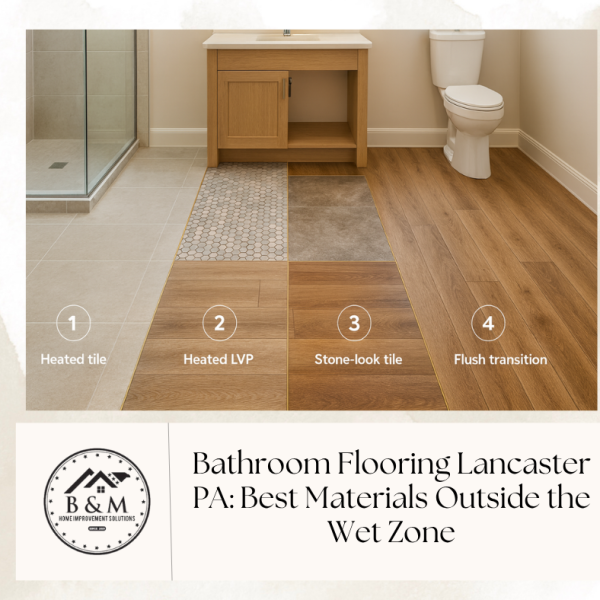
Bathroom Flooring Lancaster PA: Best Materials Outside the Wet Zone (2025 Guide)
Homeowners in Lancaster County and York County, PA
Who it’s for and what you’ll learn.
If you’re remodeling a bath in Lancaster or York, you’re likely focused on the shower. Yet the flooring outside the wet splash zone—the area beyond direct shower spray—has as much impact on safety, cleaning, and long-term durability. In this 2025 guide, B&M explains the best bathroom flooring options for Lancaster & York homes, how we detail edges and transitions, and why finish choices matter. You’ll see clear pros/cons, code-aware installation notes, local budget ranges, and timelines we actually meet in Central PA.
Homeowner Pain (localized)
In Lancaster County colonials, York rowhomes, and newer builds in Bent Creek, Manheim Twp, Lititz, and Spring Garden, we see the same issues:
Peeling vinyl seams and water wicking into luan underlayment.
Slippery glazed tile combined with hard water spots.
Toilet leaks that quietly swell MDF baseboards or laminate.
Cold floors that make winter mornings unpleasant.
Threshold trip points where bath floors meet hall or bedroom flooring.
Your floor should resist incidental moisture, clean quickly, and move safely with your home’s seasonal changes. That comes down to the right material + the right finish + the right build-up.
Solutions/Options Overview (map of choices)
Outside the wet zone, four materials dominate our Lancaster/York installs:
Porcelain tile (matte or honed, textured, rectified)
Engineered LVP/LVT (waterproof vinyl plank/tile with rigid core)
Engineered hardwood alternatives (true waterproof laminate or hybrid products rated for full baths)
Stone (select granites/quartzites; honed finishes; used selectively)
We also specify heated floors, waterproof uncoupling membranes, and tile or PVC bases to finish the room and protect wall edges.
Inside the wet zone (shower), we prefer Samuel Mueller or Onyx panels/pans for low maintenance. Outside the wet zone, the floor must complement that performance.
Step-by-Step Considerations (planning, Central PA budgets, timeline, sequencing)
1) Define the wet area vs. splash zone
Wet zone = shower/tub footprint.
Splash zone = in front of shower/tub, typically 24–36″.
Dry zone = rest of bath.
We floor for incidental water across the entire room.
2) Subfloor and deflection
We verify joist span/species and subfloor thickness. Tile/stone require tighter deflection than LVP. Where needed, we stiffen the assembly with Lezzer Lumber materials.
3) Membrane strategy
For tile/stone, we use an uncoupling/waterproofing layer (e.g., a bonded sheet membrane) and flood-safe detailing at the shower threshold and toilet flange. This minimizes crack telegraphing and protects the subfloor from small spills.
4) Heat, ventilation, and controls
Radiant mats sit above the membrane and below tile/stone. Thermostats go on GFCI as required. Proper ventilation reduces condensation—critical for finishes.
5) Transitions
We plan a flush or low-profile transition to hall/bedroom floors to avoid toe stubs. Metal profiles or reducer strips are selected to match the finish.
6) Timeline & lead times
Porcelain tile floor: 3–4 on-site days, plus dry/cure periods.
LVP/LVT floor: often 1–2 on-site days.
Shower work proceeds in parallel: Samuel Mueller walls/pan: 3 working days; tile shower: minimum 7 working days. We stage so you’re never without a bathroom longer than necessary. See Bathroom Remodel Timeline – Lancaster PA 2025 for sequencing.
Materials/Specs Deep Dive (construction, waterproofing, code, accessibility)
1) Porcelain Tile (our benchmark)
Why we use it
Dense, highly water-resistant.
Exceptional finish control: matte/honed textures add slip resistance.
Works beautifully with floor heat.
Long service life when properly detailed.
Finish we specify
Matte or honed. We avoid high-gloss in main walk paths.
Light texture that’s easy to mop but adds micro-grip.
Rectified edges for tight, consistent joints.
Build-up
Prep subfloor; correct deflection.
Bonded waterproof/uncoupling membrane across the room.
Thinset set tile; movement joints at perimeters.
Tile base or PVC base with a micro-reveal for cleaning.
Sealants at tub/shower perimeters.
Where it excels
Primary suites needing a timeless, upmarket feel.
2) LVP/LVT (rigid core waterproof vinyl)
Why we use it
Warm underfoot; fast install; excellent in renovations where downtime is tight.
Truly waterproof surface; click joints resist incidental spills when correctly installed.
Finish we specify
Embossed matte with realistic grain to diffuse glare and improve traction.
Wear layer ≥20 mil for long life.
Build-up
Flat, clean substrate; appropriate underlayment per manufacturer.
Careful edge sealing at tub/shower, toilet flange, and vanity.
Proper expansion perimeter; matched reducers at thresholds.
Where it excels
Family/hall baths, rentals, or quick turnarounds where tile is unnecessary.
3) Waterproof Laminate / Hybrid Floors (select-only)
Why we rarely but sometimes use it
Some premium laminates provide true waterproof cores and click systems validated for bathrooms.
Feels closer to hardwood underfoot.
Finish we specify
Low-sheen, textured face.
Board lengths that reduce repeating patterns.
Build-up
Meticulous perimeter and penetration sealing.
Strict acclimation and climate control.
Where it excels
Design-led projects desiring the hardwood aesthetic without committing to tile. We vet products case by case.
4) Stone (select granites/quartzites)
Why we use it cautiously
Beautiful and durable in honed finishes; pairs with stone benches/sills from Henry H. Ross & Son or Natural Stoneworks.
Requires correct membrane and penetrating sealer in the bathroom environment.
Finish we specify
Honed, not polished.
Light texture improves safety.
Build-up
Stiffened subfloor; waterproof/uncoupling membrane.
Narrow grout joints with high-performance grout.
Where it excels
High-design primaries where stone is used on vanity tops/sills for a cohesive palette.
Design & Selection Guidance (local examples + vendor callouts)
Neutral, matte porcelain in Lancaster City homes: 12×24 with a subtle linen texture; pairs with Samuel Mueller shower walls for a grout-lite cleanup routine.
Warm LVP in York hall baths: wide-plank oak tone, matte face, flush transition to hallway LVP, PVC base for wipe-down ease.
Honed stone in Bent Creek primaries: stone floor with matched bench and niche sills from Henry H. Ross & Son, Samuel Mueller walls for the shower, brushed nickel fixtures sourced via Hajoca.
Pattern tile field in Lititz cottages: encaustic-look porcelain in matte, tight grout, tile base, and a clean reducer to site-finished oak in the hall.
Local supply partners:
Hajoca (plumbing trims, drains, radiant thermostats), Lezzer Lumber (subfloor, underlayments, profiles), Red Rose Cabinetry (vanities that clear toe-kicks and allow baseboard continuity), Too the Trades (trade orchestration), Henry H. Ross & Son / Natural Stoneworks (stone tops, sills, thresholds).
Installation & Project Management (what B&M handles)
Assessment & design: room scan, subfloor evaluation, deflection check.
Permits where electrical heat or layout changes trigger inspections.
Moisture strategy: membrane coverage, flange/seal details at toilet, tub/shower perimeters, and doorways.
Scheduling: coordinate with Too the Trades so flooring, shower, glass, and vanity dovetail.
Quality controls: flatness tolerances, movement joints, heat mat resistance checks, and photo logs.
See Bathroom Layout Code Minimums (Lancaster & York, PA) for spacing basics we follow, and Leak-Proof Tile Shower (Schluter) Installation for our wet-zone approach that your floor ties into.
Cost & ROI (Local Context)
Typical installed ranges in Central PA (material + labor, excluding full bath cabinetry/countertops):
| Material | Typical range | Notes |
|---|---|---|
| Porcelain tile (matte/honed) | $2,200–$4,500 | Avg. 35–60 sq ft bath; membrane included; add $900–$1,800 for heat |
| LVP/LVT (rigid core) | $1,400–$3,000 | Fastest timeline; board/trim quality drives upper end |
| Waterproof laminate/hybrid | $1,800–$3,400 | Select-only; verify product suitability |
| Honed stone | $3,200–$6,000 | Stiffer subfloor; sealer; paired stone sills/bench add cost |
Why finishes matter to ROI:
Matte/honed porcelain and textured LVP reduce slip risk, hide water spots from Lancaster’s hard water, and photograph well for resale. Correct bases (tile or PVC) and clean transitions reduce punch-list issues at appraisal.
Common Mistakes We Fix
Glossy tile outside the shower: slippery and shows every spot.
No membrane under tile: cracks telegraph within a season.
MDF baseboards in baths: swell at the first leak.
High thresholds: trip hazards and ugly reducers.
Skipping toilet flange/seal upgrades: recurring smells and leaks.
Mismatched finishes: floor sheen clashes with shower wall gloss.
For more pitfalls, review Shower Remodel Mistakes—many apply to floor planning too.
Next Steps
Want a bathroom flooring Lancaster PA solution that looks premium, cleans easily, and lasts? B&M designs, permits, and installs complete bathrooms across Lancaster and York—detailing membranes, bases, heat, and transitions so your floor performs for decades. Book an in-home consultation to see samples, finishes, and a clear, fixed proposal.
FAQs (People Also Ask)
Matte or honed porcelain with a fine texture. It balances grip with easy cleaning.
Yes—quality rigid-core LVP performs well if edges and penetrations are sealed and expansion gaps honored.
Not required, but it improves comfort and helps dry residual moisture. We add a GFCI-protected thermostat and test resistance before tile.
Slightly. We plan transitions so thresholds remain low and safe.
Tile floors are typically 3–4 on-site days (with cure time). LVP often installs in 1–2 days.
Yes. We coordinate with our cabinet vendors for heights/toe-kicks and with Henry H. Ross & Son/Natural Stoneworks for tops and sills that complement your floor finish.